009C Sample Final 2, Problem 3 Detailed Solution
Jump to navigation
Jump to search
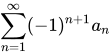
Determine if the following series converges or diverges. Please give your reason(s).
(a)

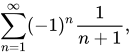
(b)

| Background Information: |
|---|
| 1. Ratio Test |
| Let be a series and Then, |
|
If the series is absolutely convergent. |
|
If the series is divergent. |
|
If the test is inconclusive. |
| 2. If a series absolutely converges, then it also converges. |
| 3. Alternating Series Test |
| Let be a positive, decreasing sequence where |
| Then, and converge. |


Solution:
(a)
| Step 1: |
|---|
| We begin by using the Ratio Test. |
| We have |
|
|

| Step 2: |
|---|
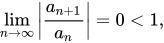
| Since |
| the series is absolutely convergent by the Ratio Test. |
| Therefore, the series converges. |
(b)
| Step 1: |
|---|
| For |
| we notice that this series is alternating. |
| Let |
| The sequence is decreasing since |
| for all |


| Step 2: |
|---|
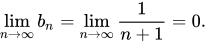
| Also, |
| Therefore, the series converges |
| by the Alternating Series Test. |

| Final Answer: |
|---|
| (a) converges |
| (b) converges |