009C Sample Final 3, Problem 7 Detailed Solution
A curve is given in polar coordinates by

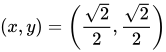
(a) Show that the point with Cartesian coordinates belongs to the curve.
(b) Sketch the curve.
(c) In Cartesian coordinates, find the equation of the tangent line at Failed to parse (MathML with SVG or PNG fallback (recommended for modern browsers and accessibility tools): Invalid response ("Math extension cannot connect to Restbase.") from server "https://wikimedia.org/api/rest_v1/":): {\displaystyle \bigg(\frac{\sqrt{2}}{2},\frac{\sqrt{2}}{2}\bigg).}
| Background Information: |
|---|
| 1. What two pieces of information do you need to write the equation of a line? |
|
You need the slope of the line and a point on the line. |
| 2. How do you calculate Failed to parse (MathML with SVG or PNG fallback (recommended for modern browsers and accessibility tools): Invalid response ("Math extension cannot connect to Restbase.") from server "https://wikimedia.org/api/rest_v1/":): {\displaystyle y'} for a polar curve Failed to parse (MathML with SVG or PNG fallback (recommended for modern browsers and accessibility tools): Invalid response ("Math extension cannot connect to Restbase.") from server "https://wikimedia.org/api/rest_v1/":): {\displaystyle r=f(\theta)?} |
|
Since Failed to parse (MathML with SVG or PNG fallback (recommended for modern browsers and accessibility tools): Invalid response ("Math extension cannot connect to Restbase.") from server "https://wikimedia.org/api/rest_v1/":): {\displaystyle x=r\cos(\theta),~y=r\sin(\theta),} we have |
|
Failed to parse (MathML with SVG or PNG fallback (recommended for modern browsers and accessibility tools): Invalid response ("Math extension cannot connect to Restbase.") from server "https://wikimedia.org/api/rest_v1/":): {\displaystyle y'=\frac{dy}{dx}=\frac{\frac{dr}{d\theta}\sin\theta+r\cos\theta}{\frac{dr}{d\theta}\cos\theta-r\sin\theta}.} |
Solution:
(a)
| Step 1: |
|---|
| First, we need to convert this Cartesian point into polar. |
| We have |
| Failed to parse (MathML with SVG or PNG fallback (recommended for modern browsers and accessibility tools): Invalid response ("Math extension cannot connect to Restbase.") from server "https://wikimedia.org/api/rest_v1/":): {\displaystyle \begin{array}{rcl} \displaystyle{r} & = & \displaystyle{\sqrt{x^2+y^2}}\\ &&\\ & = & \displaystyle{\sqrt{\frac{2}{4}+\frac{2}{4}}}\\ &&\\ & = & \displaystyle{\sqrt{1}}\\ &&\\ & = & \displaystyle{1.} \end{array}} |
| Also, we have |
| Failed to parse (MathML with SVG or PNG fallback (recommended for modern browsers and accessibility tools): Invalid response ("Math extension cannot connect to Restbase.") from server "https://wikimedia.org/api/rest_v1/":): {\displaystyle \begin{array}{rcl} \displaystyle{\tan \theta } & = & \displaystyle{\frac{y}{x}}\\ &&\\ & = & \displaystyle{1.} \end{array}} |
| So, Failed to parse (MathML with SVG or PNG fallback (recommended for modern browsers and accessibility tools): Invalid response ("Math extension cannot connect to Restbase.") from server "https://wikimedia.org/api/rest_v1/":): {\displaystyle \theta=\frac{\pi}{4}.} |
| Now, this point in polar is Failed to parse (MathML with SVG or PNG fallback (recommended for modern browsers and accessibility tools): Invalid response ("Math extension cannot connect to Restbase.") from server "https://wikimedia.org/api/rest_v1/":): {\displaystyle \bigg(1,\frac{\pi}{4}\bigg).} |
| Step 2: |
|---|
| Now, we plug in Failed to parse (MathML with SVG or PNG fallback (recommended for modern browsers and accessibility tools): Invalid response ("Math extension cannot connect to Restbase.") from server "https://wikimedia.org/api/rest_v1/":): {\displaystyle \theta=\frac{\pi}{4}} into our polar equation. |
| We get |
| Failed to parse (MathML with SVG or PNG fallback (recommended for modern browsers and accessibility tools): Invalid response ("Math extension cannot connect to Restbase.") from server "https://wikimedia.org/api/rest_v1/":): {\displaystyle \begin{array}{rcl} \displaystyle{r} & = & \displaystyle{1+\cos^2\bigg(\frac{2\pi}{4}\bigg)}\\ &&\\ & = & \displaystyle{1+(0)^2}\\ &&\\ & = & \displaystyle{1.} \end{array}} |
| So, the point Failed to parse (MathML with SVG or PNG fallback (recommended for modern browsers and accessibility tools): Invalid response ("Math extension cannot connect to Restbase.") from server "https://wikimedia.org/api/rest_v1/":): {\displaystyle (x,y)} belongs to the curve. |
| (b) |
|---|

(c)
| Step 1: |
|---|
| Since Failed to parse (MathML with SVG or PNG fallback (recommended for modern browsers and accessibility tools): Invalid response ("Math extension cannot connect to Restbase.") from server "https://wikimedia.org/api/rest_v1/":): {\displaystyle r=1+\cos^2(2\theta),} |
|
Failed to parse (MathML with SVG or PNG fallback (recommended for modern browsers and accessibility tools): Invalid response ("Math extension cannot connect to Restbase.") from server "https://wikimedia.org/api/rest_v1/":): {\displaystyle \frac{dr}{d\theta}=-4\cos(2\theta)\sin(2\theta).} |
| Since |
|
Failed to parse (MathML with SVG or PNG fallback (recommended for modern browsers and accessibility tools): Invalid response ("Math extension cannot connect to Restbase.") from server "https://wikimedia.org/api/rest_v1/":): {\displaystyle y'=\frac{dy}{dx}=\frac{\frac{dr}{d\theta}\sin\theta+r\cos\theta}{\frac{dr}{d\theta}\cos\theta-r\sin\theta},} |
| we have |
|
Failed to parse (MathML with SVG or PNG fallback (recommended for modern browsers and accessibility tools): Invalid response ("Math extension cannot connect to Restbase.") from server "https://wikimedia.org/api/rest_v1/":): {\displaystyle \begin{array}{rcl} \displaystyle{\frac{dy}{dx}} & = & \displaystyle{\frac{-4\cos(2\theta)\sin(2\theta)\sin\theta+(1+\cos^2(2\theta))\cos\theta}{-4\cos(2\theta)\sin(2\theta)\cos\theta-(1+\cos^2(2\theta))\sin\theta}.}\\ \end{array}} |
| Step 2: |
|---|
| Now, recall from part (a) that the given point in polar coordinates is Failed to parse (MathML with SVG or PNG fallback (recommended for modern browsers and accessibility tools): Invalid response ("Math extension cannot connect to Restbase.") from server "https://wikimedia.org/api/rest_v1/":): {\displaystyle \bigg(1,\frac{\pi}{4}\bigg).} |
| Therefore, the slope of the tangent line at this point is |
| Failed to parse (MathML with SVG or PNG fallback (recommended for modern browsers and accessibility tools): Invalid response ("Math extension cannot connect to Restbase.") from server "https://wikimedia.org/api/rest_v1/":): {\displaystyle \begin{array}{rcl} \displaystyle{m} & = & \displaystyle{\frac{-4\cos(\frac{\pi}{2})\sin(\frac{\pi}{2})\sin(\frac{\pi}{4})+(1+\cos^2(\frac{\pi}{2}))\cos(\frac{\pi}{4})}{-4\cos(\frac{\pi}{2})\sin(\frac{\pi}{2})\cos(\frac{\pi}{4})-(1+\cos^2(\frac{\pi}{2}))\sin(\frac{\pi}{4})}}\\ &&\\ & = & \displaystyle{\frac{0+(1)(\frac{\sqrt{2}}{2})}{0-(1)(\frac{\sqrt{2}}{2})}}\\ &&\\ & = & \displaystyle{-1.} \end{array}} |
| Therefore, the equation of the tangent line at the point Failed to parse (MathML with SVG or PNG fallback (recommended for modern browsers and accessibility tools): Invalid response ("Math extension cannot connect to Restbase.") from server "https://wikimedia.org/api/rest_v1/":): {\displaystyle (x,y)} is |
| Failed to parse (MathML with SVG or PNG fallback (recommended for modern browsers and accessibility tools): Invalid response ("Math extension cannot connect to Restbase.") from server "https://wikimedia.org/api/rest_v1/":): {\displaystyle y=-1\bigg(x-\frac{\sqrt{2}}{2}\bigg)+\frac{\sqrt{2}}{2}.} |
| Final Answer: |
|---|
| (a) See above. |
| (b) See above. |
| (c) Failed to parse (MathML with SVG or PNG fallback (recommended for modern browsers and accessibility tools): Invalid response ("Math extension cannot connect to Restbase.") from server "https://wikimedia.org/api/rest_v1/":): {\displaystyle y=-1\bigg(x-\frac{\sqrt{2}}{2}\bigg)+\frac{\sqrt{2}}{2}} |