007B Sample Midterm 1, Problem 5 Detailed Solution
Revision as of 14:33, 22 November 2017 by Kayla Murray (talk | contribs)
Find the area bounded by and from to


| Background Information: |
|---|
| 1. You can find the intersection points of two functions, say |
|
by setting and solving for |
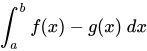
| 2. The area between two functions, and is given by |
|
for where is the upper function and Failed to parse (MathML with SVG or PNG fallback (recommended for modern browsers and accessibility tools): Invalid response ("Math extension cannot connect to Restbase.") from server "https://wikimedia.org/api/rest_v1/":): {\displaystyle g(x)} is the lower function. |



Solution:
(a)
| Step 1: |
|---|
| We use Failed to parse (MathML with SVG or PNG fallback (recommended for modern browsers and accessibility tools): Invalid response ("Math extension cannot connect to Restbase.") from server "https://wikimedia.org/api/rest_v1/":): {\displaystyle u} -substitution. |
| Let Failed to parse (MathML with SVG or PNG fallback (recommended for modern browsers and accessibility tools): Invalid response ("Math extension cannot connect to Restbase.") from server "https://wikimedia.org/api/rest_v1/":): {\displaystyle u=1+x^3.} |
| Then, Failed to parse (MathML with SVG or PNG fallback (recommended for modern browsers and accessibility tools): Invalid response ("Math extension cannot connect to Restbase.") from server "https://wikimedia.org/api/rest_v1/":): {\displaystyle du=3x^2dx} and Failed to parse (MathML with SVG or PNG fallback (recommended for modern browsers and accessibility tools): Invalid response ("Math extension cannot connect to Restbase.") from server "https://wikimedia.org/api/rest_v1/":): {\displaystyle \frac{du}{3}=x^2dx.} |
| Therefore, the integral becomes |
| Failed to parse (MathML with SVG or PNG fallback (recommended for modern browsers and accessibility tools): Invalid response ("Math extension cannot connect to Restbase.") from server "https://wikimedia.org/api/rest_v1/":): {\displaystyle \frac{1}{3}\int \sqrt{u}~du.} |
| Step 2: |
|---|
| We now have |
| Failed to parse (MathML with SVG or PNG fallback (recommended for modern browsers and accessibility tools): Invalid response ("Math extension cannot connect to Restbase.") from server "https://wikimedia.org/api/rest_v1/":): {\displaystyle \begin{array}{rcl} \displaystyle{\int x^2\sqrt{1+x^3}~dx} & = & \displaystyle{\frac{1}{3}\int \sqrt{u}~du}\\ &&\\ & = & \displaystyle{\frac{2}{9}u^{\frac{3}{2}}+C}\\ &&\\ & = & \displaystyle{\frac{2}{9}(1+x^3)^{\frac{3}{2}}+C.} \end{array}} |
(b)
| Step 1: |
|---|
| We use Failed to parse (MathML with SVG or PNG fallback (recommended for modern browsers and accessibility tools): Invalid response ("Math extension cannot connect to Restbase.") from server "https://wikimedia.org/api/rest_v1/":): {\displaystyle u} -substitution. |
| Let Failed to parse (MathML with SVG or PNG fallback (recommended for modern browsers and accessibility tools): Invalid response ("Math extension cannot connect to Restbase.") from server "https://wikimedia.org/api/rest_v1/":): {\displaystyle u=\sin(x).} |
| Then, Failed to parse (MathML with SVG or PNG fallback (recommended for modern browsers and accessibility tools): Invalid response ("Math extension cannot connect to Restbase.") from server "https://wikimedia.org/api/rest_v1/":): {\displaystyle du=\cos(x)dx.} |
| Also, we need to change the bounds of integration. |
| Plugging in our values into the equation we get |
| and |
| Therefore, the integral becomes |


| Step 2: |
|---|
| We now have |
|
|

| Final Answer: |
|---|
| (a) |
| (b) |

