To determine drug dosages, doctors estimate a person's body surface area (BSA) (in meters squared) using the formula:
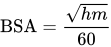
where Failed to parse (MathML with SVG or PNG fallback (recommended for modern browsers and accessibility tools): Invalid response ("Math extension cannot connect to Restbase.") from server "https://wikimedia.org/api/rest_v1/":): {\displaystyle h}
is the height in centimeters and Failed to parse (MathML with SVG or PNG fallback (recommended for modern browsers and accessibility tools): Invalid response ("Math extension cannot connect to Restbase.") from server "https://wikimedia.org/api/rest_v1/":): {\displaystyle m}
is the mass in kilograms. Calculate the rate of change of BSA with respect to height for a person of a constant mass of Failed to parse (MathML with SVG or PNG fallback (recommended for modern browsers and accessibility tools): Invalid response ("Math extension cannot connect to Restbase.") from server "https://wikimedia.org/api/rest_v1/":): {\displaystyle m=85.}
What is the rate at Failed to parse (MathML with SVG or PNG fallback (recommended for modern browsers and accessibility tools): Invalid response ("Math extension cannot connect to Restbase.") from server "https://wikimedia.org/api/rest_v1/":): {\displaystyle h=170}
and Failed to parse (MathML with SVG or PNG fallback (recommended for modern browsers and accessibility tools): Invalid response ("Math extension cannot connect to Restbase.") from server "https://wikimedia.org/api/rest_v1/":): {\displaystyle h=190?}
Express your results in the correct units. Does the BSA increase more rapidly with respect to height at lower or higher heights?
| Background Information:
|
| Power Rule
|
| Failed to parse (MathML with SVG or PNG fallback (recommended for modern browsers and accessibility tools): Invalid response ("Math extension cannot connect to Restbase.") from server "https://wikimedia.org/api/rest_v1/":): {\displaystyle \frac{d}{dx}(x^n)=nx^{n-1}}
|
Solution:
| Step 1:
|
| Let Failed to parse (MathML with SVG or PNG fallback (recommended for modern browsers and accessibility tools): Invalid response ("Math extension cannot connect to Restbase.") from server "https://wikimedia.org/api/rest_v1/":): {\displaystyle f(x)=\frac{1+x}{3x}.}
|
| Using the limit definition of derivative, we have
|
| Failed to parse (MathML with SVG or PNG fallback (recommended for modern browsers and accessibility tools): Invalid response ("Math extension cannot connect to Restbase.") from server "https://wikimedia.org/api/rest_v1/":): {\displaystyle \begin{array}{rcl} \displaystyle{f'(x)} & = & \displaystyle{\lim_{h\rightarrow 0} \frac{f(x+h)-f(x)}{h}}\\ &&\\ & = & \displaystyle{\lim_{h\rightarrow 0} \frac{(\frac{1+(x+h)}{3(x+h)})-(\frac{1+x}{3x})}{h}}\\ &&\\ & = & \displaystyle{\lim_{h\rightarrow 0} \frac{(\frac{1+x+h}{3x+3h})-(\frac{1+x}{h})}{h}.} \end{array}}
|
| Step 2:
|
| Now, we get a common denominator for the fractions in the numerator.
|
| Hence, we have
|
| Failed to parse (MathML with SVG or PNG fallback (recommended for modern browsers and accessibility tools): Invalid response ("Math extension cannot connect to Restbase.") from server "https://wikimedia.org/api/rest_v1/":): {\displaystyle \begin{array}{rcl} \displaystyle{f'(x)} & = & \displaystyle{\lim_{h\rightarrow 0}\frac{\frac{(1+x+h)3x}{(3x+3h)(3x)}-\frac{(1+x)(3x+3h)}{(3x+3h)(3x)}}{h}}\\ &&\\ & = & \displaystyle{\lim_{h\rightarrow 0}\frac{\frac{3x+3x^2+3xh-(3x+3h+3x^2+3hx)}{(3x+3h)(3x)}}{h}}\\ &&\\ & = & \displaystyle{\lim_{h\rightarrow 0} \frac{-3h}{h(3x+3h)(3x)}}\\ &&\\ & = & \displaystyle{\lim_{h\rightarrow 0} \frac{-3}{(3x+3h)(3x)}}\\ &&\\ & = & \displaystyle{\frac{-3}{(3x)(3x)}}\\ & = & \displaystyle{-\frac{1}{3x^2}.} \end{array}}
|
| Step 3:
|
| Now, we get a common denominator for the fractions in the numerator.
|
| Hence, we have
|
| Failed to parse (MathML with SVG or PNG fallback (recommended for modern browsers and accessibility tools): Invalid response ("Math extension cannot connect to Restbase.") from server "https://wikimedia.org/api/rest_v1/":): {\displaystyle \begin{array}{rcl} \displaystyle{f'(x)} & = & \displaystyle{\lim_{h\rightarrow 0}\frac{\frac{(1+x+h)3x}{(3x+3h)(3x)}-\frac{(1+x)(3x+3h)}{(3x+3h)(3x)}}{h}}\\ &&\\ & = & \displaystyle{\lim_{h\rightarrow 0}\frac{\frac{3x+3x^2+3xh-(3x+3h+3x^2+3hx)}{(3x+3h)(3x)}}{h}}\\ &&\\ & = & \displaystyle{\lim_{h\rightarrow 0} \frac{-3h}{h(3x+3h)(3x)}}\\ &&\\ & = & \displaystyle{\lim_{h\rightarrow 0} \frac{-3}{(3x+3h)(3x)}}\\ &&\\ & = & \displaystyle{\frac{-3}{(3x)(3x)}}\\ & = & \displaystyle{-\frac{1}{3x^2}.} \end{array}}
|
| Step 4:
|
| Now, we get a common denominator for the fractions in the numerator.
|
| Hence, we have
|
| Failed to parse (MathML with SVG or PNG fallback (recommended for modern browsers and accessibility tools): Invalid response ("Math extension cannot connect to Restbase.") from server "https://wikimedia.org/api/rest_v1/":): {\displaystyle \begin{array}{rcl} \displaystyle{f'(x)} & = & \displaystyle{\lim_{h\rightarrow 0}\frac{\frac{(1+x+h)3x}{(3x+3h)(3x)}-\frac{(1+x)(3x+3h)}{(3x+3h)(3x)}}{h}}\\ &&\\ & = & \displaystyle{\lim_{h\rightarrow 0}\frac{\frac{3x+3x^2+3xh-(3x+3h+3x^2+3hx)}{(3x+3h)(3x)}}{h}}\\ &&\\ & = & \displaystyle{\lim_{h\rightarrow 0} \frac{-3h}{h(3x+3h)(3x)}}\\ &&\\ & = & \displaystyle{\lim_{h\rightarrow 0} \frac{-3}{(3x+3h)(3x)}}\\ &&\\ & = & \displaystyle{\frac{-3}{(3x)(3x)}}\\ & = & \displaystyle{-\frac{1}{3x^2}.} \end{array}}
|
| Final Answer:
|
| Failed to parse (MathML with SVG or PNG fallback (recommended for modern browsers and accessibility tools): Invalid response ("Math extension cannot connect to Restbase.") from server "https://wikimedia.org/api/rest_v1/":): {\displaystyle \frac{dy}{dx}=-\frac{1}{3x^2}}
|
|
|
Return to Sample Exam