Find a formula for
by diagonalizing the matrix.
| Foundations:
|
| Recall:
|
| 1. To diagonalize a matrix, you need to know the eigenvalues of the matrix.
|
| 2. Diagonalization Theorem
|
- An
matrix is diagonalizable if and only if has linearly independent eigenvectors.
|
- In fact,
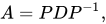
with a diagonal matrix, if and only if the columns of are linearly
|
- independent eigenvectors of
In this case, the diagonal entries of are eigenvalues of that
|
- correspond, respectively , to the eigenvectors in Failed to parse (Conversion error. Server ("https://wikimedia.org/api/rest_") reported: "Cannot get mml. Server problem."): {\displaystyle P.}
|
Solution:
| Step 1:
|
| To diagonalize this matrix, we need to find the eigenvalues and a basis for each eigenspace.
|
First, we find the eigenvalues of by solving
|
|
| Therefore, setting
|
- Failed to parse (Conversion error. Server ("https://wikimedia.org/api/rest_") reported: "Cannot get mml. Server problem."): {\displaystyle (\lambda +2)(\lambda +3)=0,}
|
we find that the eigenvalues of are and
|
| Step 3:
|
| For the eigenvalue Failed to parse (Conversion error. Server ("https://wikimedia.org/api/rest_") reported: "Cannot get mml. Server problem."): {\displaystyle \lambda =-3,}
we have
|
|
Failed to parse (Conversion error. Server ("https://wikimedia.org/api/rest_") reported: "Cannot get mml. Server problem."): {\displaystyle {\begin{array}{rcl}\displaystyle {A+3I}&=&\displaystyle {{\begin{bmatrix}1&-6\\2&-6\end{bmatrix}}-{\begin{bmatrix}3&0\\0&3\end{bmatrix}}}\\&&\\&=&\displaystyle {\begin{bmatrix}4&-6\\2&-3\end{bmatrix}}\\&&\\&\sim &\displaystyle {{\begin{bmatrix}1&{\frac {-3}{2}}\\0&0\end{bmatrix}}.}\end{array}}}
|
We see that is a free variable. So, a basis for the eigenspace corresponding to is
|
- Failed to parse (Conversion error. Server ("https://wikimedia.org/api/rest_") reported: "Cannot get mml. Server problem."): {\displaystyle {\bigg \{}{\begin{bmatrix}{\frac {3}{2}}\\1\\\end{bmatrix}}{\bigg \}}.}
|
| Step 4:
|
| To diagonalize our matrix, we use the information from the steps above.
|
|
Using the Diagonalization Theorem, we have Failed to parse (Conversion error. Server ("https://wikimedia.org/api/rest_") reported: "Cannot get mml. Server problem."): {\displaystyle A=PDP^{-1}}
where
|
- Failed to parse (Conversion error. Server ("https://wikimedia.org/api/rest_") reported: "Cannot get mml. Server problem."): {\displaystyle D={\begin{bmatrix}-2&0\\0&-3\end{bmatrix}},P={\begin{bmatrix}2&{\frac {3}{2}}\\1&1\end{bmatrix}}.}
|
| Step 5:
|
| Notice that
|
|
|
| Final Answer:
|
| Failed to parse (Conversion error. Server ("https://wikimedia.org/api/rest_") reported: "Cannot get mml. Server problem."): {\displaystyle {\begin{bmatrix}2(-2)^{k+1}+3(-3)^{k}&6(-2)^{k}+-6(-3)^{k}\\(-2)^{k+1}+2(-3)^{k}&3(-2)^{k}+(-4)(-3)^{k}\end{bmatrix}}}
|
|
Return to Sample Exam