009C Sample Final 3, Problem 1
Which of the following sequences Failed to parse (MathML with SVG or PNG fallback (recommended for modern browsers and accessibility tools): Invalid response ("Math extension cannot connect to Restbase.") from server "https://wikimedia.org/api/rest_v1/":): {\displaystyle (a_n)_{n\ge 1}} converges? Which diverges? Give reasons for your answers!
(a) Failed to parse (MathML with SVG or PNG fallback (recommended for modern browsers and accessibility tools): Invalid response ("Math extension cannot connect to Restbase.") from server "https://wikimedia.org/api/rest_v1/":): {\displaystyle a_n=\bigg(1+\frac{1}{2n}\bigg)^n}
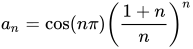
(b)
| Foundations: |
|---|
| L'Hôpital's Rule |
|
Suppose that Failed to parse (MathML with SVG or PNG fallback (recommended for modern browsers and accessibility tools): Invalid response ("Math extension cannot connect to Restbase.") from server "https://wikimedia.org/api/rest_v1/":): {\displaystyle \lim_{x\rightarrow \infty} f(x)} and Failed to parse (MathML with SVG or PNG fallback (recommended for modern browsers and accessibility tools): Invalid response ("Math extension cannot connect to Restbase.") from server "https://wikimedia.org/api/rest_v1/":): {\displaystyle \lim_{x\rightarrow \infty} g(x)} are both zero or both Failed to parse (MathML with SVG or PNG fallback (recommended for modern browsers and accessibility tools): Invalid response ("Math extension cannot connect to Restbase.") from server "https://wikimedia.org/api/rest_v1/":): {\displaystyle \pm \infty .} |
|
If Failed to parse (MathML with SVG or PNG fallback (recommended for modern browsers and accessibility tools): Invalid response ("Math extension cannot connect to Restbase.") from server "https://wikimedia.org/api/rest_v1/":): {\displaystyle \lim_{x\rightarrow \infty} \frac{f'(x)}{g'(x)}} is finite or Failed to parse (MathML with SVG or PNG fallback (recommended for modern browsers and accessibility tools): Invalid response ("Math extension cannot connect to Restbase.") from server "https://wikimedia.org/api/rest_v1/":): {\displaystyle \pm \infty ,} |
|
then Failed to parse (MathML with SVG or PNG fallback (recommended for modern browsers and accessibility tools): Invalid response ("Math extension cannot connect to Restbase.") from server "https://wikimedia.org/api/rest_v1/":): {\displaystyle \lim_{x\rightarrow \infty} \frac{f(x)}{g(x)}\,=\,\lim_{x\rightarrow \infty} \frac{f'(x)}{g'(x)}.} |
Solution:
(a)
| Step 1: |
|---|
| Let
Failed to parse (MathML with SVG or PNG fallback (recommended for modern browsers and accessibility tools): Invalid response ("Math extension cannot connect to Restbase.") from server "https://wikimedia.org/api/rest_v1/":): {\displaystyle \begin{array}{rcl} \displaystyle{y} & = & \displaystyle{\lim_{n\rightarrow \infty} \bigg(1+\frac{1}{2n}\bigg)^n.} \end{array}} |
| We then take the natural log of both sides to get |
| Failed to parse (MathML with SVG or PNG fallback (recommended for modern browsers and accessibility tools): Invalid response ("Math extension cannot connect to Restbase.") from server "https://wikimedia.org/api/rest_v1/":): {\displaystyle \ln y = \ln\bigg(\lim_{n\rightarrow \infty} \bigg(1+\frac{1}{2n}\bigg)^n\bigg).} |
| Step 2: |
|---|
| We can interchange limits and continuous functions. |
| Therefore, we have |
|
Failed to parse (MathML with SVG or PNG fallback (recommended for modern browsers and accessibility tools): Invalid response ("Math extension cannot connect to Restbase.") from server "https://wikimedia.org/api/rest_v1/":): {\displaystyle \begin{array}{rcl} \displaystyle{\ln y} & = & \displaystyle{\lim_{n\rightarrow \infty} \ln \bigg(1+\frac{1}{2n}\bigg)^n}\\ &&\\ & = & \displaystyle{\lim_{n\rightarrow \infty} n\ln\bigg(1+\frac{1}{2n}\bigg)}\\ &&\\ & = & \displaystyle{\lim_{n\rightarrow \infty} \frac{\ln \bigg(1+\frac{1}{2n}\bigg)}{\frac{1}{n}}.} \end{array}} |
| Now, this limit has the form Failed to parse (MathML with SVG or PNG fallback (recommended for modern browsers and accessibility tools): Invalid response ("Math extension cannot connect to Restbase.") from server "https://wikimedia.org/api/rest_v1/":): {\displaystyle \frac{0}{0}.} |
| Hence, we can use L'Hopital's Rule to calculate this limit. |
(b)
| Step 1: |
|---|
| Step 2: |
|---|
| Final Answer: |
|---|
| (a) |
| (b) |