009A Sample Midterm 2, Problem 5
Find the derivatives of the following functions. Do not simplify.
(a)

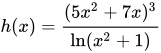
(b)

(c)
| Foundations: |
|---|
| 1. Chain Rule |
| Failed to parse (MathML with SVG or PNG fallback (recommended for modern browsers and accessibility tools): Invalid response ("Math extension cannot connect to Restbase.") from server "https://wikimedia.org/api/rest_v1/":): {\displaystyle \frac{d}{dx}(f(g(x)))=f'(g(x))g'(x)} |
| 2. Trig Derivatives |
| Failed to parse (MathML with SVG or PNG fallback (recommended for modern browsers and accessibility tools): Invalid response ("Math extension cannot connect to Restbase.") from server "https://wikimedia.org/api/rest_v1/":): {\displaystyle \frac{d}{dx}(\sin x)=\cos x,\quad\frac{d}{dx}(\cos x)=-\sin x} |
| 3. Quotient Rule |
| Failed to parse (MathML with SVG or PNG fallback (recommended for modern browsers and accessibility tools): Invalid response ("Math extension cannot connect to Restbase.") from server "https://wikimedia.org/api/rest_v1/":): {\displaystyle \frac{d}{dx}\bigg(\frac{f(x)}{g(x)}\bigg)=\frac{g(x)f'(x)-f(x)g'(x)}{(g(x))^2}} |
| 4. Derivative of natural logarithm |
| Failed to parse (MathML with SVG or PNG fallback (recommended for modern browsers and accessibility tools): Invalid response ("Math extension cannot connect to Restbase.") from server "https://wikimedia.org/api/rest_v1/":): {\displaystyle \frac{d}{dx}(\ln x)=\frac{1}{x}} |
Solution:
(a)
| Step 1: |
|---|
| First, we use the Chain Rule to get |
| Failed to parse (MathML with SVG or PNG fallback (recommended for modern browsers and accessibility tools): Invalid response ("Math extension cannot connect to Restbase.") from server "https://wikimedia.org/api/rest_v1/":): {\displaystyle f'(x)=3\tan^2(7x^2+5)(\tan(7x^2+5))'.} |
| Step 2: |
|---|
| Now, we use the Chain Rule again to get |
|
Failed to parse (MathML with SVG or PNG fallback (recommended for modern browsers and accessibility tools): Invalid response ("Math extension cannot connect to Restbase.") from server "https://wikimedia.org/api/rest_v1/":): {\displaystyle \begin{array}{rcl} \displaystyle{f'(x)} & = & \displaystyle{3\tan^2(7x^2+5)(\tan(7x^2+5))'}\\ &&\\ & = & \displaystyle{3\tan^2(7x^2+5)\sec^2(7x^2+5)(7x^2+5)'}\\ &&\\ & = & \displaystyle{3\tan^2(7x^2+5)\sec^2(7x^2+5)(14x).} \end{array}} |
(b)
| Step 1: |
|---|
| First, we use the Chain Rule to get |
| Failed to parse (MathML with SVG or PNG fallback (recommended for modern browsers and accessibility tools): Invalid response ("Math extension cannot connect to Restbase.") from server "https://wikimedia.org/api/rest_v1/":): {\displaystyle g'(x)=\cos(\cos(e^x))(\cos(e^x))'.} |
| Step 2: |
|---|
| Now, we use the Chain Rule again to get |
|
Failed to parse (MathML with SVG or PNG fallback (recommended for modern browsers and accessibility tools): Invalid response ("Math extension cannot connect to Restbase.") from server "https://wikimedia.org/api/rest_v1/":): {\displaystyle \begin{array}{rcl} \displaystyle{g'(x)} & = & \displaystyle{\cos(\cos(e^x))(\cos(e^x))'}\\ &&\\ & = & \displaystyle{\cos(\cos(e^x))(-\sin(e^x))(e^x)'}\\ &&\\ & = & \displaystyle{\cos(\cos(e^x))(-\sin(e^x))(e^x).} \end{array}} |
(c)
| Step 1: |
|---|
| First, we use the Quotient Rule to get |
| Failed to parse (MathML with SVG or PNG fallback (recommended for modern browsers and accessibility tools): Invalid response ("Math extension cannot connect to Restbase.") from server "https://wikimedia.org/api/rest_v1/":): {\displaystyle h'(x)=\frac{\ln(x^2+1)((5x^2+7x)^2)'-(5x^2+7x)^2(\ln(x^2+1))'}{(\ln(x^2+1))^2}.} |
| Step 2: |
|---|
| Now, we use the Chain Rule to get |
| Failed to parse (MathML with SVG or PNG fallback (recommended for modern browsers and accessibility tools): Invalid response ("Math extension cannot connect to Restbase.") from server "https://wikimedia.org/api/rest_v1/":): {\displaystyle \begin{array}{rcl} \displaystyle{h'(x)} & = & \displaystyle{\frac{\ln(x^2+1)((5x^2+7x)^2)'-(5x^2+7x)^2(\ln(x^2+1))'}{(\ln(x^2+1))^2}}\\ &&\\ & = & \displaystyle{\frac{\ln(x^2+1)2(5x^2+7x)(5x^2+7x)'-(5x^2+7x)^2\frac{1}{x^2+1}(x^2+1)'}{(\ln(x^2+1))^2}}\\ &&\\ & = & \displaystyle{\frac{\ln(x^2+1)2(5x^2+7x)(10x+7)-(5x^2+7x)^2\frac{1}{x^2+1}(2x)}{(\ln(x^2+1))^2}.} \end{array}} |
| Final Answer: |
|---|
| (a) Failed to parse (MathML with SVG or PNG fallback (recommended for modern browsers and accessibility tools): Invalid response ("Math extension cannot connect to Restbase.") from server "https://wikimedia.org/api/rest_v1/":): {\displaystyle 3\tan^2(7x^2+5)\sec^2(7x^2+5)(14x)} |
| (b) Failed to parse (MathML with SVG or PNG fallback (recommended for modern browsers and accessibility tools): Invalid response ("Math extension cannot connect to Restbase.") from server "https://wikimedia.org/api/rest_v1/":): {\displaystyle \cos(\cos(e^x))(-\sin(e^x))(e^x)} |
| (c) Failed to parse (MathML with SVG or PNG fallback (recommended for modern browsers and accessibility tools): Invalid response ("Math extension cannot connect to Restbase.") from server "https://wikimedia.org/api/rest_v1/":): {\displaystyle \frac{\ln(x^2+1)2(5x^2+7x)(10x+7)-(5x^2+7x)^2\frac{1}{x^2+1}(2x)}{(\ln(x^2+1))^2}} |