Consider the region  bounded by
  and the
  -axis.
- a) Use four rectangles and a Riemann sum to approximate the area of the region . Sketch the region and the rectangles and indicate whether your rectangles overestimate or underestimate the area of .
- b) Find an expression for the area of the region as a limit. Do not evaluate the limit.
| Foundations:
|
| Link to Riemann sums page
|
Solution:
(a)
| Step 1:
|
Let  . Since our interval is Failed to parse (Conversion error. Server ("https://wikimedia.org/api/rest_") reported: "Cannot get mml. Server problem."): {\displaystyle [1,5]}
and we are using 4 rectangles, each rectangle has width 1. Since the problem doesn't specify, we can choose either right- or left-endpoints. Choosing left-endpoints, the Riemann sum is . Since our interval is Failed to parse (Conversion error. Server ("https://wikimedia.org/api/rest_") reported: "Cannot get mml. Server problem."): {\displaystyle [1,5]}
and we are using 4 rectangles, each rectangle has width 1. Since the problem doesn't specify, we can choose either right- or left-endpoints. Choosing left-endpoints, the Riemann sum is
|
| Failed to parse (Conversion error. Server ("https://wikimedia.org/api/rest_") reported: "Cannot get mml. Server problem."): {\displaystyle 1\cdot (f(1)+f(2)+f(3)+f(4))}
.
|
|
|
| Step 2:
|
| Thus, the left-endpoint Riemann sum is
|
| Failed to parse (Conversion error. Server ("https://wikimedia.org/api/rest_") reported: "Cannot get mml. Server problem."): {\displaystyle 1\cdot (f(1)+f(2)+f(3)+f(4))={\bigg (}1+{\frac {1}{4}}+{\frac {1}{9}}+{1}{16}{\bigg )}={\frac {205}{144}}}
.
|
| The left-endpoint Riemann sum overestimates the area of .
|
(b)
| Step 1:
|
Let  be the number of rectangles used in the left-endpoint Riemann sum for . be the number of rectangles used in the left-endpoint Riemann sum for .
|
| The width of each rectangle is Failed to parse (Conversion error. Server ("https://wikimedia.org/api/rest_") reported: "Cannot get mml. Server problem."): {\displaystyle \Delta x={\frac {5-1}{n}}={\frac {4}{n}}}
.
|
|
|
|
|
| Step 2:
|
| So, the left-endpoint Riemann sum is
|
| Failed to parse (Conversion error. Server ("https://wikimedia.org/api/rest_") reported: "Cannot get mml. Server problem."): {\displaystyle \Delta x{\bigg (}f(1)+f{\bigg (}1+{\frac {4}{n}}{\bigg )}+f{\bigg (}1+2{\frac {4}{n}}{\bigg )}+\ldots +f{\bigg (}1+(n-1){\frac {4}{n}}{\bigg )}{\bigg )}}
.
|
| Now, we let go to infinity to get a limit.
|
So, the area of is equal to 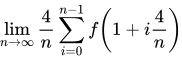 . .
|
| Final Answer:
|
(a) Left-endpoint Riemann sum:  , The left-endpoint Riemann sum overestimates the area of . , The left-endpoint Riemann sum overestimates the area of .
|
| (b) Using left-endpoint Riemann sums:
|
Return to Sample Exam