009A Sample Final 1, Problem 6

From Grad Wiki
Revision as of 12:19, 18 March 2017 by Kayla Murray (talk | contribs)
Jump to navigation Jump to search

Consider the following function:

(a) Use the Intermediate Value Theorem to show that    has at least one zero.

(b) Use the Mean Value Theorem to show that    has at most one zero.

Foundations:  
1. Intermediate Value Theorem
       If    is continuous on a closed interval    and    is any number

       between    and    then there is at least one number    in the closed interval such that  

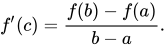
2. Mean Value Theorem
        Suppose    is a function that satisfies the following:

         is continuous on the closed interval  

         is differentiable on the open interval  

       Then, there is a number    such that    and  


Solution:

(a)

Step 1:  
First note that  
Also,  
Since  


Thus,    and hence  Failed to parse (MathML with SVG or PNG fallback (recommended for modern browsers and accessibility tools): Invalid response ("Math extension cannot connect to Restbase.") from server "https://wikimedia.org/api/rest_v1/":): {\displaystyle f(-5)<0.}
Step 2:  
Since    and    there exists    with    such that
  by the Intermediate Value Theorem. Hence,    has at least one zero.

(b)

Step 1:  
Suppose that    has more than one zero. So, there exist    with  Failed to parse (Conversion error. Server ("https://wikimedia.org/api/rest_") reported: "Cannot get mml. Server problem."): {\displaystyle a<b}   such that  Failed to parse (MathML with SVG or PNG fallback (recommended for modern browsers and accessibility tools): Invalid response ("Math extension cannot connect to Restbase.") from server "https://wikimedia.org/api/rest_v1/":): {\displaystyle f(a)=f(b)=0.}
Then, by the Mean Value Theorem, there exists  Failed to parse (MathML with SVG or PNG fallback (recommended for modern browsers and accessibility tools): Invalid response ("Math extension cannot connect to Restbase.") from server "https://wikimedia.org/api/rest_v1/":): {\displaystyle c}   with  Failed to parse (MathML with SVG or PNG fallback (recommended for modern browsers and accessibility tools): Invalid response ("Math extension cannot connect to Restbase.") from server "https://wikimedia.org/api/rest_v1/":): {\displaystyle a<c<b}   such that  Failed to parse (MathML with SVG or PNG fallback (recommended for modern browsers and accessibility tools): Invalid response ("Math extension cannot connect to Restbase.") from server "https://wikimedia.org/api/rest_v1/":): {\displaystyle f'(c)=0.}
Step 2:  
We have  Failed to parse (MathML with SVG or PNG fallback (recommended for modern browsers and accessibility tools): Invalid response ("Math extension cannot connect to Restbase.") from server "https://wikimedia.org/api/rest_v1/":): {\displaystyle f'(x)=3-2\cos(x).}  
Since  Failed to parse (MathML with SVG or PNG fallback (recommended for modern browsers and accessibility tools): Invalid response ("Math extension cannot connect to Restbase.") from server "https://wikimedia.org/api/rest_v1/":): {\displaystyle -1\leq \cos(x)\leq 1,}
       Failed to parse (MathML with SVG or PNG fallback (recommended for modern browsers and accessibility tools): Invalid response ("Math extension cannot connect to Restbase.") from server "https://wikimedia.org/api/rest_v1/":): {\displaystyle -2 \leq -2\cos(x)\leq 2.}  
So,  Failed to parse (MathML with SVG or PNG fallback (recommended for modern browsers and accessibility tools): Invalid response ("Math extension cannot connect to Restbase.") from server "https://wikimedia.org/api/rest_v1/":): {\displaystyle 1\leq f'(x) \leq 5,}
which contradicts  Failed to parse (MathML with SVG or PNG fallback (recommended for modern browsers and accessibility tools): Invalid response ("Math extension cannot connect to Restbase.") from server "https://wikimedia.org/api/rest_v1/":): {\displaystyle f'(c)=0.}   Thus,  Failed to parse (MathML with SVG or PNG fallback (recommended for modern browsers and accessibility tools): Invalid response ("Math extension cannot connect to Restbase.") from server "https://wikimedia.org/api/rest_v1/":): {\displaystyle f(x)}   has at most one zero.


Final Answer:  
    (a)     See solution above.
    (b)     See solution above.

Return to Sample Exam