Integration by Parts
Introduction
Let's say we want to integrate

Here, we can compute this antiderivative by using substitution.

While substitution is an important integration technique, it will not help us evaluate all integrals.
For example, consider the integral

There is no substitution that will allow us to integrate this integral.
We need another integration technique called integration by parts.
The formula for integration by parts comes from the product rule for derivatives.
Recall from the product rule,

Then, we have

If we solve the last equation for the second integral, we obtain

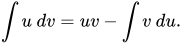
This formula is the formula for integration by parts.
But, as it is currently stated, it is long and hard to remember.
So, we make a substitution to obtain a nicer formula.
Let and


Then, and


Plugging these into our formula, we obtain
Warm-Up
Evaluate the following integrals.
1)

| Solution: |
|---|
| We have two options when doing integration by parts. |
| We can let or |
| In this case, we let be the polynomial. |
| So, we let and |
| Then, and |
| Hence, by integration by parts, we get |
|
|


| Final Answer: |
|---|

2)

| Solution: |
|---|
|
We have a choice to make. |
| We can let or |
| In this case, we let be the polynomial. |
| So, we let and |
| Then, |
| By Failed to parse (MathML with SVG or PNG fallback (recommended for modern browsers and accessibility tools): Invalid response ("Math extension cannot connect to Restbase.") from server "https://wikimedia.org/api/rest_v1/":): {\displaystyle u-} substitution, Failed to parse (MathML with SVG or PNG fallback (recommended for modern browsers and accessibility tools): Invalid response ("Math extension cannot connect to Restbase.") from server "https://wikimedia.org/api/rest_v1/":): {\displaystyle v=\int \cos(2x)~dx=\frac{1}{2} \sin(2x).} |
| Hence, by integration by parts, we get |
|
| where we use Failed to parse (MathML with SVG or PNG fallback (recommended for modern browsers and accessibility tools): Invalid response ("Math extension cannot connect to Restbase.") from server "https://wikimedia.org/api/rest_v1/":): {\displaystyle u-} substitution to evaluate the last integral. |


| Final Answer: |
|---|
| Failed to parse (MathML with SVG or PNG fallback (recommended for modern browsers and accessibility tools): Invalid response ("Math extension cannot connect to Restbase.") from server "https://wikimedia.org/api/rest_v1/":): {\displaystyle \frac{1}{2}x\sin(2x)+\frac{1}{4}\cos(2x)+C} |
3) Failed to parse (MathML with SVG or PNG fallback (recommended for modern browsers and accessibility tools): Invalid response ("Math extension cannot connect to Restbase.") from server "https://wikimedia.org/api/rest_v1/":): {\displaystyle \int \ln x~dx}
| Solution: |
|---|
| We have a choice to make. |
| We can let Failed to parse (MathML with SVG or PNG fallback (recommended for modern browsers and accessibility tools): Invalid response ("Math extension cannot connect to Restbase.") from server "https://wikimedia.org/api/rest_v1/":): {\displaystyle u=\ln x} or Failed to parse (MathML with SVG or PNG fallback (recommended for modern browsers and accessibility tools): Invalid response ("Math extension cannot connect to Restbase.") from server "https://wikimedia.org/api/rest_v1/":): {\displaystyle dv=\ln x~dx.} |
| In this case, we don't want to let Failed to parse (MathML with SVG or PNG fallback (recommended for modern browsers and accessibility tools): Invalid response ("Math extension cannot connect to Restbase.") from server "https://wikimedia.org/api/rest_v1/":): {\displaystyle dv=\ln x~dx} since we don't know how to integrate Failed to parse (MathML with SVG or PNG fallback (recommended for modern browsers and accessibility tools): Invalid response ("Math extension cannot connect to Restbase.") from server "https://wikimedia.org/api/rest_v1/":): {\displaystyle \ln x} yet. |
| So, we let Failed to parse (MathML with SVG or PNG fallback (recommended for modern browsers and accessibility tools): Invalid response ("Math extension cannot connect to Restbase.") from server "https://wikimedia.org/api/rest_v1/":): {\displaystyle u=\ln x} and Failed to parse (MathML with SVG or PNG fallback (recommended for modern browsers and accessibility tools): Invalid response ("Math extension cannot connect to Restbase.") from server "https://wikimedia.org/api/rest_v1/":): {\displaystyle dv=1~dx.} |
| Then, Failed to parse (MathML with SVG or PNG fallback (recommended for modern browsers and accessibility tools): Invalid response ("Math extension cannot connect to Restbase.") from server "https://wikimedia.org/api/rest_v1/":): {\displaystyle du=\frac{1}{x}~dx} and Failed to parse (MathML with SVG or PNG fallback (recommended for modern browsers and accessibility tools): Invalid response ("Math extension cannot connect to Restbase.") from server "https://wikimedia.org/api/rest_v1/":): {\displaystyle v=x.} |
| Hence, by integration by parts, we get |
|
| Final Answer: |
|---|
| Failed to parse (MathML with SVG or PNG fallback (recommended for modern browsers and accessibility tools): Invalid response ("Math extension cannot connect to Restbase.") from server "https://wikimedia.org/api/rest_v1/":): {\displaystyle x\ln (x)-x+C} |
Exercise 1
Evaluate Failed to parse (MathML with SVG or PNG fallback (recommended for modern browsers and accessibility tools): Invalid response ("Math extension cannot connect to Restbase.") from server "https://wikimedia.org/api/rest_v1/":): {\displaystyle \int x \sec^2 x~dx.}
Since we know the antiderivative of Failed to parse (MathML with SVG or PNG fallback (recommended for modern browsers and accessibility tools): Invalid response ("Math extension cannot connect to Restbase.") from server "https://wikimedia.org/api/rest_v1/":): {\displaystyle \sec^2 x,}
we let Failed to parse (MathML with SVG or PNG fallback (recommended for modern browsers and accessibility tools): Invalid response ("Math extension cannot connect to Restbase.") from server "https://wikimedia.org/api/rest_v1/":): {\displaystyle u=x} and Failed to parse (MathML with SVG or PNG fallback (recommended for modern browsers and accessibility tools): Invalid response ("Math extension cannot connect to Restbase.") from server "https://wikimedia.org/api/rest_v1/":): {\displaystyle dv=\sec^2 x~dx.}
Then, Failed to parse (MathML with SVG or PNG fallback (recommended for modern browsers and accessibility tools): Invalid response ("Math extension cannot connect to Restbase.") from server "https://wikimedia.org/api/rest_v1/":): {\displaystyle du=dx} and Failed to parse (MathML with SVG or PNG fallback (recommended for modern browsers and accessibility tools): Invalid response ("Math extension cannot connect to Restbase.") from server "https://wikimedia.org/api/rest_v1/":): {\displaystyle v=\tan x.}
Using integration by parts, we get
- Failed to parse (MathML with SVG or PNG fallback (recommended for modern browsers and accessibility tools): Invalid response ("Math extension cannot connect to Restbase.") from server "https://wikimedia.org/api/rest_v1/":): {\displaystyle \begin{array}{rcl} \displaystyle{\int x \sec^2 x~dx} & = & \displaystyle{x\tan x -\int \tan x~dx}\\ &&\\ & = & \displaystyle{x\tan x -\int \frac{\sin x}{\cos x}~dx.} \end{array}}
For the remaining integral, we use Failed to parse (MathML with SVG or PNG fallback (recommended for modern browsers and accessibility tools): Invalid response ("Math extension cannot connect to Restbase.") from server "https://wikimedia.org/api/rest_v1/":): {\displaystyle u-} substitution.
Let Failed to parse (MathML with SVG or PNG fallback (recommended for modern browsers and accessibility tools): Invalid response ("Math extension cannot connect to Restbase.") from server "https://wikimedia.org/api/rest_v1/":): {\displaystyle u=\cos x.} Then, Failed to parse (MathML with SVG or PNG fallback (recommended for modern browsers and accessibility tools): Invalid response ("Math extension cannot connect to Restbase.") from server "https://wikimedia.org/api/rest_v1/":): {\displaystyle du=-\sin x~dx.}
So, we get
- Failed to parse (MathML with SVG or PNG fallback (recommended for modern browsers and accessibility tools): Invalid response ("Math extension cannot connect to Restbase.") from server "https://wikimedia.org/api/rest_v1/":): {\displaystyle \begin{array}{rcl} \displaystyle{\int x \sec^2 x~dx} & = & \displaystyle{x\tan x +\int \frac{1}{u}~du}\\ &&\\ & = & \displaystyle{x\tan x + \ln |u|+C}\\ &&\\ & = & \displaystyle{x\tan x+ \ln |\cos x|+C.} \end{array}}
So, we have
- Failed to parse (MathML with SVG or PNG fallback (recommended for modern browsers and accessibility tools): Invalid response ("Math extension cannot connect to Restbase.") from server "https://wikimedia.org/api/rest_v1/":): {\displaystyle \int x \sec^2 x~dx=x\tan x+ \ln |\cos x|+C.}
Exercise 2
Evaluate Failed to parse (MathML with SVG or PNG fallback (recommended for modern browsers and accessibility tools): Invalid response ("Math extension cannot connect to Restbase.") from server "https://wikimedia.org/api/rest_v1/":): {\displaystyle \int \frac{\ln x}{x^3}~dx.}
We start by letting Failed to parse (MathML with SVG or PNG fallback (recommended for modern browsers and accessibility tools): Invalid response ("Math extension cannot connect to Restbase.") from server "https://wikimedia.org/api/rest_v1/":): {\displaystyle u=\ln x} and Failed to parse (MathML with SVG or PNG fallback (recommended for modern browsers and accessibility tools): Invalid response ("Math extension cannot connect to Restbase.") from server "https://wikimedia.org/api/rest_v1/":): {\displaystyle dv=\frac{1}{x^3}~dx.}
Then, Failed to parse (MathML with SVG or PNG fallback (recommended for modern browsers and accessibility tools): Invalid response ("Math extension cannot connect to Restbase.") from server "https://wikimedia.org/api/rest_v1/":): {\displaystyle du=\frac{1}{x}~dx} and Failed to parse (MathML with SVG or PNG fallback (recommended for modern browsers and accessibility tools): Invalid response ("Math extension cannot connect to Restbase.") from server "https://wikimedia.org/api/rest_v1/":): {\displaystyle v=\frac{-1}{2x^2}.}
So, using integration by parts, we get
- Failed to parse (MathML with SVG or PNG fallback (recommended for modern browsers and accessibility tools): Invalid response ("Math extension cannot connect to Restbase.") from server "https://wikimedia.org/api/rest_v1/":): {\displaystyle \begin{array}{rcl} \displaystyle{\int \frac{\ln x}{x^3}~dx} & = & \displaystyle{\frac{-\ln x}{2x^2}-\int \frac{-1}{2x^2}\bigg(\frac{1}{x}\bigg)~dx}\\ &&\\ & = & \displaystyle{\frac{-\ln x}{2x^2}+\int \frac{1}{2x^3}~dx}\\ &&\\ & = & \displaystyle{\frac{-\ln x}{2x^2}-\frac{1}{4x^2}+C.} \end{array}}
So, we have
- Failed to parse (MathML with SVG or PNG fallback (recommended for modern browsers and accessibility tools): Invalid response ("Math extension cannot connect to Restbase.") from server "https://wikimedia.org/api/rest_v1/":): {\displaystyle \int \frac{\ln x}{x^3}~dx=\frac{-\ln x}{2x^2}-\frac{1}{4x^2}+C.}
Exercise 3
Evaluate Failed to parse (MathML with SVG or PNG fallback (recommended for modern browsers and accessibility tools): Invalid response ("Math extension cannot connect to Restbase.") from server "https://wikimedia.org/api/rest_v1/":): {\displaystyle \int x\sqrt{x+1}~dx.}
We start by letting Failed to parse (MathML with SVG or PNG fallback (recommended for modern browsers and accessibility tools): Invalid response ("Math extension cannot connect to Restbase.") from server "https://wikimedia.org/api/rest_v1/":): {\displaystyle u=x} and Failed to parse (MathML with SVG or PNG fallback (recommended for modern browsers and accessibility tools): Invalid response ("Math extension cannot connect to Restbase.") from server "https://wikimedia.org/api/rest_v1/":): {\displaystyle dv=\sqrt{x+1}~dx.}
Then, Failed to parse (MathML with SVG or PNG fallback (recommended for modern browsers and accessibility tools): Invalid response ("Math extension cannot connect to Restbase.") from server "https://wikimedia.org/api/rest_v1/":): {\displaystyle du=dx.}
Also, by Failed to parse (MathML with SVG or PNG fallback (recommended for modern browsers and accessibility tools): Invalid response ("Math extension cannot connect to Restbase.") from server "https://wikimedia.org/api/rest_v1/":): {\displaystyle u-} substitution, we have
- Failed to parse (MathML with SVG or PNG fallback (recommended for modern browsers and accessibility tools): Invalid response ("Math extension cannot connect to Restbase.") from server "https://wikimedia.org/api/rest_v1/":): {\displaystyle v=\int \sqrt{x+1}~dx=\frac{2}{3}(x+1)^{\frac{3}{2}}.}
Hence, by integration by parts, we get
- Failed to parse (MathML with SVG or PNG fallback (recommended for modern browsers and accessibility tools): Invalid response ("Math extension cannot connect to Restbase.") from server "https://wikimedia.org/api/rest_v1/":): {\displaystyle \begin{array}{rcl} \displaystyle{\int x\sqrt{x+1}~dx} & = & \displaystyle{\frac{2}{3}x(x+1)^{\frac{3}{2}}-\int \frac{2}{3}(x+1)^{\frac{3}{2}}~dx}\\ &&\\ & = & \displaystyle{\frac{2}{3}x(x+1)^{\frac{3}{2}}-\frac{4}{15}(x+1)^{\frac{5}{2}}+C,} \end{array}}
where we use Failed to parse (MathML with SVG or PNG fallback (recommended for modern browsers and accessibility tools): Invalid response ("Math extension cannot connect to Restbase.") from server "https://wikimedia.org/api/rest_v1/":): {\displaystyle u-} substitution to evaluate the last integral.
So, we have
- Failed to parse (MathML with SVG or PNG fallback (recommended for modern browsers and accessibility tools): Invalid response ("Math extension cannot connect to Restbase.") from server "https://wikimedia.org/api/rest_v1/":): {\displaystyle \int x\sqrt{x+1}~dx=\frac{2}{3}x(x+1)^{\frac{3}{2}}-\frac{4}{15}(x+1)^{\frac{5}{2}}+C.}
Exercise 4
Evaluate Failed to parse (MathML with SVG or PNG fallback (recommended for modern browsers and accessibility tools): Invalid response ("Math extension cannot connect to Restbase.") from server "https://wikimedia.org/api/rest_v1/":): {\displaystyle \int x^2e^{-2x}~dx.}
We start by letting Failed to parse (MathML with SVG or PNG fallback (recommended for modern browsers and accessibility tools): Invalid response ("Math extension cannot connect to Restbase.") from server "https://wikimedia.org/api/rest_v1/":): {\displaystyle u=x^2} and Failed to parse (MathML with SVG or PNG fallback (recommended for modern browsers and accessibility tools): Invalid response ("Math extension cannot connect to Restbase.") from server "https://wikimedia.org/api/rest_v1/":): {\displaystyle dv=e^{-2x}~dx.}
Then, Failed to parse (MathML with SVG or PNG fallback (recommended for modern browsers and accessibility tools): Invalid response ("Math extension cannot connect to Restbase.") from server "https://wikimedia.org/api/rest_v1/":): {\displaystyle du=2x~dx.}
Also, by Failed to parse (MathML with SVG or PNG fallback (recommended for modern browsers and accessibility tools): Invalid response ("Math extension cannot connect to Restbase.") from server "https://wikimedia.org/api/rest_v1/":): {\displaystyle u-} substitution, we have
- Failed to parse (MathML with SVG or PNG fallback (recommended for modern browsers and accessibility tools): Invalid response ("Math extension cannot connect to Restbase.") from server "https://wikimedia.org/api/rest_v1/":): {\displaystyle v=\int e^{-2x}~dx=\frac{e^{-2x}}{-2}.}
Hence, by integration by parts, we get
- Failed to parse (MathML with SVG or PNG fallback (recommended for modern browsers and accessibility tools): Invalid response ("Math extension cannot connect to Restbase.") from server "https://wikimedia.org/api/rest_v1/":): {\displaystyle \begin{array}{rcl} \displaystyle{\int x^2 e^{-2x}~dx} & = & \displaystyle{\frac{x^2e^{-2x}}{-2}-\int 2x\frac{e^{-2x}}{-2}~dx}\\ &&\\ & = & \displaystyle{\frac{x^2e^{-2x}}{-2}+\int xe^{-2x}~dx.} \end{array}}
Now, we need to use integration by parts a second time.
Let Failed to parse (MathML with SVG or PNG fallback (recommended for modern browsers and accessibility tools): Invalid response ("Math extension cannot connect to Restbase.") from server "https://wikimedia.org/api/rest_v1/":): {\displaystyle u=x} and Failed to parse (MathML with SVG or PNG fallback (recommended for modern browsers and accessibility tools): Invalid response ("Math extension cannot connect to Restbase.") from server "https://wikimedia.org/api/rest_v1/":): {\displaystyle dv=e^{-2x}~dx.}
Then, Failed to parse (MathML with SVG or PNG fallback (recommended for modern browsers and accessibility tools): Invalid response ("Math extension cannot connect to Restbase.") from server "https://wikimedia.org/api/rest_v1/":): {\displaystyle du=dx} and Failed to parse (MathML with SVG or PNG fallback (recommended for modern browsers and accessibility tools): Invalid response ("Math extension cannot connect to Restbase.") from server "https://wikimedia.org/api/rest_v1/":): {\displaystyle v=\frac{e^{-2x}}{-2}.}
Therefore, using integration by parts again, we get
- Failed to parse (MathML with SVG or PNG fallback (recommended for modern browsers and accessibility tools): Invalid response ("Math extension cannot connect to Restbase.") from server "https://wikimedia.org/api/rest_v1/":): {\displaystyle \begin{array}{rcl} \displaystyle{\int x^2 e^{-2x}~dx} & = & \displaystyle{\frac{x^2 e^{-2x} }{-2}+\frac{x e^{-2x} }{-2}-\int \frac{e^{-2x}}{-2}~dx}\\ &&\\ & = & \displaystyle{\frac{x^2e^{-2x}}{-2}+\frac{xe^{-2x}}{-2}+\frac{e^{-2x}}{-4}+C.} \end{array}}
So, we have
- Failed to parse (MathML with SVG or PNG fallback (recommended for modern browsers and accessibility tools): Invalid response ("Math extension cannot connect to Restbase.") from server "https://wikimedia.org/api/rest_v1/":): {\displaystyle \int x^2e^{-2x}~dx=\frac{x^2e^{-2x}}{-2}+\frac{xe^{-2x}}{-2}+\frac{e^{-2x}}{-4}+C.}
Exercise 5
Evaluate Failed to parse (MathML with SVG or PNG fallback (recommended for modern browsers and accessibility tools): Invalid response ("Math extension cannot connect to Restbase.") from server "https://wikimedia.org/api/rest_v1/":): {\displaystyle \int e^{3x}\sin(2x)~dx.}
We begin by letting Failed to parse (MathML with SVG or PNG fallback (recommended for modern browsers and accessibility tools): Invalid response ("Math extension cannot connect to Restbase.") from server "https://wikimedia.org/api/rest_v1/":): {\displaystyle u=\sin(2x)} and Failed to parse (MathML with SVG or PNG fallback (recommended for modern browsers and accessibility tools): Invalid response ("Math extension cannot connect to Restbase.") from server "https://wikimedia.org/api/rest_v1/":): {\displaystyle dv=e^{3x}~dx.}
Then, Failed to parse (MathML with SVG or PNG fallback (recommended for modern browsers and accessibility tools): Invalid response ("Math extension cannot connect to Restbase.") from server "https://wikimedia.org/api/rest_v1/":): {\displaystyle u=2\cos (2x)~dx.}
Also, by Failed to parse (MathML with SVG or PNG fallback (recommended for modern browsers and accessibility tools): Invalid response ("Math extension cannot connect to Restbase.") from server "https://wikimedia.org/api/rest_v1/":): {\displaystyle u-} substitution, we have
- Failed to parse (MathML with SVG or PNG fallback (recommended for modern browsers and accessibility tools): Invalid response ("Math extension cannot connect to Restbase.") from server "https://wikimedia.org/api/rest_v1/":): {\displaystyle v=\int e^{3x}~dx=\frac{e^{3x}}{3}.}
Hence, by integration by parts, we have
- Failed to parse (MathML with SVG or PNG fallback (recommended for modern browsers and accessibility tools): Invalid response ("Math extension cannot connect to Restbase.") from server "https://wikimedia.org/api/rest_v1/":): {\displaystyle \begin{array}{rcl} \displaystyle{\int e^{3x} \sin(2x)~dx} & = & \displaystyle{\frac{e^{3x}\sin(2x)}{3}-\int \frac{2}{3}\cos(2x)e^{3x}~dx}\\ &&\\ & = & \displaystyle{\frac{e^{3x}\sin(2x)}{3}-\frac{2}{3} \int \cos(2x)e^{3x}~dx.} \end{array}}
Now, we need to use integration by parts a second time.
Let Failed to parse (MathML with SVG or PNG fallback (recommended for modern browsers and accessibility tools): Invalid response ("Math extension cannot connect to Restbase.") from server "https://wikimedia.org/api/rest_v1/":): {\displaystyle u=\cos (2x)} and Failed to parse (MathML with SVG or PNG fallback (recommended for modern browsers and accessibility tools): Invalid response ("Math extension cannot connect to Restbase.") from server "https://wikimedia.org/api/rest_v1/":): {\displaystyle dv=e^{3x}~dx.}
Then, Failed to parse (MathML with SVG or PNG fallback (recommended for modern browsers and accessibility tools): Invalid response ("Math extension cannot connect to Restbase.") from server "https://wikimedia.org/api/rest_v1/":): {\displaystyle du=-2\sin(2x)~dx} and Failed to parse (MathML with SVG or PNG fallback (recommended for modern browsers and accessibility tools): Invalid response ("Math extension cannot connect to Restbase.") from server "https://wikimedia.org/api/rest_v1/":): {\displaystyle v=\frac{e^{3x}}{3}.}
Therefore, using integration by parts again, we get
- Failed to parse (MathML with SVG or PNG fallback (recommended for modern browsers and accessibility tools): Invalid response ("Math extension cannot connect to Restbase.") from server "https://wikimedia.org/api/rest_v1/":): {\displaystyle \begin{array}{rcl} \displaystyle{\int e^{3x} \sin(2x)~dx} & = & \displaystyle{\frac{e^{3x}\sin(2x)}{3}-\frac{2}{3} \bigg[ \frac{\cos(2x)e^{3x}}{3}+\int \frac{2}{3}\sin(2x)e^{3x}~dx\bigg]}\\ &&\\ & = & \displaystyle{\frac{e^{3x}\sin(2x)}{3}-\frac{2\cos(2x)e^{3x}}{9}-\frac{4}{9}\int e^{3x}\sin(2x)~dx.} \end{array}}
Now, we have the exact same integral that we had at the beginning of the problem.
So, we add this integral to the other side of the equation.
When we do this, we get
- Failed to parse (MathML with SVG or PNG fallback (recommended for modern browsers and accessibility tools): Invalid response ("Math extension cannot connect to Restbase.") from server "https://wikimedia.org/api/rest_v1/":): {\displaystyle \frac{13}{9} \int e^{3x}\sin(2x)~dx = \frac{e^{3x}\sin(2x)}{3}-\frac{2\cos(2x)e^{3x}}{9}.}
Therefore, we get
- Failed to parse (MathML with SVG or PNG fallback (recommended for modern browsers and accessibility tools): Invalid response ("Math extension cannot connect to Restbase.") from server "https://wikimedia.org/api/rest_v1/":): {\displaystyle \int e^{3x}\sin(2x)~dx = \frac{9}{13}\bigg(\frac{e^{3x}\sin(2x)}{3}-\frac{2\cos(2x)e^{3x}}{9}\bigg)+C.}
Exercise 6
Evaluate Failed to parse (MathML with SVG or PNG fallback (recommended for modern browsers and accessibility tools): Invalid response ("Math extension cannot connect to Restbase.") from server "https://wikimedia.org/api/rest_v1/":): {\displaystyle \int \sin(2x)\cos(3x)~dx.}
First, using the Quotient Rule, we have
- Failed to parse (MathML with SVG or PNG fallback (recommended for modern browsers and accessibility tools): Invalid response ("Math extension cannot connect to Restbase.") from server "https://wikimedia.org/api/rest_v1/":): {\displaystyle \begin{array}{rcl} \displaystyle{f'(x)} & = & \displaystyle{\frac{x^2\sin x (e^x)'-e^x(x^2\sin x)'}{(x^2\sin x)^2}}\\ &&\\ & = & \displaystyle{\frac{x^2\sin x e^x - e^x(x^2\sin x)'}{x^4\sin^2 x}.} \end{array}}
Now, we need to use the Product Rule. So, we have
- Failed to parse (MathML with SVG or PNG fallback (recommended for modern browsers and accessibility tools): Invalid response ("Math extension cannot connect to Restbase.") from server "https://wikimedia.org/api/rest_v1/":): {\displaystyle \begin{array}{rcl} \displaystyle{f'(x)} & = & \displaystyle{\frac{x^2\sin x e^x - e^x(x^2(\sin x)'+(x^2)'\sin x)}{x^4\sin^2 x}}\\ &&\\ & = & \displaystyle{\frac{x^2\sin x e^x - e^x(x^2\cos x+2x\sin x)}{x^4\sin^2 x}.} \end{array}}
So, we have
- Failed to parse (MathML with SVG or PNG fallback (recommended for modern browsers and accessibility tools): Invalid response ("Math extension cannot connect to Restbase.") from server "https://wikimedia.org/api/rest_v1/":): {\displaystyle f'(x)=\frac{x^2\sin x e^x - e^x(x^2\cos x+2x\sin x)}{x^4\sin^2 x}.}