Which of the following sequences
converges? Which diverges? Give reasons for your answers!
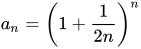
(a)
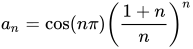
(b)
Solution:
(a)
| Step 1:
|
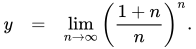
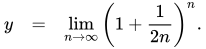
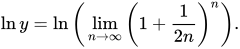
| Let
|
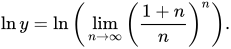
| We then take the natural log of both sides to get
|
|
| Step 2:
|
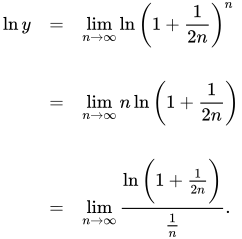
| We can interchange limits and continuous functions.
|
| Therefore, we have
|
|
|
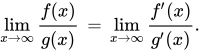
Now, this limit has the form
|
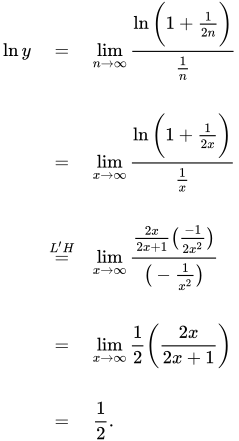
| Hence, we can use L'Hopital's Rule to calculate this limit.
|
| Step 3:
|
| Now, we have
|
|
|
| Step 4:
|
Since we know
|
|
(b)
| Step 1:
|
| First, we have
|

|
| Step 3:
|
| Now, we have
|
|
|
| Step 4:
|
Since we know
|
| Failed to parse (Conversion error. Server ("https://wikimedia.org/api/rest_") reported: "Cannot get mml. Server problem."): {\displaystyle y=e.}
|
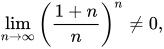
| Since
|
| Failed to parse (Conversion error. Server ("https://wikimedia.org/api/rest_") reported: "Cannot get mml. Server problem."): {\displaystyle \lim _{n\rightarrow \infty }{\bigg (}{\frac {1+n}{n}}{\bigg )}^{n}\neq 0,}
|
| we have
|
|
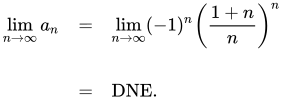
Failed to parse (Conversion error. Server ("https://wikimedia.org/api/rest_") reported: "Cannot get mml. Server problem."): {\displaystyle {\begin{array}{rcl}\displaystyle {\lim _{n\rightarrow \infty }a_{n}}&=&\displaystyle {\lim _{n\rightarrow \infty }(-1)^{n}{\bigg (}{\frac {1+n}{n}}{\bigg )}^{n}}\\&&\\&=&\displaystyle {{\text{DNE}}.}\end{array}}}
|
| Final Answer:
|
(a)
|
(b)
|
Return to Sample Exam