009C Sample Midterm 2, Problem 3
Determine convergence or divergence:
(a) Failed to parse (MathML with SVG or PNG fallback (recommended for modern browsers and accessibility tools): Invalid response ("Math extension cannot connect to Restbase.") from server "https://wikimedia.org/api/rest_v1/":): {\displaystyle \sum_{n=1}^\infty (-1)^n \sqrt{\frac{1}{n}}}
(b) Failed to parse (MathML with SVG or PNG fallback (recommended for modern browsers and accessibility tools): Invalid response ("Math extension cannot connect to Restbase.") from server "https://wikimedia.org/api/rest_v1/":): {\displaystyle \sum_{n=1}^\infty (-2)^n \frac{n!}{n^n} }
| Foundations: |
|---|
| 1. Alternating Series Test |
| Let be a positive, decreasing sequence where Failed to parse (MathML with SVG or PNG fallback (recommended for modern browsers and accessibility tools): Invalid response ("Math extension cannot connect to Restbase.") from server "https://wikimedia.org/api/rest_v1/":): {\displaystyle \lim_{n\rightarrow \infty} a_n=0.} |
| Then, Failed to parse (MathML with SVG or PNG fallback (recommended for modern browsers and accessibility tools): Invalid response ("Math extension cannot connect to Restbase.") from server "https://wikimedia.org/api/rest_v1/":): {\displaystyle \sum_{n=1}^\infty (-1)^na_n} and Failed to parse (MathML with SVG or PNG fallback (recommended for modern browsers and accessibility tools): Invalid response ("Math extension cannot connect to Restbase.") from server "https://wikimedia.org/api/rest_v1/":): {\displaystyle \sum_{n=1}^\infty (-1)^{n+1}a_n} |
| converge. |
| 2. Ratio Test |
| Let Failed to parse (MathML with SVG or PNG fallback (recommended for modern browsers and accessibility tools): Invalid response ("Math extension cannot connect to Restbase.") from server "https://wikimedia.org/api/rest_v1/":): {\displaystyle \sum a_n} be a series and Failed to parse (MathML with SVG or PNG fallback (recommended for modern browsers and accessibility tools): Invalid response ("Math extension cannot connect to Restbase.") from server "https://wikimedia.org/api/rest_v1/":): {\displaystyle L=\lim_{n\rightarrow \infty}\bigg|\frac{a_{n+1}}{a_n}\bigg|.} |
| Then, |
|
If Failed to parse (MathML with SVG or PNG fallback (recommended for modern browsers and accessibility tools): Invalid response ("Math extension cannot connect to Restbase.") from server "https://wikimedia.org/api/rest_v1/":): {\displaystyle L<1,} the series is absolutely convergent. |
|
If Failed to parse (MathML with SVG or PNG fallback (recommended for modern browsers and accessibility tools): Invalid response ("Math extension cannot connect to Restbase.") from server "https://wikimedia.org/api/rest_v1/":): {\displaystyle L>1,} the series is divergent. |
|
If Failed to parse (MathML with SVG or PNG fallback (recommended for modern browsers and accessibility tools): Invalid response ("Math extension cannot connect to Restbase.") from server "https://wikimedia.org/api/rest_v1/":): {\displaystyle L=1,} the test is inconclusive. |
| 3. If a series absolutely converges, then it also converges. |

Solution:
(a)
| Step 1: |
|---|
| First, we have |
| Failed to parse (MathML with SVG or PNG fallback (recommended for modern browsers and accessibility tools): Invalid response ("Math extension cannot connect to Restbase.") from server "https://wikimedia.org/api/rest_v1/":): {\displaystyle \sum_{n=1}^\infty (-1)^n \sqrt{\frac{1}{n}}=\sum_{n=1}^\infty (-1)^n \frac{1}{\sqrt{n}}.} |
| Step 2: |
|---|
| We notice that the series is alternating. |
| Let Failed to parse (MathML with SVG or PNG fallback (recommended for modern browsers and accessibility tools): Invalid response ("Math extension cannot connect to Restbase.") from server "https://wikimedia.org/api/rest_v1/":): {\displaystyle b_n=\frac{1}{\sqrt{n}}.} |
| First, we have |
| Failed to parse (MathML with SVG or PNG fallback (recommended for modern browsers and accessibility tools): Invalid response ("Math extension cannot connect to Restbase.") from server "https://wikimedia.org/api/rest_v1/":): {\displaystyle \frac{1}{\sqrt{n}}\ge 0} |
| for all Failed to parse (MathML with SVG or PNG fallback (recommended for modern browsers and accessibility tools): Invalid response ("Math extension cannot connect to Restbase.") from server "https://wikimedia.org/api/rest_v1/":): {\displaystyle n\ge 1.} |
| The sequence Failed to parse (MathML with SVG or PNG fallback (recommended for modern browsers and accessibility tools): Invalid response ("Math extension cannot connect to Restbase.") from server "https://wikimedia.org/api/rest_v1/":): {\displaystyle \{b_n\}} is decreasing since |
| Failed to parse (MathML with SVG or PNG fallback (recommended for modern browsers and accessibility tools): Invalid response ("Math extension cannot connect to Restbase.") from server "https://wikimedia.org/api/rest_v1/":): {\displaystyle \frac{1}{\sqrt{n+1}}<\frac{1}{\sqrt{n}}} |
| for all |
| Also, |
| Failed to parse (MathML with SVG or PNG fallback (recommended for modern browsers and accessibility tools): Invalid response ("Math extension cannot connect to Restbase.") from server "https://wikimedia.org/api/rest_v1/":): {\displaystyle \lim_{n\rightarrow \infty}b_n=\lim_{n\rightarrow \infty}\frac{1}{\sqrt{n}}=0.} |
| Therefore, the series Failed to parse (MathML with SVG or PNG fallback (recommended for modern browsers and accessibility tools): Invalid response ("Math extension cannot connect to Restbase.") from server "https://wikimedia.org/api/rest_v1/":): {\displaystyle \sum_{n=1}^\infty \frac{(-1)^n}{\sqrt{n}}} converges by the Alternating Series Test. |

(b)
| Step 1: |
|---|
| We begin by using the Ratio Test. |
| We have |
|
Failed to parse (MathML with SVG or PNG fallback (recommended for modern browsers and accessibility tools): Invalid response ("Math extension cannot connect to Restbase.") from server "https://wikimedia.org/api/rest_v1/":): {\displaystyle \begin{array}{rcl} \displaystyle{\lim_{n\rightarrow \infty}\bigg|\frac{a_{n+1}}{a_n}\bigg|} & = & \displaystyle{\lim_{n\rightarrow \infty} \bigg| \frac{(-2)^{n+1} (n+1)!}{(n+1)^{n+1}} \frac{n^n}{(-2)^n n!}\bigg|}\\ &&\\ & = & \displaystyle{\lim_{n\rightarrow \infty} \bigg| (-2)(n+1) \frac{n^n}{(n+1)^{n+1}}\bigg|}\\ &&\\ & = & \displaystyle{\lim_{n\rightarrow \infty} 2\frac{n^n}{(n+1)^n}}\\ &&\\ & = & \displaystyle{2\lim_{n\rightarrow \infty} \bigg(\frac{n}{n+1}\bigg)^n.} \end{array}} |
| Step 2: |
|---|
| Now, we need to calculate Failed to parse (MathML with SVG or PNG fallback (recommended for modern browsers and accessibility tools): Invalid response ("Math extension cannot connect to Restbase.") from server "https://wikimedia.org/api/rest_v1/":): {\displaystyle \lim_{n\rightarrow \infty} \bigg(\frac{n}{n+1}\bigg)^n.} |
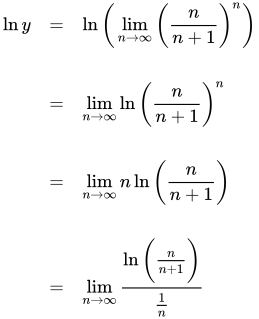
| Let Failed to parse (MathML with SVG or PNG fallback (recommended for modern browsers and accessibility tools): Invalid response ("Math extension cannot connect to Restbase.") from server "https://wikimedia.org/api/rest_v1/":): {\displaystyle y=\lim_{n\rightarrow \infty} \bigg(\frac{n}{n+1}\bigg)^n.} |
| Then, taking the natural log of both sides, we get |
|
|
| since we can interchange limits and continuous functions. |
| Now, this limit has the form Failed to parse (MathML with SVG or PNG fallback (recommended for modern browsers and accessibility tools): Invalid response ("Math extension cannot connect to Restbase.") from server "https://wikimedia.org/api/rest_v1/":): {\displaystyle \frac{0}{0}.} |
| Hence, we can use L'Hopital's Rule to calculate this limit. |
| Step 3: |
|---|
| Now, we have |
|
Failed to parse (MathML with SVG or PNG fallback (recommended for modern browsers and accessibility tools): Invalid response ("Math extension cannot connect to Restbase.") from server "https://wikimedia.org/api/rest_v1/":): {\displaystyle \begin{array}{rcl} \displaystyle{\ln y } & = & \displaystyle{\lim_{n\rightarrow \infty} \frac{\ln \bigg(\frac{n}{n+1}\bigg)}{\frac{1}{n}}}\\ &&\\ & = & \displaystyle{\lim_{x\rightarrow \infty} \frac{\ln \bigg(\frac{x}{x+1}\bigg)}{\frac{1}{x}}}\\ &&\\ & \overset{L'H}{=} & \displaystyle{\lim_{x\rightarrow \infty} \frac{\frac{1}{\bigg(\frac{x}{x+1}\bigg)}\frac{1}{(x+1)^2}}{\big(-\frac{1}{x^2}\big)}}\\ &&\\ & = & \displaystyle{\lim_{x\rightarrow \infty} \frac{-x}{x+1}}\\ &&\\ & = & \displaystyle{-1.} \end{array}} |
| Step 4: |
|---|
| Since Failed to parse (MathML with SVG or PNG fallback (recommended for modern browsers and accessibility tools): Invalid response ("Math extension cannot connect to Restbase.") from server "https://wikimedia.org/api/rest_v1/":): {\displaystyle \ln y=-1,} we know |
| Failed to parse (MathML with SVG or PNG fallback (recommended for modern browsers and accessibility tools): Invalid response ("Math extension cannot connect to Restbase.") from server "https://wikimedia.org/api/rest_v1/":): {\displaystyle y=e^{-1}.} |
| Now, we have |
| Failed to parse (MathML with SVG or PNG fallback (recommended for modern browsers and accessibility tools): Invalid response ("Math extension cannot connect to Restbase.") from server "https://wikimedia.org/api/rest_v1/":): {\displaystyle \lim_{n\rightarrow \infty} \bigg|\frac{a_{n+1}}{a_n}\bigg|=2e^{-1}=\frac{2}{e}.} |
| Since Failed to parse (MathML with SVG or PNG fallback (recommended for modern browsers and accessibility tools): Invalid response ("Math extension cannot connect to Restbase.") from server "https://wikimedia.org/api/rest_v1/":): {\displaystyle \frac{2}{e}<1,} the series is absolutely convergent by the Ratio Test. |
| Therefore, the series converges. |
| Final Answer: |
|---|
| (a) converges (by the Alternating Series Test) |
| (b) converges (by the Ratio Test) |