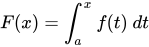
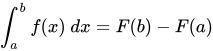
009B Sample Final 1, Problem 2

From Grad Wiki
Revision as of 19:10, 18 February 2017 by Kayla Murray (talk | contribs)
Jump to navigation Jump to search

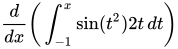
We would like to evaluate
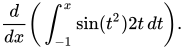
(a) Compute .
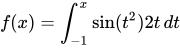
(b) Find .

(c) State the Fundamental Theorem of Calculus.

(d) Use the Fundamental Theorem of Calculus to compute   without first computing the integral.
Foundations:  
How would you integrate ?
You could use -substitution. Let . Then, .
So, we get .


Solution:

(a)

Step 1:  
We proceed using -substitution. Let Failed to parse (MathML with SVG or PNG fallback (recommended for modern browsers and accessibility tools): Invalid response ("Math extension cannot connect to Restbase.") from server "https://wikimedia.org/api/rest_v1/":): {\displaystyle u=t^2} . Then, .
Since this is a definite integral, we need to change the bounds of integration.
Plugging our values into the equation , we get and .
Step 2:  
So, we have


(b)

Step 1:  
From part (a), we have .
Step 2:  
If we take the derivative, we get , since is just a constant.

(c)

Step 1:  
The Fundamental Theorem of Calculus has two parts.
The Fundamental Theorem of Calculus, Part 1
  Let be continuous on and let .
  Then, is a differentiable function on and .
Step 2:  
The Fundamental Theorem of Calculus, Part 2
  Let be continuous on and let be any antiderivative of .
  Then, .
(d)  
By the Fundamental Theorem of Calculus, Part 1,


Final Answer:  
(a)  
(b)  
(c)  The Fundamental Theorem of Calculus, Part 1
  Let be continuous on and let .
  Then, is a differentiable function on Failed to parse (MathML with SVG or PNG fallback (recommended for modern browsers and accessibility tools): Invalid response ("Math extension cannot connect to Restbase.") from server "https://wikimedia.org/api/rest_v1/":): {\displaystyle (a,b)} and Failed to parse (MathML with SVG or PNG fallback (recommended for modern browsers and accessibility tools): Invalid response ("Math extension cannot connect to Restbase.") from server "https://wikimedia.org/api/rest_v1/":): {\displaystyle F'(x)=f(x)} .
The Fundamental Theorem of Calculus, Part 2
  Let Failed to parse (MathML with SVG or PNG fallback (recommended for modern browsers and accessibility tools): Invalid response ("Math extension cannot connect to Restbase.") from server "https://wikimedia.org/api/rest_v1/":): {\displaystyle f} be continuous on Failed to parse (MathML with SVG or PNG fallback (recommended for modern browsers and accessibility tools): Invalid response ("Math extension cannot connect to Restbase.") from server "https://wikimedia.org/api/rest_v1/":): {\displaystyle [a,b]} and let Failed to parse (MathML with SVG or PNG fallback (recommended for modern browsers and accessibility tools): Invalid response ("Math extension cannot connect to Restbase.") from server "https://wikimedia.org/api/rest_v1/":): {\displaystyle F} be any antiderivative of Failed to parse (MathML with SVG or PNG fallback (recommended for modern browsers and accessibility tools): Invalid response ("Math extension cannot connect to Restbase.") from server "https://wikimedia.org/api/rest_v1/":): {\displaystyle f} .
  Then, Failed to parse (MathML with SVG or PNG fallback (recommended for modern browsers and accessibility tools): Invalid response ("Math extension cannot connect to Restbase.") from server "https://wikimedia.org/api/rest_v1/":): {\displaystyle \int_a^b f(x)~dx=F(b)-F(a)} .
(d)  Failed to parse (MathML with SVG or PNG fallback (recommended for modern browsers and accessibility tools): Invalid response ("Math extension cannot connect to Restbase.") from server "https://wikimedia.org/api/rest_v1/":): {\displaystyle \sin(x^2)2x}

Return to Sample Exam