009C Sample Final 1, Problem 1
From Grad Wiki
Revision as of 18:17, 18 April 2016 by
Kayla Murray
(
talk
|
contribs
)
(
diff
)
← Older revision
|
Latest revision
(
diff
) |
Newer revision →
(
diff
)
Jump to navigation
Jump to search
Compute
a)
lim
n
→
∞
3
−
2
n
2
5
n
2
+
n
+
1
{\displaystyle \lim _{n\rightarrow \infty }{\frac {3-2n^{2}}{5n^{2}+n+1}}}
b)
lim
n
→
∞
ln
n
ln
3
n
{\displaystyle \lim _{n\rightarrow \infty }{\frac {\ln n}{\ln 3n}}}
Foundations:
Recall:
L'Hopital's Rule
Suppose that
lim
x
→
∞
f
(
x
)
{\displaystyle \lim _{x\rightarrow \infty }f(x)}
and
lim
x
→
∞
g
(
x
)
{\displaystyle \lim _{x\rightarrow \infty }g(x)}
are both zero or both
±
∞
.
{\displaystyle \pm \infty .}
If
lim
x
→
∞
f
′
(
x
)
g
′
(
x
)
{\displaystyle \lim _{x\rightarrow \infty }{\frac {f'(x)}{g'(x)}}}
is finite or
±
∞
,
{\displaystyle \pm \infty ,}
then
lim
x
→
∞
f
(
x
)
g
(
x
)
=
lim
x
→
∞
f
′
(
x
)
g
′
(
x
)
.
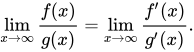
{\displaystyle \lim _{x\rightarrow \infty }{\frac {f(x)}{g(x)}}=\lim _{x\rightarrow \infty }{\frac {f'(x)}{g'(x)}}.}
Solution:
(a)
Step 1:
First, we switch to the limit to
x
{\displaystyle x}
so that we can use L'Hopital's rule.
So, we have
lim
x
→
∞
3
−
2
x
2
5
x
2
+
x
+
1
=
l
′
H
lim
x
→
∞
−
4
x
10
x
+
1
=
l
′
H
−
4
10
=
−
2
5
.
{\displaystyle {\begin{array}{rcl}\displaystyle {\lim _{x\rightarrow \infty }{\frac {3-2x^{2}}{5x^{2}+x+1}}}&{\overset {l'H}{=}}&\displaystyle {\lim _{x\rightarrow \infty }{\frac {-4x}{10x+1}}}\\&&\\&{\overset {l'H}{=}}&\displaystyle {\frac {-4}{10}}\\&&\\&=&\displaystyle {\frac {-2}{5}}.\end{array}}}
Step 2:
Hence, we have
lim
n
→
∞
3
−
2
n
2
5
n
2
+
n
+
1
=
−
2
5
.
{\displaystyle \lim _{n\rightarrow \infty }{\frac {3-2n^{2}}{5n^{2}+n+1}}={\frac {-2}{5}}.}
(b)
Step 1:
Again, we switch to the limit to
x
{\displaystyle x}
so that we can use L'Hopital's rule.
So, we have
lim
x
→
∞
ln
x
ln
(
3
x
)
=
l
′
H
lim
x
→
∞
1
x
3
3
x
=
lim
x
→
∞
1
=
1.
{\displaystyle {\begin{array}{rcl}\displaystyle {\lim _{x\rightarrow \infty }{\frac {\ln x}{\ln(3x)}}}&{\overset {l'H}{=}}&\displaystyle {\lim _{x\rightarrow \infty }{\frac {\frac {1}{x}}{\frac {3}{3x}}}}\\&&\\&=&\displaystyle {\lim _{x\rightarrow \infty }1}\\&&\\&=&1.\end{array}}}
Step 2:
Hence, we have
Failed to parse (MathML with SVG or PNG fallback (recommended for modern browsers and accessibility tools): Invalid response ("Math extension cannot connect to Restbase.") from server "https://wikimedia.org/api/rest_v1/":): {\displaystyle \lim_{n\rightarrow \infty} \frac{\ln n}{\ln 3n}=1.}
Final Answer:
(a)
Failed to parse (MathML with SVG or PNG fallback (recommended for modern browsers and accessibility tools): Invalid response ("Math extension cannot connect to Restbase.") from server "https://wikimedia.org/api/rest_v1/":): {\displaystyle \frac{-2}{5}}
(b)
Failed to parse (MathML with SVG or PNG fallback (recommended for modern browsers and accessibility tools): Invalid response ("Math extension cannot connect to Restbase.") from server "https://wikimedia.org/api/rest_v1/":): {\displaystyle 1}
Return to Sample Exam
Categories
:
Pages with math errors
Pages with math render errors
Navigation menu
Personal tools
Log in
Namespaces
Page
Discussion
Variants
Views
Read
View source
View history
More
Search
Navigation
Main page
Recent changes
Random page
Help about MediaWiki
Tools
What links here
Related changes
Special pages
Printable version
Permanent link
Page information