Consider the region bounded by the following two functions:
-
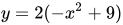 and
and 
a) Using the lower sum with three rectangles having equal width , approximate the area.
b) Using the upper sum with three rectangles having equal width, approximate the area.
c) Find the actual area of the region.
| Foundations:
|
| Link to Riemann sums page
|
Solution:
(a)
| Step 1:
|
| We need to set these two equations equal in order to find the intersection points of these functions.
|
So, we let  . Solving for . Solving for  , we get , we get  . .
|
This means that we need to calculate the Riemann sums over the interval ![{\displaystyle [-3,3]}](https://wikimedia.org/api/rest_v1/media/math/render/svg/3a869f6f7ff84a95f888c6b8705e2465ba21960e) . .
|
|
|
| Step 2:
|
Since the length of our interval is  and we are using and we are using  rectangles, rectangles,
|
each rectangle will have width  . .
|
| Thus, the lower Riemann sum is
|
 . .
|
(b)
| Step 1:
|
| As in Part (a), the length of our inteval is and
|
| each rectangle will have width . (See Step 1 and 2 for (a))
|
| Step 2:
|
| Thus, the upper Riemann sum is
|

|
(c)
| Step 1:
|
| To find the actual area of the region, we need to calculate
|

|
| Step 2:
|
| We integrate to get
|

|
| Final Answer:
|
(a) 
|
(b) 
|
(c) 
|
Return to Sample Exam