Difference between revisions of "005 Sample Final A, Question 10"
Jump to navigation
Jump to search
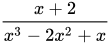
(Created page with "''' Question ''' Write the partial fraction decomposition of the following, <center> <math> \frac{x+2}{x^3-2x^2+x}</math></center> {| class="mw-collapsible mw-collapsed" sty...") |
Kayla Murray (talk | contribs) |
||
| Line 3: | Line 3: | ||
{| class="mw-collapsible mw-collapsed" style = "text-align:left;" | {| class="mw-collapsible mw-collapsed" style = "text-align:left;" | ||
| − | ! | + | ! Step 1: |
|- | |- | ||
| − | | | + | | First, we factor the denominator. We have <math>x^3-2x^2+x=x(x^2-2x+1)=x(x-1)^2</math> |
| + | |} | ||
| + | |||
| + | {| class="mw-collapsible mw-collapsed" style = "text-align:left;" | ||
| + | ! Step 2: | ||
|- | |- | ||
| − | | | + | | Since we have a repeated factor in the denominator, we set <math>\frac{x+2}{x(x-1)^2}=\frac{A}{x}+\frac{B}{x-1}+\frac{C}{(x-1)^2}</math>. |
| + | |} | ||
| + | |||
| + | {| class="mw-collapsible mw-collapsed" style = "text-align:left;" | ||
| + | ! Step 3: | ||
|- | |- | ||
| − | | | + | | Multiplying both sides of the equation by the denominator <math>x(x-1)^2</math>, we get |
|- | |- | ||
| − | | | + | | <math>x+2=A(x-1)^2+B(x)(x-1)+Cx</math>. |
| + | |} | ||
| + | |||
| + | {| class="mw-collapsible mw-collapsed" style = "text-align:left;" | ||
| + | ! Step 4: | ||
|- | |- | ||
| − | | | + | | If we let <math>x=0</math>, we get <math>2=A</math>. If we let <math>x=1</math>, we get <math>3=C</math>. |
| + | |} | ||
| + | |||
| + | {| class="mw-collapsible mw-collapsed" style = "text-align:left;" | ||
| + | ! Step 5: | ||
|- | |- | ||
| − | | | + | | To solve for <math>B</math>, we plug in <math>A=2</math> and <math>C=3</math> and simplify. We have |
| + | |- | ||
| + | |<math>x+2=2(x-1)^2+B(x)(x-1)+3x=2x^2-4x+2+Bx^2-Bx+3x. So, <math>x+2=(2+B)x^2+(-1-B)x+2</math>. Since both sides are equal, | ||
| + | |- | ||
| + | |we must have <math>2+B=0</math> and <math>-1-B=1</math>. So, <math>B=2</math>. Thus, the decomposition is <math>\frac{x+2}{x(x-1)^2}=\frac{2}{x}+\frac{2}{x-1}+\frac{3}{(x-1)^2}</math>. | ||
| + | |} | ||
| + | |||
| + | {| class="mw-collapsible mw-collapsed" style = "text-align:left;" | ||
| + | ! Final Answer: | ||
| + | |- | ||
| + | | <math>\frac{x+2}{x(x-1)^2}=\frac{2}{x}+\frac{2}{x-1}+\frac{3}{(x-1)^2}</math> | ||
|} | |} | ||
Revision as of 15:35, 19 May 2015
Question Write the partial fraction decomposition of the following,
| Step 1: |
|---|
| First, we factor the denominator. We have |

| Step 2: |
|---|
| Since we have a repeated factor in the denominator, we set Failed to parse (MathML with SVG or PNG fallback (recommended for modern browsers and accessibility tools): Invalid response ("Math extension cannot connect to Restbase.") from server "https://wikimedia.org/api/rest_v1/":): {\displaystyle \frac{x+2}{x(x-1)^2}=\frac{A}{x}+\frac{B}{x-1}+\frac{C}{(x-1)^2}} . |
| Step 3: |
|---|
| Multiplying both sides of the equation by the denominator Failed to parse (MathML with SVG or PNG fallback (recommended for modern browsers and accessibility tools): Invalid response ("Math extension cannot connect to Restbase.") from server "https://wikimedia.org/api/rest_v1/":): {\displaystyle x(x-1)^2} , we get |
| Failed to parse (MathML with SVG or PNG fallback (recommended for modern browsers and accessibility tools): Invalid response ("Math extension cannot connect to Restbase.") from server "https://wikimedia.org/api/rest_v1/":): {\displaystyle x+2=A(x-1)^2+B(x)(x-1)+Cx} . |
| Step 4: |
|---|
| If we let Failed to parse (MathML with SVG or PNG fallback (recommended for modern browsers and accessibility tools): Invalid response ("Math extension cannot connect to Restbase.") from server "https://wikimedia.org/api/rest_v1/":): {\displaystyle x=0} , we get Failed to parse (MathML with SVG or PNG fallback (recommended for modern browsers and accessibility tools): Invalid response ("Math extension cannot connect to Restbase.") from server "https://wikimedia.org/api/rest_v1/":): {\displaystyle 2=A} . If we let Failed to parse (MathML with SVG or PNG fallback (recommended for modern browsers and accessibility tools): Invalid response ("Math extension cannot connect to Restbase.") from server "https://wikimedia.org/api/rest_v1/":): {\displaystyle x=1} , we get Failed to parse (MathML with SVG or PNG fallback (recommended for modern browsers and accessibility tools): Invalid response ("Math extension cannot connect to Restbase.") from server "https://wikimedia.org/api/rest_v1/":): {\displaystyle 3=C} . |
| Step 5: |
|---|
| To solve for Failed to parse (MathML with SVG or PNG fallback (recommended for modern browsers and accessibility tools): Invalid response ("Math extension cannot connect to Restbase.") from server "https://wikimedia.org/api/rest_v1/":): {\displaystyle B} , we plug in Failed to parse (MathML with SVG or PNG fallback (recommended for modern browsers and accessibility tools): Invalid response ("Math extension cannot connect to Restbase.") from server "https://wikimedia.org/api/rest_v1/":): {\displaystyle A=2} and Failed to parse (MathML with SVG or PNG fallback (recommended for modern browsers and accessibility tools): Invalid response ("Math extension cannot connect to Restbase.") from server "https://wikimedia.org/api/rest_v1/":): {\displaystyle C=3} and simplify. We have |
| Failed to parse (MathML with SVG or PNG fallback (recommended for modern browsers and accessibility tools): Invalid response ("Math extension cannot connect to Restbase.") from server "https://wikimedia.org/api/rest_v1/":): {\displaystyle x+2=2(x-1)^2+B(x)(x-1)+3x=2x^2-4x+2+Bx^2-Bx+3x. So, <math>x+2=(2+B)x^2+(-1-B)x+2} . Since both sides are equal, |
| we must have Failed to parse (MathML with SVG or PNG fallback (recommended for modern browsers and accessibility tools): Invalid response ("Math extension cannot connect to Restbase.") from server "https://wikimedia.org/api/rest_v1/":): {\displaystyle 2+B=0} and Failed to parse (MathML with SVG or PNG fallback (recommended for modern browsers and accessibility tools): Invalid response ("Math extension cannot connect to Restbase.") from server "https://wikimedia.org/api/rest_v1/":): {\displaystyle -1-B=1} . So, Failed to parse (MathML with SVG or PNG fallback (recommended for modern browsers and accessibility tools): Invalid response ("Math extension cannot connect to Restbase.") from server "https://wikimedia.org/api/rest_v1/":): {\displaystyle B=2} . Thus, the decomposition is Failed to parse (MathML with SVG or PNG fallback (recommended for modern browsers and accessibility tools): Invalid response ("Math extension cannot connect to Restbase.") from server "https://wikimedia.org/api/rest_v1/":): {\displaystyle \frac{x+2}{x(x-1)^2}=\frac{2}{x}+\frac{2}{x-1}+\frac{3}{(x-1)^2}} . |
| Final Answer: |
|---|
| Failed to parse (MathML with SVG or PNG fallback (recommended for modern browsers and accessibility tools): Invalid response ("Math extension cannot connect to Restbase.") from server "https://wikimedia.org/api/rest_v1/":): {\displaystyle \frac{x+2}{x(x-1)^2}=\frac{2}{x}+\frac{2}{x-1}+\frac{3}{(x-1)^2}} |