Difference between revisions of "009A Sample Final 2, Problem 1"
Kayla Murray (talk | contribs) |
Kayla Murray (talk | contribs) |
||
| Line 117: | Line 117: | ||
& = & \displaystyle{\frac{-\sqrt{1+0}}{(2-0)}}\\ | & = & \displaystyle{\frac{-\sqrt{1+0}}{(2-0)}}\\ | ||
&&\\ | &&\\ | ||
| − | & = & \displaystyle{\frac{ | + | & = & \displaystyle{-\frac{1}{2}.} |
\end{array}</math> | \end{array}</math> | ||
|} | |} | ||
| Line 129: | Line 129: | ||
| '''(b)''' <math>0</math> | | '''(b)''' <math>0</math> | ||
|- | |- | ||
| − | | '''(c)''' <math>\frac{ | + | | '''(c)''' <math>-\frac{1}{2}</math> |
|} | |} | ||
[[009A_Sample_Final_2|'''<u>Return to Sample Exam</u>''']] | [[009A_Sample_Final_2|'''<u>Return to Sample Exam</u>''']] | ||
Revision as of 13:27, 18 March 2017
Compute
(a)
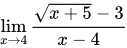
(b)

(c) Failed to parse (MathML with SVG or PNG fallback (recommended for modern browsers and accessibility tools): Invalid response ("Math extension cannot connect to Restbase.") from server "https://wikimedia.org/api/rest_v1/":): {\displaystyle \lim_{x\rightarrow -\infty} \frac{\sqrt{x^2+2}}{2x-1}}
| Foundations: |
|---|
| L'Hôpital's Rule |
| Suppose that Failed to parse (MathML with SVG or PNG fallback (recommended for modern browsers and accessibility tools): Invalid response ("Math extension cannot connect to Restbase.") from server "https://wikimedia.org/api/rest_v1/":): {\displaystyle \lim_{x\rightarrow \infty} f(x)} and Failed to parse (MathML with SVG or PNG fallback (recommended for modern browsers and accessibility tools): Invalid response ("Math extension cannot connect to Restbase.") from server "https://wikimedia.org/api/rest_v1/":): {\displaystyle \lim_{x\rightarrow \infty} g(x)} are both zero or both Failed to parse (MathML with SVG or PNG fallback (recommended for modern browsers and accessibility tools): Invalid response ("Math extension cannot connect to Restbase.") from server "https://wikimedia.org/api/rest_v1/":): {\displaystyle \pm \infty .} |
|
If Failed to parse (MathML with SVG or PNG fallback (recommended for modern browsers and accessibility tools): Invalid response ("Math extension cannot connect to Restbase.") from server "https://wikimedia.org/api/rest_v1/":): {\displaystyle \lim_{x\rightarrow \infty} \frac{f'(x)}{g'(x)}} is finite or Failed to parse (MathML with SVG or PNG fallback (recommended for modern browsers and accessibility tools): Invalid response ("Math extension cannot connect to Restbase.") from server "https://wikimedia.org/api/rest_v1/":): {\displaystyle \pm \infty ,} |
|
then Failed to parse (MathML with SVG or PNG fallback (recommended for modern browsers and accessibility tools): Invalid response ("Math extension cannot connect to Restbase.") from server "https://wikimedia.org/api/rest_v1/":): {\displaystyle \lim_{x\rightarrow \infty} \frac{f(x)}{g(x)}\,=\,\lim_{x\rightarrow \infty} \frac{f'(x)}{g'(x)}.} |
Solution:
(a)
| Step 1: |
|---|
| We begin by noticing that we plug in Failed to parse (MathML with SVG or PNG fallback (recommended for modern browsers and accessibility tools): Invalid response ("Math extension cannot connect to Restbase.") from server "https://wikimedia.org/api/rest_v1/":): {\displaystyle x=4} into |
| Failed to parse (MathML with SVG or PNG fallback (recommended for modern browsers and accessibility tools): Invalid response ("Math extension cannot connect to Restbase.") from server "https://wikimedia.org/api/rest_v1/":): {\displaystyle \frac{\sqrt{x+5}-3}{x-4},} |
| we get Failed to parse (MathML with SVG or PNG fallback (recommended for modern browsers and accessibility tools): Invalid response ("Math extension cannot connect to Restbase.") from server "https://wikimedia.org/api/rest_v1/":): {\displaystyle \frac{0}{0}.} |
| Step 2: |
|---|
| Now, we multiply the numerator and denominator by the conjugate of the numerator. |
| Hence, we have |
| Failed to parse (MathML with SVG or PNG fallback (recommended for modern browsers and accessibility tools): Invalid response ("Math extension cannot connect to Restbase.") from server "https://wikimedia.org/api/rest_v1/":): {\displaystyle \begin{array}{rcl} \displaystyle{\lim_{x\rightarrow 4} \frac{\sqrt{x+5}-3}{x-4}} & = & \displaystyle{\lim_{x\rightarrow 4} \frac{\sqrt{x+5}-3}{x-4}\frac{(\sqrt{x+5}+3)}{(\sqrt{x+5}+3)}}\\ &&\\ & = & \displaystyle{\lim_{x\rightarrow 4} \frac{(x+5)-9}{(x-4)(\sqrt{x+5}+3)}}\\ &&\\ & = & \displaystyle{\lim_{x\rightarrow 4} \frac{x-4}{(x-4)(\sqrt{x+5}+3)}}\\ &&\\ & = & \displaystyle{\lim_{x\rightarrow 4} \frac{1}{\sqrt{x+5}+3}}\\ &&\\ & = & \displaystyle{ \frac{1}{\sqrt{9}+3}}\\ &&\\ & = & \displaystyle{\frac{1}{6}.} \end{array}} |
(b)
| Step 1: |
|---|
| We proceed using L'Hôpital's Rule. So, we have |
|
Failed to parse (MathML with SVG or PNG fallback (recommended for modern browsers and accessibility tools): Invalid response ("Math extension cannot connect to Restbase.") from server "https://wikimedia.org/api/rest_v1/":): {\displaystyle \begin{array}{rcl} \displaystyle{\lim_{x\rightarrow 0} \frac{\sin^2 (x)}{3x}} & \overset{L'H}{=} & \displaystyle{\lim_{x\rightarrow 0}\frac{2\sin(x)\cos(x)}{3}.} \end{array}} |
| Step 2: |
|---|
| Now, we plug in Failed to parse (MathML with SVG or PNG fallback (recommended for modern browsers and accessibility tools): Invalid response ("Math extension cannot connect to Restbase.") from server "https://wikimedia.org/api/rest_v1/":): {\displaystyle x=0} to get |
| Failed to parse (MathML with SVG or PNG fallback (recommended for modern browsers and accessibility tools): Invalid response ("Math extension cannot connect to Restbase.") from server "https://wikimedia.org/api/rest_v1/":): {\displaystyle \begin{array}{rcl} \displaystyle{\lim_{x\rightarrow 0} \frac{\sin^2 (x)}{3x}} & = & \displaystyle{\frac{2\sin(0)\cos(0)}{3}}\\ &&\\ & = & \displaystyle{\frac{2(0)(1)}{3}}\\ &&\\ & = & \displaystyle{0.} \end{array}} |
(c)
| Step 1: |
|---|
| First, we have |
| Failed to parse (MathML with SVG or PNG fallback (recommended for modern browsers and accessibility tools): Invalid response ("Math extension cannot connect to Restbase.") from server "https://wikimedia.org/api/rest_v1/":): {\displaystyle \begin{array}{rcl} \displaystyle{\lim_{x\rightarrow -\infty} \frac{\sqrt{x^2+2}}{2x-1}} & = & \displaystyle{\lim_{x\rightarrow -\infty} \frac{\sqrt{x^2(1+\frac{2}{x^2})}}{2x-1}}\\ &&\\ & = & \displaystyle{\lim_{x\rightarrow -\infty} \frac{|x|\sqrt{1+\frac{2}{x^2}}}{2x-1}}\\ &&\\ & = & \displaystyle{\lim_{x\rightarrow -\infty} \frac{-x\sqrt{1+\frac{2}{x^2}}}{x(2-\frac{1}{x})}}\\ &&\\ & = & \displaystyle{\lim_{x\rightarrow -\infty} \frac{-1\sqrt{1+\frac{2}{x^2}}}{(2-\frac{1}{x})}.} \end{array}} |
| Step 2: |
|---|
| Now, |
| Failed to parse (MathML with SVG or PNG fallback (recommended for modern browsers and accessibility tools): Invalid response ("Math extension cannot connect to Restbase.") from server "https://wikimedia.org/api/rest_v1/":): {\displaystyle \begin{array}{rcl} \displaystyle{\lim_{x\rightarrow -\infty} \frac{\sqrt{x^2+2}}{2x-1}} & = & \displaystyle{\lim_{x\rightarrow -\infty} \frac{-1\sqrt{1+\frac{2}{x^2}}}{(2-\frac{1}{x})} }\\ &&\\ & = & \displaystyle{\frac{-\sqrt{1+0}}{(2-0)}}\\ &&\\ & = & \displaystyle{-\frac{1}{2}.} \end{array}} |
| Final Answer: |
|---|
| (a) Failed to parse (MathML with SVG or PNG fallback (recommended for modern browsers and accessibility tools): Invalid response ("Math extension cannot connect to Restbase.") from server "https://wikimedia.org/api/rest_v1/":): {\displaystyle \frac{1}{6}} |
| (b) Failed to parse (MathML with SVG or PNG fallback (recommended for modern browsers and accessibility tools): Invalid response ("Math extension cannot connect to Restbase.") from server "https://wikimedia.org/api/rest_v1/":): {\displaystyle 0} |
| (c) Failed to parse (MathML with SVG or PNG fallback (recommended for modern browsers and accessibility tools): Invalid response ("Math extension cannot connect to Restbase.") from server "https://wikimedia.org/api/rest_v1/":): {\displaystyle -\frac{1}{2}} |