Difference between revisions of "009C Sample Final 2, Problem 3"

From Grad Wiki
Jump to navigation Jump to search
Line 1: Line 1:
<span class="exam">Determine if the following series converges or diverges. Please give your reason(s).
+
<span class="exam"> Determine if the following series converges or diverges. Please give your reason(s).
  
<span class="exam">(a) &nbsp;<math>\sum_{n=1}^{\infty} \frac{n!}{(2n)!}</math>
+
<span class="exam">(a) &nbsp;<math>\sum_{n=1}^{\infty} \frac{n!}{(2n)!}</math>  
  
<span class="exam">(b) &nbsp;<math>\sum_{n=1}^{\infty} (-1)^n \frac{1}{n+1}</math>
+
<span class="exam">(b) &nbsp;<math>\sum_{n=1}^{\infty} (-1)^n\frac{1}{n+1}</math>
  
 
{| class="mw-collapsible mw-collapsed" style = "text-align:left;"
 
{| class="mw-collapsible mw-collapsed" style = "text-align:left;"
Line 48: Line 48:
 
|
 
|
 
&nbsp; &nbsp; &nbsp; &nbsp; <math>\begin{array}{rcl}
 
&nbsp; &nbsp; &nbsp; &nbsp; <math>\begin{array}{rcl}
\displaystyle{\lim_{n\rightarrow \infty}\bigg|\frac{a_{n+1}}{a_n}\bigg|} & = & \displaystyle{\lim_{n\rightarrow \infty} \bigg| \frac{(n+1)!}{(2(n+1))!} \cdot\frac{(2n)!}{n!}\bigg|}\\
+
\displaystyle{\lim_{n\rightarrow \infty}\bigg|\frac{a_{n+1}}{a_n}\bigg|} & = & \displaystyle{\lim_{n\rightarrow \infty} \bigg| \frac{(n+1)!}{(2(n+1))!} \frac{(2n)!}{n!}\bigg|}\\
 
&&\\
 
&&\\
& = & \displaystyle{\lim_{n\rightarrow \infty} \bigg| \frac{(n+1)n!}{(2n+2)(2n+1)(2n)!} \cdot \frac{(2n)!}{n!}\bigg|}\\
+
& = & \displaystyle{\lim_{n\rightarrow \infty} \bigg| \frac{(n+1)n!}{(2n+2)(2n+1)(2n)!} \frac{(2n)!}{n!}\bigg|}\\
 
&&\\
 
&&\\
 
& = & \displaystyle{\lim_{n\rightarrow \infty} \frac{n+1}{(2n+2)(2n+1)}}\\
 
& = & \displaystyle{\lim_{n\rightarrow \infty} \frac{n+1}{(2n+2)(2n+1)}}\\
Line 82: Line 82:
 
|-
 
|-
 
|Let &nbsp;<math style="vertical-align: -16px"> b_n=\frac{1}{n+1}.</math>
 
|Let &nbsp;<math style="vertical-align: -16px"> b_n=\frac{1}{n+1}.</math>
 +
|-
 +
|First, we have
 +
|-
 +
|&nbsp; &nbsp; &nbsp; &nbsp;<math>\frac{1}{n+1}\ge 0</math>
 +
|-
 +
|for all &nbsp;<math style="vertical-align: -3px">n\ge 1.</math>
 
|-
 
|-
 
|The sequence &nbsp;<math style="vertical-align: -5px">\{b_n\}</math>&nbsp; is decreasing since
 
|The sequence &nbsp;<math style="vertical-align: -5px">\{b_n\}</math>&nbsp; is decreasing since
Line 87: Line 93:
 
|&nbsp; &nbsp; &nbsp; &nbsp; <math>\frac{1}{n+2}<\frac{1}{n+1}</math>
 
|&nbsp; &nbsp; &nbsp; &nbsp; <math>\frac{1}{n+2}<\frac{1}{n+1}</math>
 
|-
 
|-
|for all &nbsp;<math style="vertical-align: -3px">n\ge 0.</math>
+
|for all &nbsp;<math style="vertical-align: -3px">n\ge 1.</math>
 
|}
 
|}
  
Line 106: Line 112:
 
!Final Answer: &nbsp;  
 
!Final Answer: &nbsp;  
 
|-
 
|-
|&nbsp;&nbsp; '''(a)''' &nbsp;&nbsp; converges
+
|&nbsp;&nbsp; '''(a)''' &nbsp;&nbsp; converges (by the Ratio Test)
 
|-
 
|-
|&nbsp;&nbsp; '''(b)''' &nbsp;&nbsp; converges
+
|&nbsp;&nbsp; '''(b)''' &nbsp;&nbsp; converges (by the Alternating Series Test)
 
|}
 
|}
 
[[009C_Sample_Final_2|'''<u>Return to Sample Exam</u>''']]
 
[[009C_Sample_Final_2|'''<u>Return to Sample Exam</u>''']]

Revision as of 11:16, 17 March 2017

Determine if the following series converges or diverges. Please give your reason(s).

(a)  

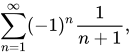
(b)  Failed to parse (MathML with SVG or PNG fallback (recommended for modern browsers and accessibility tools): Invalid response ("Math extension cannot connect to Restbase.") from server "https://wikimedia.org/api/rest_v1/":): {\displaystyle \sum_{n=1}^{\infty} (-1)^n\frac{1}{n+1}}

Foundations:  
1. Ratio Test
        Let  Failed to parse (MathML with SVG or PNG fallback (recommended for modern browsers and accessibility tools): Invalid response ("Math extension cannot connect to Restbase.") from server "https://wikimedia.org/api/rest_v1/":): {\displaystyle \sum a_n}   be a series and  Failed to parse (MathML with SVG or PNG fallback (recommended for modern browsers and accessibility tools): Invalid response ("Math extension cannot connect to Restbase.") from server "https://wikimedia.org/api/rest_v1/":): {\displaystyle L=\lim_{n\rightarrow \infty}\bigg|\frac{a_{n+1}}{a_n}\bigg|.}
        Then,

        If  Failed to parse (MathML with SVG or PNG fallback (recommended for modern browsers and accessibility tools): Invalid response ("Math extension cannot connect to Restbase.") from server "https://wikimedia.org/api/rest_v1/":): {\displaystyle L<1,}   the series is absolutely convergent.

        If  Failed to parse (MathML with SVG or PNG fallback (recommended for modern browsers and accessibility tools): Invalid response ("Math extension cannot connect to Restbase.") from server "https://wikimedia.org/api/rest_v1/":): {\displaystyle L>1,}   the series is divergent.

        If  Failed to parse (MathML with SVG or PNG fallback (recommended for modern browsers and accessibility tools): Invalid response ("Math extension cannot connect to Restbase.") from server "https://wikimedia.org/api/rest_v1/":): {\displaystyle L=1,}   the test is inconclusive.

2. If a series absolutely converges, then it also converges.
3. Alternating Series Test
        Let  Failed to parse (MathML with SVG or PNG fallback (recommended for modern browsers and accessibility tools): Invalid response ("Math extension cannot connect to Restbase.") from server "https://wikimedia.org/api/rest_v1/":): {\displaystyle \{a_n\}}   be a positive, decreasing sequence where  Failed to parse (MathML with SVG or PNG fallback (recommended for modern browsers and accessibility tools): Invalid response ("Math extension cannot connect to Restbase.") from server "https://wikimedia.org/api/rest_v1/":): {\displaystyle \lim_{n\rightarrow \infty} a_n=0.}
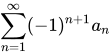
        Then,  Failed to parse (MathML with SVG or PNG fallback (recommended for modern browsers and accessibility tools): Invalid response ("Math extension cannot connect to Restbase.") from server "https://wikimedia.org/api/rest_v1/":): {\displaystyle \sum_{n=1}^\infty (-1)^na_n}   and  Failed to parse (MathML with SVG or PNG fallback (recommended for modern browsers and accessibility tools): Invalid response ("Math extension cannot connect to Restbase.") from server "https://wikimedia.org/api/rest_v1/":): {\displaystyle \sum_{n=1}^\infty (-1)^{n+1}a_n}
        converge.


Solution:

(a)

Step 1:  
We begin by using the Ratio Test.
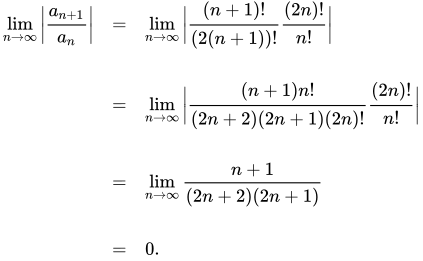
We have

        Failed to parse (MathML with SVG or PNG fallback (recommended for modern browsers and accessibility tools): Invalid response ("Math extension cannot connect to Restbase.") from server "https://wikimedia.org/api/rest_v1/":): {\displaystyle \begin{array}{rcl} \displaystyle{\lim_{n\rightarrow \infty}\bigg|\frac{a_{n+1}}{a_n}\bigg|} & = & \displaystyle{\lim_{n\rightarrow \infty} \bigg| \frac{(n+1)!}{(2(n+1))!} \frac{(2n)!}{n!}\bigg|}\\ &&\\ & = & \displaystyle{\lim_{n\rightarrow \infty} \bigg| \frac{(n+1)n!}{(2n+2)(2n+1)(2n)!} \frac{(2n)!}{n!}\bigg|}\\ &&\\ & = & \displaystyle{\lim_{n\rightarrow \infty} \frac{n+1}{(2n+2)(2n+1)}}\\ &&\\ & = & \displaystyle{0.} \end{array}}

Step 2:  
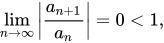
Since
        Failed to parse (MathML with SVG or PNG fallback (recommended for modern browsers and accessibility tools): Invalid response ("Math extension cannot connect to Restbase.") from server "https://wikimedia.org/api/rest_v1/":): {\displaystyle \lim_{n\rightarrow \infty} \bigg|\frac{a_{n+1}}{a_n}\bigg|=0<1,}
the series is absolutely convergent by the Ratio Test.
Therefore, the series converges.

(b)

Step 1:  
For
        Failed to parse (MathML with SVG or PNG fallback (recommended for modern browsers and accessibility tools): Invalid response ("Math extension cannot connect to Restbase.") from server "https://wikimedia.org/api/rest_v1/":): {\displaystyle \sum_{n=1}^\infty (-1)^n\frac{1}{n+1},}
we notice that this series is alternating.
Let  Failed to parse (MathML with SVG or PNG fallback (recommended for modern browsers and accessibility tools): Invalid response ("Math extension cannot connect to Restbase.") from server "https://wikimedia.org/api/rest_v1/":): {\displaystyle b_n=\frac{1}{n+1}.}
First, we have
       Failed to parse (MathML with SVG or PNG fallback (recommended for modern browsers and accessibility tools): Invalid response ("Math extension cannot connect to Restbase.") from server "https://wikimedia.org/api/rest_v1/":): {\displaystyle \frac{1}{n+1}\ge 0}
for all  Failed to parse (MathML with SVG or PNG fallback (recommended for modern browsers and accessibility tools): Invalid response ("Math extension cannot connect to Restbase.") from server "https://wikimedia.org/api/rest_v1/":): {\displaystyle n\ge 1.}
The sequence  Failed to parse (MathML with SVG or PNG fallback (recommended for modern browsers and accessibility tools): Invalid response ("Math extension cannot connect to Restbase.") from server "https://wikimedia.org/api/rest_v1/":): {\displaystyle \{b_n\}}   is decreasing since
        Failed to parse (MathML with SVG or PNG fallback (recommended for modern browsers and accessibility tools): Invalid response ("Math extension cannot connect to Restbase.") from server "https://wikimedia.org/api/rest_v1/":): {\displaystyle \frac{1}{n+2}<\frac{1}{n+1}}
for all  Failed to parse (MathML with SVG or PNG fallback (recommended for modern browsers and accessibility tools): Invalid response ("Math extension cannot connect to Restbase.") from server "https://wikimedia.org/api/rest_v1/":): {\displaystyle n\ge 1.}
Step 2:  
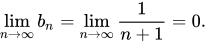
Also,
        Failed to parse (MathML with SVG or PNG fallback (recommended for modern browsers and accessibility tools): Invalid response ("Math extension cannot connect to Restbase.") from server "https://wikimedia.org/api/rest_v1/":): {\displaystyle \lim_{n\rightarrow \infty}b_n=\lim_{n\rightarrow \infty}\frac{1}{n+1}=0.}
Therefore, the series  Failed to parse (MathML with SVG or PNG fallback (recommended for modern browsers and accessibility tools): Invalid response ("Math extension cannot connect to Restbase.") from server "https://wikimedia.org/api/rest_v1/":): {\displaystyle \sum_{n=1}^\infty (-1)^n\frac{1}{n+1}}   converges
by the Alternating Series Test.


Final Answer:  
   (a)    converges (by the Ratio Test)
   (b)    converges (by the Alternating Series Test)

Return to Sample Exam