Difference between revisions of "009A Sample Final 2, Problem 8"
Kayla Murray (talk | contribs) |
Kayla Murray (talk | contribs) |
||
| Line 10: | Line 10: | ||
!Foundations: | !Foundations: | ||
|- | |- | ||
| − | | | + | |<span class="exam">In each part, compute the limit. If the limit is infinite, be sure to specify positive or negative infinity. |
| − | + | ||
| − | + | <span class="exam">(a) <math style="vertical-align: -14px">\lim_{x\rightarrow -3} \frac{x^3-9x}{6+2x}</math> | |
| − | + | ||
| − | + | <span class="exam">(b) <math style="vertical-align: -14px">\lim_{x\rightarrow 0^+} \frac{\sin (2x)}{x^2}</math> | |
| − | + | ||
| − | + | <span class="exam">(c) <math style="vertical-align: -14px">\lim_{x\rightarrow -\infty} \frac{3x}{\sqrt{4x^2+x+5}}</math> | |
|} | |} | ||
Revision as of 20:42, 7 March 2017
Compute
(a)
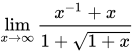
(b) Failed to parse (MathML with SVG or PNG fallback (recommended for modern browsers and accessibility tools): Invalid response ("Math extension cannot connect to Restbase.") from server "https://wikimedia.org/api/rest_v1/":): {\displaystyle \lim_{x\rightarrow 0} \frac{\sin x}{\cos x-1}}
(c) Failed to parse (MathML with SVG or PNG fallback (recommended for modern browsers and accessibility tools): Invalid response ("Math extension cannot connect to Restbase.") from server "https://wikimedia.org/api/rest_v1/":): {\displaystyle \lim_{x\rightarrow 1} \frac{x^3-1}{x^{10}-1}}
| Foundations: |
|---|
| In each part, compute the limit. If the limit is infinite, be sure to specify positive or negative infinity.
(a) Failed to parse (MathML with SVG or PNG fallback (recommended for modern browsers and accessibility tools): Invalid response ("Math extension cannot connect to Restbase.") from server "https://wikimedia.org/api/rest_v1/":): {\displaystyle \lim_{x\rightarrow -3} \frac{x^3-9x}{6+2x}} (b) Failed to parse (MathML with SVG or PNG fallback (recommended for modern browsers and accessibility tools): Invalid response ("Math extension cannot connect to Restbase.") from server "https://wikimedia.org/api/rest_v1/":): {\displaystyle \lim_{x\rightarrow 0^+} \frac{\sin (2x)}{x^2}} (c) Failed to parse (MathML with SVG or PNG fallback (recommended for modern browsers and accessibility tools): Invalid response ("Math extension cannot connect to Restbase.") from server "https://wikimedia.org/api/rest_v1/":): {\displaystyle \lim_{x\rightarrow -\infty} \frac{3x}{\sqrt{4x^2+x+5}}} |
Solution:
(a)
| Step 1: |
|---|
| Step 2: |
|---|
(b)
| Step 1: |
|---|
| Step 2: |
|---|
(c)
| Step 1: |
|---|
| Step 2: |
|---|
| Final Answer: |
|---|
| (a) |
| (b) |
| (c) |