Difference between revisions of "009B Sample Final 2, Problem 2"

From Grad Wiki
Jump to navigation Jump to search
Line 49: Line 49:
 
|which correspond to the interval &nbsp;<math>[-2,0]</math>&nbsp; and &nbsp;<math>[0,2].</math>
 
|which correspond to the interval &nbsp;<math>[-2,0]</math>&nbsp; and &nbsp;<math>[0,2].</math>
 
|-
 
|-
|Now, in each of the regions we need to determine which curve has the higher <math>y</math> value.  
+
|Now, in each of the regions we need to determine which curve has the higher &nbsp;<math>y</math>&nbsp; value.  
 
|-
 
|-
 
|To figure this out, we use test points in each interval.
 
|To figure this out, we use test points in each interval.
 
|-
 
|-
|For <math>x=-1,</math> we have
+
|For &nbsp;<math>x=-1,</math>&nbsp; we have
 
|-
 
|-
|&nbsp; &nbsp; &nbsp; &nbsp; <math> y=3(-1)-(-1)^2=-4</math>&nbsp; and &nbsp;<math>y=2(-1)^3-(-1)^2-5(-1)=2.</math>  
+
|&nbsp;<math> y=3(-1)-(-1)^2=-4</math>&nbsp; and &nbsp;<math>y=2(-1)^3-(-1)^2-5(-1)=2.</math>  
 
|-
 
|-
|For <math>x=1,</math> we have
+
|For &nbsp;<math>x=1,</math>&nbsp; we have
 
|-
 
|-
|&nbsp; &nbsp; &nbsp; &nbsp; <math> y=3(1)-(1)^2=2</math>&nbsp; and &nbsp;<math>y=2(1)^3-(1)^2-5(1)=-4.</math>
+
|&nbsp;<math> y=3(1)-(1)^2=2</math>&nbsp; and &nbsp;<math>y=2(1)^3-(1)^2-5(1)=-4.</math>
 
|-
 
|-
|Hence, the area <math>A</math> of the region bounded by these two curves is given by
+
|Hence, the area &nbsp;<math>A</math>&nbsp; of the region bounded by these two curves is given by
 
|-
 
|-
 
|&nbsp; &nbsp; &nbsp; &nbsp;<math>A=\int_{-2}^0 (2x^3-x^2-5x)-(3x-x^2)~dx+\int_0^2 (3x-x^2)-(2x^3-x^2-5x)~dx.</math>  
 
|&nbsp; &nbsp; &nbsp; &nbsp;<math>A=\int_{-2}^0 (2x^3-x^2-5x)-(3x-x^2)~dx+\int_0^2 (3x-x^2)-(2x^3-x^2-5x)~dx.</math>  

Revision as of 14:59, 4 March 2017

Find the area of the region between the two curves    and  

Foundations:  
1. You can find the intersection points of two functions, say  

       by setting    and solving for  

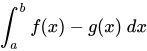
2. The area between two functions,    and    is given by  

       for    where    is the upper function and    is the lower function.


Solution:

Step 1:  
First, we need to find the intersection points of these two curves.
To do this, we set
       
Getting all the terms on one side of the equation, we get
       
Therefore, we get that these two curves intersect at  
Hence, the region we are interested in occurs between    and  
Step 2:  
Since the curves intersect also intersect at    this breaks our region up into two parts,
which correspond to the interval    and  Failed to parse (MathML with SVG or PNG fallback (recommended for modern browsers and accessibility tools): Invalid response ("Math extension cannot connect to Restbase.") from server "https://wikimedia.org/api/rest_v1/":): {\displaystyle [0,2].}
Now, in each of the regions we need to determine which curve has the higher  Failed to parse (MathML with SVG or PNG fallback (recommended for modern browsers and accessibility tools): Invalid response ("Math extension cannot connect to Restbase.") from server "https://wikimedia.org/api/rest_v1/":): {\displaystyle y}   value.
To figure this out, we use test points in each interval.
For  Failed to parse (MathML with SVG or PNG fallback (recommended for modern browsers and accessibility tools): Invalid response ("Math extension cannot connect to Restbase.") from server "https://wikimedia.org/api/rest_v1/":): {\displaystyle x=-1,}   we have
 Failed to parse (MathML with SVG or PNG fallback (recommended for modern browsers and accessibility tools): Invalid response ("Math extension cannot connect to Restbase.") from server "https://wikimedia.org/api/rest_v1/":): {\displaystyle y=3(-1)-(-1)^2=-4}   and  Failed to parse (MathML with SVG or PNG fallback (recommended for modern browsers and accessibility tools): Invalid response ("Math extension cannot connect to Restbase.") from server "https://wikimedia.org/api/rest_v1/":): {\displaystyle y=2(-1)^3-(-1)^2-5(-1)=2.}
For  Failed to parse (MathML with SVG or PNG fallback (recommended for modern browsers and accessibility tools): Invalid response ("Math extension cannot connect to Restbase.") from server "https://wikimedia.org/api/rest_v1/":): {\displaystyle x=1,}   we have
 Failed to parse (MathML with SVG or PNG fallback (recommended for modern browsers and accessibility tools): Invalid response ("Math extension cannot connect to Restbase.") from server "https://wikimedia.org/api/rest_v1/":): {\displaystyle y=3(1)-(1)^2=2}   and  Failed to parse (MathML with SVG or PNG fallback (recommended for modern browsers and accessibility tools): Invalid response ("Math extension cannot connect to Restbase.") from server "https://wikimedia.org/api/rest_v1/":): {\displaystyle y=2(1)^3-(1)^2-5(1)=-4.}
Hence, the area  Failed to parse (MathML with SVG or PNG fallback (recommended for modern browsers and accessibility tools): Invalid response ("Math extension cannot connect to Restbase.") from server "https://wikimedia.org/api/rest_v1/":): {\displaystyle A}   of the region bounded by these two curves is given by
       Failed to parse (MathML with SVG or PNG fallback (recommended for modern browsers and accessibility tools): Invalid response ("Math extension cannot connect to Restbase.") from server "https://wikimedia.org/api/rest_v1/":): {\displaystyle A=\int_{-2}^0 (2x^3-x^2-5x)-(3x-x^2)~dx+\int_0^2 (3x-x^2)-(2x^3-x^2-5x)~dx.}
Step 3:  
Now, we integrate to get
        Failed to parse (MathML with SVG or PNG fallback (recommended for modern browsers and accessibility tools): Invalid response ("Math extension cannot connect to Restbase.") from server "https://wikimedia.org/api/rest_v1/":): {\displaystyle \begin{array}{rcl} \displaystyle{A} & = & \displaystyle{\int_{-2}^0 (2x^3-8x)~dx+\int_0^2 (-2x^3+8x)~dx}\\ &&\\ & = & \displaystyle{\bigg(\frac{x^4}{2}-4x^2\bigg)\bigg|_{-2}^0+\bigg(\frac{-x^4}{2}+4x^2\bigg)\bigg|_0^2}\\ &&\\ & = & \displaystyle{0-\bigg(\frac{(-2)^4}{2}-4(-2)^2\bigg)+\bigg(\frac{-2^4}{2}+4(2)^2\bigg)-0}\\ &&\\ & = & \displaystyle{-(8-16)+(-8+16)}\\ &&\\ & = & \displaystyle{16.} \end{array}}


Final Answer:  
       Failed to parse (MathML with SVG or PNG fallback (recommended for modern browsers and accessibility tools): Invalid response ("Math extension cannot connect to Restbase.") from server "https://wikimedia.org/api/rest_v1/":): {\displaystyle 16}

Return to Sample Exam