Difference between revisions of "009B Sample Final 2, Problem 1"
Jump to navigation
Jump to search
Kayla Murray (talk | contribs) |
Kayla Murray (talk | contribs) |
||
| Line 11: | Line 11: | ||
{| class="mw-collapsible mw-collapsed" style = "text-align:left;" | {| class="mw-collapsible mw-collapsed" style = "text-align:left;" | ||
!Foundations: | !Foundations: | ||
| + | |- | ||
| + | |'''1.''' What does Part 2 of the Fundamental Theorem of Calculus say about <math style="vertical-align: -15px">\int_a^b\sec^2x~dx</math> where <math style="vertical-align: -5px">a,b</math> are constants? | ||
|- | |- | ||
| | | | ||
| + | Part 2 of the Fundamental Theorem of Calculus says that | ||
| + | |- | ||
| + | | <math style="vertical-align: -15px">\int_a^b\sec^2x~dx=F(b)-F(a)</math> where <math style="vertical-align: 0px">F</math> is any antiderivative of <math style="vertical-align: 0px">\sec^2x.</math> | ||
|- | |- | ||
| − | | | + | |'''2.''' What does Part 1 of the Fundamental Theorem of Calculus say about <math style="vertical-align: -15px">\frac{d}{dx}\int_0^x\sin(t)~dt?</math> |
|- | |- | ||
| | | | ||
| + | Part 1 of the Fundamental Theorem of Calculus says that | ||
|- | |- | ||
| − | | | + | | <math style="vertical-align: -15px">\frac{d}{dx}\int_0^x\sin(t)~dt=\sin(x).</math> |
|} | |} | ||
Revision as of 15:37, 4 March 2017
(a) State both parts of the Fundamental Theorem of Calculus.
(b) Evaluate the integral

(c) Compute
- Failed to parse (MathML with SVG or PNG fallback (recommended for modern browsers and accessibility tools): Invalid response ("Math extension cannot connect to Restbase.") from server "https://wikimedia.org/api/rest_v1/":): {\displaystyle \frac{d}{dx}\int_1^{\frac{1}{x}} \sin t~dt}
| Foundations: |
|---|
| 1. What does Part 2 of the Fundamental Theorem of Calculus say about Failed to parse (MathML with SVG or PNG fallback (recommended for modern browsers and accessibility tools): Invalid response ("Math extension cannot connect to Restbase.") from server "https://wikimedia.org/api/rest_v1/":): {\displaystyle \int_a^b\sec^2x~dx} where Failed to parse (MathML with SVG or PNG fallback (recommended for modern browsers and accessibility tools): Invalid response ("Math extension cannot connect to Restbase.") from server "https://wikimedia.org/api/rest_v1/":): {\displaystyle a,b} are constants? |
|
Part 2 of the Fundamental Theorem of Calculus says that |
| Failed to parse (MathML with SVG or PNG fallback (recommended for modern browsers and accessibility tools): Invalid response ("Math extension cannot connect to Restbase.") from server "https://wikimedia.org/api/rest_v1/":): {\displaystyle \int_a^b\sec^2x~dx=F(b)-F(a)} where Failed to parse (MathML with SVG or PNG fallback (recommended for modern browsers and accessibility tools): Invalid response ("Math extension cannot connect to Restbase.") from server "https://wikimedia.org/api/rest_v1/":): {\displaystyle F} is any antiderivative of Failed to parse (MathML with SVG or PNG fallback (recommended for modern browsers and accessibility tools): Invalid response ("Math extension cannot connect to Restbase.") from server "https://wikimedia.org/api/rest_v1/":): {\displaystyle \sec^2x.} |
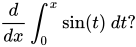
| 2. What does Part 1 of the Fundamental Theorem of Calculus say about |
|
Part 1 of the Fundamental Theorem of Calculus says that |
| Failed to parse (MathML with SVG or PNG fallback (recommended for modern browsers and accessibility tools): Invalid response ("Math extension cannot connect to Restbase.") from server "https://wikimedia.org/api/rest_v1/":): {\displaystyle \frac{d}{dx}\int_0^x\sin(t)~dt=\sin(x).} |
Solution:
(a)
| Step 1: |
|---|
| The Fundamental Theorem of Calculus has two parts. |
| The Fundamental Theorem of Calculus, Part 1 |
| Let Failed to parse (MathML with SVG or PNG fallback (recommended for modern browsers and accessibility tools): Invalid response ("Math extension cannot connect to Restbase.") from server "https://wikimedia.org/api/rest_v1/":): {\displaystyle f} be continuous on Failed to parse (MathML with SVG or PNG fallback (recommended for modern browsers and accessibility tools): Invalid response ("Math extension cannot connect to Restbase.") from server "https://wikimedia.org/api/rest_v1/":): {\displaystyle [a,b]} and let Failed to parse (MathML with SVG or PNG fallback (recommended for modern browsers and accessibility tools): Invalid response ("Math extension cannot connect to Restbase.") from server "https://wikimedia.org/api/rest_v1/":): {\displaystyle F(x)=\int_a^x f(t)~dt.} |
| Then, Failed to parse (MathML with SVG or PNG fallback (recommended for modern browsers and accessibility tools): Invalid response ("Math extension cannot connect to Restbase.") from server "https://wikimedia.org/api/rest_v1/":): {\displaystyle F} is a differentiable function on Failed to parse (MathML with SVG or PNG fallback (recommended for modern browsers and accessibility tools): Invalid response ("Math extension cannot connect to Restbase.") from server "https://wikimedia.org/api/rest_v1/":): {\displaystyle (a,b)} and Failed to parse (MathML with SVG or PNG fallback (recommended for modern browsers and accessibility tools): Invalid response ("Math extension cannot connect to Restbase.") from server "https://wikimedia.org/api/rest_v1/":): {\displaystyle F'(x)=f(x).} |
| Step 2: |
|---|
| The Fundamental Theorem of Calculus, Part 2 |
| Let Failed to parse (MathML with SVG or PNG fallback (recommended for modern browsers and accessibility tools): Invalid response ("Math extension cannot connect to Restbase.") from server "https://wikimedia.org/api/rest_v1/":): {\displaystyle f} be continuous on Failed to parse (MathML with SVG or PNG fallback (recommended for modern browsers and accessibility tools): Invalid response ("Math extension cannot connect to Restbase.") from server "https://wikimedia.org/api/rest_v1/":): {\displaystyle [a,b]} and let Failed to parse (MathML with SVG or PNG fallback (recommended for modern browsers and accessibility tools): Invalid response ("Math extension cannot connect to Restbase.") from server "https://wikimedia.org/api/rest_v1/":): {\displaystyle F} be any antiderivative of Failed to parse (MathML with SVG or PNG fallback (recommended for modern browsers and accessibility tools): Invalid response ("Math extension cannot connect to Restbase.") from server "https://wikimedia.org/api/rest_v1/":): {\displaystyle f.} |
| Then, Failed to parse (MathML with SVG or PNG fallback (recommended for modern browsers and accessibility tools): Invalid response ("Math extension cannot connect to Restbase.") from server "https://wikimedia.org/api/rest_v1/":): {\displaystyle \int_a^b f(x)~dx=F(b)-F(a).} |
(b)
| Step 1: |
|---|
| The Fundamental Theorem of Calculus Part 2 says that |
| Failed to parse (MathML with SVG or PNG fallback (recommended for modern browsers and accessibility tools): Invalid response ("Math extension cannot connect to Restbase.") from server "https://wikimedia.org/api/rest_v1/":): {\displaystyle \int_0^1 \frac{d}{dx}(e^{\arctan(x)})~dx=F(1)-F(0)} |
| where Failed to parse (MathML with SVG or PNG fallback (recommended for modern browsers and accessibility tools): Invalid response ("Math extension cannot connect to Restbase.") from server "https://wikimedia.org/api/rest_v1/":): {\displaystyle F(x)} is any antiderivative of Failed to parse (MathML with SVG or PNG fallback (recommended for modern browsers and accessibility tools): Invalid response ("Math extension cannot connect to Restbase.") from server "https://wikimedia.org/api/rest_v1/":): {\displaystyle \frac{d}{dx}(e^{\arctan(x)}).} |
| Thus, we can take |
| Failed to parse (MathML with SVG or PNG fallback (recommended for modern browsers and accessibility tools): Invalid response ("Math extension cannot connect to Restbase.") from server "https://wikimedia.org/api/rest_v1/":): {\displaystyle F(x)=e^{\arctan(x)}} |
| since then Failed to parse (MathML with SVG or PNG fallback (recommended for modern browsers and accessibility tools): Invalid response ("Math extension cannot connect to Restbase.") from server "https://wikimedia.org/api/rest_v1/":): {\displaystyle F'(x)=\frac{d}{dx}(e^{\arctan(x)}).} |
| Step 2: |
|---|
| Now, we have |
| Failed to parse (MathML with SVG or PNG fallback (recommended for modern browsers and accessibility tools): Invalid response ("Math extension cannot connect to Restbase.") from server "https://wikimedia.org/api/rest_v1/":): {\displaystyle \begin{array}{rcl} \displaystyle{\int_0^1 \frac{d}{dx}(e^{\arctan(x)})~dx} & = & \displaystyle{F(1)-F(0)}\\ &&\\ & = & \displaystyle{e^{\arctan(1}-e^{\arctan(0)}}\\ &&\\ & = & \displaystyle{e^{\frac{\pi}{4}}-e^0}\\ &&\\ & = & \displaystyle{e^{\frac{\pi}{4}}-1.} \end{array}} |
(c)
| Step 1: |
|---|
| Using the Fundamental Theorem of Calculus Part 1 and the Chain Rule, we have |
| Failed to parse (MathML with SVG or PNG fallback (recommended for modern browsers and accessibility tools): Invalid response ("Math extension cannot connect to Restbase.") from server "https://wikimedia.org/api/rest_v1/":): {\displaystyle \frac{d}{dx}\int_1^{\frac{1}{x}} \sin t~dt=\sin\bigg(\frac{1}{x}\bigg)\frac{d}{dx}\bigg(\frac{1}{x}\bigg).} |
| Step 2: |
|---|
| Hence, we have |
| Failed to parse (MathML with SVG or PNG fallback (recommended for modern browsers and accessibility tools): Invalid response ("Math extension cannot connect to Restbase.") from server "https://wikimedia.org/api/rest_v1/":): {\displaystyle \frac{d}{dx}\int_1^{\frac{1}{x}} \sin t~dt=\sin\bigg(\frac{1}{x}\bigg)\bigg(-\frac{1}{x^2}\bigg).} |
| Final Answer: |
|---|
| (a) See above |
| (b) Failed to parse (MathML with SVG or PNG fallback (recommended for modern browsers and accessibility tools): Invalid response ("Math extension cannot connect to Restbase.") from server "https://wikimedia.org/api/rest_v1/":): {\displaystyle e^{\frac{\pi}{4}}-1} |
| (c) Failed to parse (MathML with SVG or PNG fallback (recommended for modern browsers and accessibility tools): Invalid response ("Math extension cannot connect to Restbase.") from server "https://wikimedia.org/api/rest_v1/":): {\displaystyle \sin\bigg(\frac{1}{x}\bigg)\bigg(-\frac{1}{x^2}\bigg)} |