Difference between revisions of "009C Sample Midterm 2, Problem 1"

From Grad Wiki
Jump to navigation Jump to search
Line 1: Line 1:
 
<span class="exam">Evaluate:
 
<span class="exam">Evaluate:
  
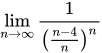
<span class="exam">(a) <math>\lim _{n\rightarrow \infty} \frac{1}{\big(\frac{n-4}{n}\big)^n}</math>
+
<span class="exam">(a) &nbsp;<math>\lim _{n\rightarrow \infty} \frac{1}{\big(\frac{n-4}{n}\big)^n}</math>
  
<span class="exam">(b) <math>\sum_{n=1}^\infty \frac{1}{2} \bigg(\frac{1}{4}\bigg)^{n-1} </math>
+
<span class="exam">(b) &nbsp;<math>\sum_{n=1}^\infty \frac{1}{2} \bigg(\frac{1}{4}\bigg)^{n-1} </math>
  
  
Line 12: Line 12:
 
|-
 
|-
 
|
 
|
&nbsp; &nbsp; &nbsp; &nbsp; Suppose that <math style="vertical-align: -11px">\lim_{x\rightarrow \infty} f(x)</math>&thinsp; and <math style="vertical-align: -11px">\lim_{x\rightarrow \infty} g(x)</math>&thinsp; are both zero or both <math style="vertical-align: -1px">\pm \infty .</math>
+
&nbsp; &nbsp; &nbsp; &nbsp; Suppose that &nbsp;<math style="vertical-align: -11px">\lim_{x\rightarrow \infty} f(x)</math>&nbsp; and &nbsp;<math style="vertical-align: -11px">\lim_{x\rightarrow \infty} g(x)</math>&nbsp; are both zero or both &nbsp;<math style="vertical-align: -1px">\pm \infty .</math>
 
|-
 
|-
 
|
 
|
&nbsp; &nbsp; &nbsp; &nbsp; If <math style="vertical-align: -19px">\lim_{x\rightarrow \infty} \frac{f'(x)}{g'(x)}</math>&thinsp; is finite or&thinsp; <math style="vertical-align: -4px">\pm \infty ,</math>
+
&nbsp; &nbsp; &nbsp; &nbsp; If &nbsp;<math style="vertical-align: -19px">\lim_{x\rightarrow \infty} \frac{f'(x)}{g'(x)}</math>&nbsp; is finite or &nbsp;<math style="vertical-align: -4px">\pm \infty ,</math>
 
|-
 
|-
 
|
 
|
&nbsp; &nbsp; &nbsp; &nbsp; then <math style="vertical-align: -19px">\lim_{x\rightarrow \infty} \frac{f(x)}{g(x)}\,=\,\lim_{x\rightarrow \infty} \frac{f'(x)}{g'(x)}.</math>
+
&nbsp; &nbsp; &nbsp; &nbsp; then &nbsp;<math style="vertical-align: -19px">\lim_{x\rightarrow \infty} \frac{f(x)}{g(x)}\,=\,\lim_{x\rightarrow \infty} \frac{f'(x)}{g'(x)}.</math>
 
|-
 
|-
 
|'''2.''' The sum of a convergent geometric series is &nbsp; <math>\frac{a}{1-r}</math>
 
|'''2.''' The sum of a convergent geometric series is &nbsp; <math>\frac{a}{1-r}</math>
 
|-
 
|-
|&nbsp; &nbsp; &nbsp; &nbsp; where <math style="vertical-align: 0px">r</math> is the ratio of the geometric series  
+
|&nbsp; &nbsp; &nbsp; &nbsp; where &nbsp;<math style="vertical-align: 0px">r</math>&nbsp; is the ratio of the geometric series  
 
|-
 
|-
|&nbsp; &nbsp; &nbsp; &nbsp; and <math style="vertical-align: 0px">a</math> is the first term of the series.
+
|&nbsp; &nbsp; &nbsp; &nbsp; and &nbsp;<math style="vertical-align: 0px">a</math>&nbsp; is the first term of the series.
 
|}
 
|}
  
Line 62: Line 62:
 
\end{array}</math>
 
\end{array}</math>
 
|-
 
|-
|Now, this limit has the form <math style="vertical-align: -13px">\frac{0}{0}.</math>
+
|Now, this limit has the form &nbsp;<math style="vertical-align: -13px">\frac{0}{0}.</math>
 
|-
 
|-
 
|Hence, we can use L'Hopital's Rule to calculate this limit.
 
|Hence, we can use L'Hopital's Rule to calculate this limit.
Line 89: Line 89:
 
!Step 4: &nbsp;
 
!Step 4: &nbsp;
 
|-
 
|-
|Since <math>\ln y= -4,</math> we know
+
|Since &nbsp;<math>\ln y= -4,</math> we know
 
|-
 
|-
 
|&nbsp; &nbsp; &nbsp; &nbsp; <math>y=e^{-4}.</math>
 
|&nbsp; &nbsp; &nbsp; &nbsp; <math>y=e^{-4}.</math>
Line 109: Line 109:
 
!Step 1: &nbsp;  
 
!Step 1: &nbsp;  
 
|-
 
|-
|First, we not that this is a geometric series with <math style="vertical-align: -14px">r=\frac{1}{4}.</math>
+
|First, we not that this is a geometric series with &nbsp;<math style="vertical-align: -14px">r=\frac{1}{4}.</math>
 
|-
 
|-
|Since <math style="vertical-align: -14px">|r|=\frac{1}{4}<1,</math>
+
|Since &nbsp;<math style="vertical-align: -14px">|r|=\frac{1}{4}<1,</math>
 
|-
 
|-
 
|this series converges.
 
|this series converges.
Line 121: Line 121:
 
|Now, we need to find the sum of this series.  
 
|Now, we need to find the sum of this series.  
 
|-
 
|-
|The first term of the series is <math style="vertical-align: -13px">a_1=\frac{1}{2}.</math>
+
|The first term of the series is &nbsp;<math style="vertical-align: -13px">a_1=\frac{1}{2}.</math>
 
|-
 
|-
 
|Hence, the sum of the series is  
 
|Hence, the sum of the series is  

Revision as of 18:02, 26 February 2017

Evaluate:

(a)  

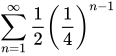
(b)  

Foundations:  
1. L'Hôpital's Rule

        Suppose that    and  Failed to parse (MathML with SVG or PNG fallback (recommended for modern browsers and accessibility tools): Invalid response ("Math extension cannot connect to Restbase.") from server "https://wikimedia.org/api/rest_v1/":): {\displaystyle \lim_{x\rightarrow \infty} g(x)}   are both zero or both  Failed to parse (MathML with SVG or PNG fallback (recommended for modern browsers and accessibility tools): Invalid response ("Math extension cannot connect to Restbase.") from server "https://wikimedia.org/api/rest_v1/":): {\displaystyle \pm \infty .}

        If  Failed to parse (MathML with SVG or PNG fallback (recommended for modern browsers and accessibility tools): Invalid response ("Math extension cannot connect to Restbase.") from server "https://wikimedia.org/api/rest_v1/":): {\displaystyle \lim_{x\rightarrow \infty} \frac{f'(x)}{g'(x)}}   is finite or  Failed to parse (MathML with SVG or PNG fallback (recommended for modern browsers and accessibility tools): Invalid response ("Math extension cannot connect to Restbase.") from server "https://wikimedia.org/api/rest_v1/":): {\displaystyle \pm \infty ,}

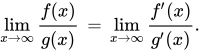
        then  Failed to parse (MathML with SVG or PNG fallback (recommended for modern browsers and accessibility tools): Invalid response ("Math extension cannot connect to Restbase.") from server "https://wikimedia.org/api/rest_v1/":): {\displaystyle \lim_{x\rightarrow \infty} \frac{f(x)}{g(x)}\,=\,\lim_{x\rightarrow \infty} \frac{f'(x)}{g'(x)}.}

2. The sum of a convergent geometric series is   Failed to parse (MathML with SVG or PNG fallback (recommended for modern browsers and accessibility tools): Invalid response ("Math extension cannot connect to Restbase.") from server "https://wikimedia.org/api/rest_v1/":): {\displaystyle \frac{a}{1-r}}
        where  Failed to parse (MathML with SVG or PNG fallback (recommended for modern browsers and accessibility tools): Invalid response ("Math extension cannot connect to Restbase.") from server "https://wikimedia.org/api/rest_v1/":): {\displaystyle r}   is the ratio of the geometric series
        and  Failed to parse (MathML with SVG or PNG fallback (recommended for modern browsers and accessibility tools): Invalid response ("Math extension cannot connect to Restbase.") from server "https://wikimedia.org/api/rest_v1/":): {\displaystyle a}   is the first term of the series.


Solution:

(a)

Step 1:  
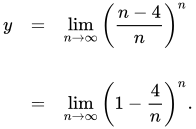
Let

        Failed to parse (MathML with SVG or PNG fallback (recommended for modern browsers and accessibility tools): Invalid response ("Math extension cannot connect to Restbase.") from server "https://wikimedia.org/api/rest_v1/":): {\displaystyle \begin{array}{rcl} \displaystyle{y} & = & \displaystyle{\lim_{n\rightarrow \infty} \bigg(\frac{n-4}{n}\bigg)^n}\\ &&\\ & = & \displaystyle{\lim_{n\rightarrow \infty} \bigg(1-\frac{4}{n}\bigg)^n.} \end{array}}

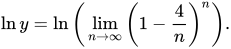
We then take the natural log of both sides to get
        Failed to parse (MathML with SVG or PNG fallback (recommended for modern browsers and accessibility tools): Invalid response ("Math extension cannot connect to Restbase.") from server "https://wikimedia.org/api/rest_v1/":): {\displaystyle \ln y = \ln\bigg(\lim_{n\rightarrow \infty} \bigg(1-\frac{4}{n}\bigg)^n\bigg).}
Step 2:  
We can interchange limits and continuous functions.
Therefore, we have

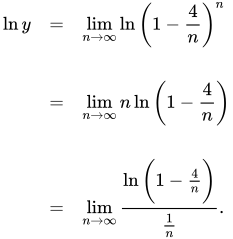
        Failed to parse (MathML with SVG or PNG fallback (recommended for modern browsers and accessibility tools): Invalid response ("Math extension cannot connect to Restbase.") from server "https://wikimedia.org/api/rest_v1/":): {\displaystyle \begin{array}{rcl} \displaystyle{\ln y} & = & \displaystyle{\lim_{n\rightarrow \infty} \ln \bigg(1-\frac{4}{n}\bigg)^n}\\ &&\\ & = & \displaystyle{\lim_{n\rightarrow \infty} n\ln\bigg(1-\frac{4}{n}\bigg)}\\ &&\\ & = & \displaystyle{\lim_{n\rightarrow \infty} \frac{\ln \bigg(1-\frac{4}{n}\bigg)}{\frac{1}{n}}.} \end{array}}

Now, this limit has the form  Failed to parse (MathML with SVG or PNG fallback (recommended for modern browsers and accessibility tools): Invalid response ("Math extension cannot connect to Restbase.") from server "https://wikimedia.org/api/rest_v1/":): {\displaystyle \frac{0}{0}.}
Hence, we can use L'Hopital's Rule to calculate this limit.
Step 3:  
Now, we have

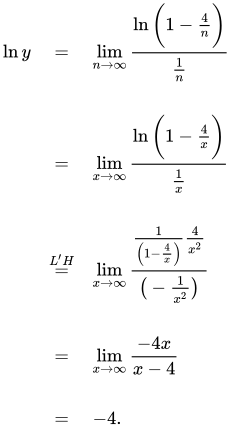
        Failed to parse (MathML with SVG or PNG fallback (recommended for modern browsers and accessibility tools): Invalid response ("Math extension cannot connect to Restbase.") from server "https://wikimedia.org/api/rest_v1/":): {\displaystyle \begin{array}{rcl} \displaystyle{\ln y } & = & \displaystyle{\lim_{n\rightarrow \infty} \frac{\ln \bigg(1-\frac{4}{n}\bigg)}{\frac{1}{n}}}\\ &&\\ & = & \displaystyle{\lim_{x\rightarrow \infty} \frac{\ln \bigg(1-\frac{4}{x}\bigg)}{\frac{1}{x}}}\\ &&\\ & \overset{L'H}{=} & \displaystyle{\lim_{x\rightarrow \infty} \frac{\frac{1}{\big(1-\frac{4}{x}\big)}\frac{4}{x^2}}{\big(-\frac{1}{x^2}\big)}}\\ &&\\ & = & \displaystyle{\lim_{x\rightarrow \infty} \frac{-4x}{x-4}}\\ &&\\ & = & \displaystyle{-4.} \end{array}}

Step 4:  
Since  Failed to parse (MathML with SVG or PNG fallback (recommended for modern browsers and accessibility tools): Invalid response ("Math extension cannot connect to Restbase.") from server "https://wikimedia.org/api/rest_v1/":): {\displaystyle \ln y= -4,} we know
        Failed to parse (MathML with SVG or PNG fallback (recommended for modern browsers and accessibility tools): Invalid response ("Math extension cannot connect to Restbase.") from server "https://wikimedia.org/api/rest_v1/":): {\displaystyle y=e^{-4}.}
Now, we have

        Failed to parse (MathML with SVG or PNG fallback (recommended for modern browsers and accessibility tools): Invalid response ("Math extension cannot connect to Restbase.") from server "https://wikimedia.org/api/rest_v1/":): {\displaystyle \begin{array}{rcl} \displaystyle{\lim _{n\rightarrow \infty} \frac{1}{\big(\frac{n-4}{n}\big)^n}} & = & \displaystyle{\frac{\lim_{n\rightarrow \infty} 1}{\lim_{n\rightarrow \infty} \big(\frac{n-4}{n}\big)^n}}\\ &&\\ & = & \displaystyle{\frac{1}{e^{-4}}}\\ &&\\ & = & \displaystyle{e^4.} \end{array}}

(b)

Step 1:  
First, we not that this is a geometric series with  Failed to parse (MathML with SVG or PNG fallback (recommended for modern browsers and accessibility tools): Invalid response ("Math extension cannot connect to Restbase.") from server "https://wikimedia.org/api/rest_v1/":): {\displaystyle r=\frac{1}{4}.}
Since  Failed to parse (MathML with SVG or PNG fallback (recommended for modern browsers and accessibility tools): Invalid response ("Math extension cannot connect to Restbase.") from server "https://wikimedia.org/api/rest_v1/":): {\displaystyle |r|=\frac{1}{4}<1,}
this series converges.
Step 2:  
Now, we need to find the sum of this series.
The first term of the series is  Failed to parse (MathML with SVG or PNG fallback (recommended for modern browsers and accessibility tools): Invalid response ("Math extension cannot connect to Restbase.") from server "https://wikimedia.org/api/rest_v1/":): {\displaystyle a_1=\frac{1}{2}.}
Hence, the sum of the series is

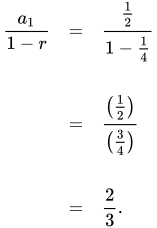
        Failed to parse (MathML with SVG or PNG fallback (recommended for modern browsers and accessibility tools): Invalid response ("Math extension cannot connect to Restbase.") from server "https://wikimedia.org/api/rest_v1/":): {\displaystyle \begin{array}{rcl} \displaystyle{\frac{a_1}{1-r}} & = & \displaystyle{\frac{\frac{1}{2}}{1-\frac{1}{4}}}\\ &&\\ & = & \displaystyle{\frac{\big(\frac{1}{2}\big)}{\big(\frac{3}{4}\big)}}\\ &&\\ & = & \displaystyle{\frac{2}{3}.} \end{array}}


Final Answer:  
    (a)     Failed to parse (MathML with SVG or PNG fallback (recommended for modern browsers and accessibility tools): Invalid response ("Math extension cannot connect to Restbase.") from server "https://wikimedia.org/api/rest_v1/":): {\displaystyle e^{4}}
    (b)     Failed to parse (MathML with SVG or PNG fallback (recommended for modern browsers and accessibility tools): Invalid response ("Math extension cannot connect to Restbase.") from server "https://wikimedia.org/api/rest_v1/":): {\displaystyle \frac{2}{3}}

Return to Sample Exam