Difference between revisions of "009B Sample Midterm 3, Problem 2"

From Grad Wiki
Jump to navigation Jump to search
Line 25: Line 25:
 
|'''The Fundamental Theorem of Calculus, Part 1'''
 
|'''The Fundamental Theorem of Calculus, Part 1'''
 
|-
 
|-
|Let <math style="vertical-align: -5px">f</math> be continuous on <math style="vertical-align: -5px">[a,b]</math> and let <math style="vertical-align: -14px">F(x)=\int_a^x f(t)~dt.</math>
+
|
 +
:Let <math style="vertical-align: -5px">f</math> be continuous on <math style="vertical-align: -5px">[a,b]</math> and let <math style="vertical-align: -14px">F(x)=\int_a^x f(t)~dt.</math>
 
|-
 
|-
|Then, <math style="vertical-align: -1px">F</math> is a differentiable function on <math style="vertical-align: -5px">(a,b)</math> and <math style="vertical-align: -5px">F'(x)=f(x).</math>
+
|
 +
:Then, <math style="vertical-align: -1px">F</math> is a differentiable function on <math style="vertical-align: -5px">(a,b)</math> and <math style="vertical-align: -5px">F'(x)=f(x).</math>
 
|-
 
|-
 
|'''The Fundamental Theorem of Calculus, Part 2'''
 
|'''The Fundamental Theorem of Calculus, Part 2'''
 
|-
 
|-
|Let <math style="vertical-align: -5px">f</math> be continuous on <math style="vertical-align: -5px">[a,b]</math> and let <math style="vertical-align: -1px">F</math> be any antiderivative of <math style="vertical-align: -5px">f.</math>
+
|
 +
:Let <math style="vertical-align: -5px">f</math> be continuous on <math style="vertical-align: -5px">[a,b]</math> and let <math style="vertical-align: -1px">F</math> be any antiderivative of <math style="vertical-align: -5px">f.</math>
 
|-
 
|-
|Then, <math style="vertical-align: -14px">\int_a^b f(x)~dx=F(b)-F(a).</math>
+
|
 +
:Then, <math style="vertical-align: -14px">\int_a^b f(x)~dx=F(b)-F(a).</math>
 
|}
 
|}
  
Line 39: Line 43:
 
!Step 2: &nbsp;
 
!Step 2: &nbsp;
 
|-
 
|-
|First, we have <math style="vertical-align: -15px">F(x)=-\int_5^{\cos (x)} \frac{1}{1+u^{10}}~du.</math>
+
|First, we have  
 +
|-
 +
|
 +
::<math style="vertical-align: -15px">F(x)=-\int_5^{\cos (x)} \frac{1}{1+u^{10}}~du.</math>
 
|-
 
|-
 
|Now, let <math style="vertical-align: -5px">g(x)=\cos(x)</math> and <math style="vertical-align: -15px">G(x)=\int_5^x \frac{1}{1+u^{10}}~du.</math>  
 
|Now, let <math style="vertical-align: -5px">g(x)=\cos(x)</math> and <math style="vertical-align: -15px">G(x)=\int_5^x \frac{1}{1+u^{10}}~du.</math>  
 
|-
 
|-
|So, <math style="vertical-align: -5px">F(x)=-G(g(x)).</math>
+
|So,  
 +
|-
 +
|
 +
::<math style="vertical-align: -5px">F(x)=-G(g(x)).</math>
 
|-
 
|-
 
|Hence, <math style="vertical-align: -5px">F'(x)=-G'(g(x))g'(x)</math> by the Chain Rule.
 
|Hence, <math style="vertical-align: -5px">F'(x)=-G'(g(x))g'(x)</math> by the Chain Rule.
Line 53: Line 63:
 
|Now, <math style="vertical-align: -5px">g'(x)=-\sin(x).</math>
 
|Now, <math style="vertical-align: -5px">g'(x)=-\sin(x).</math>
 
|-
 
|-
| By the Fundamental Theorem of Calculus, <math style="vertical-align: -15px">G'(x)=\frac{1}{1+x^{10}}.</math>
+
|By the Fundamental Theorem of Calculus,  
 
|-
 
|-
|Hence, <math style="vertical-align: -15px">F'(x)=-\frac{1}{1+\cos^{10}x}(-\sin(x))=\frac{\sin(x)}{1+\cos^{10}x}.</math>
+
|
 +
::<math style="vertical-align: -15px">G'(x)=\frac{1}{1+x^{10}}.</math>
 +
|-
 +
|Hence,
 
|-
 
|-
 
|
 
|
 +
::<math>\begin{array}{rcl}
 +
\displaystyle{F'(x)} & = & \displaystyle{-\frac{1}{1+\cos^{10}x}(-\sin(x))}\\
 +
&&\\
 +
& = & \displaystyle{\frac{\sin(x)}{1+\cos^{10}x}.}\\
 +
\end{array}</math>
 
|}
 
|}
  
Line 63: Line 81:
 
!Final Answer: &nbsp;  
 
!Final Answer: &nbsp;  
 
|-
 
|-
|'''The Fundamental Theorem of Calculus, Part 1'''
+
|&nbsp;&nbsp; '''The Fundamental Theorem of Calculus, Part 1'''
 
|-
 
|-
|Let <math style="vertical-align: -5px">f</math> be continuous on <math style="vertical-align: -5px">[a,b]</math> and let <math style="vertical-align: -14px">F(x)=\int_a^x f(t)~dt.</math>
+
|
 +
:&nbsp;&nbsp; Let <math style="vertical-align: -5px">f</math> be continuous on <math style="vertical-align: -5px">[a,b]</math> and let <math style="vertical-align: -14px">F(x)=\int_a^x f(t)~dt.</math>
 
|-
 
|-
|Then, <math style="vertical-align: -1px">F</math> is a differentiable function on <math style="vertical-align: -5px">(a,b)</math> and <math style="vertical-align: -5px">F'(x)=f(x).</math>
+
|
 +
:&nbsp;&nbsp; Then, <math style="vertical-align: -1px">F</math> is a differentiable function on <math style="vertical-align: -5px">(a,b)</math> and <math style="vertical-align: -5px">F'(x)=f(x).</math>
 
|-
 
|-
|'''The Fundamental Theorem of Calculus, Part 2'''
+
|&nbsp;&nbsp; '''The Fundamental Theorem of Calculus, Part 2'''
 
|-
 
|-
|Let <math style="vertical-align: -5px">f</math> be continuous on <math style="vertical-align: -5px">[a,b]</math> and let <math style="vertical-align: -1px">F</math> be any antiderivative of <math style="vertical-align: -5px">f.</math>
+
|
 +
:&nbsp;&nbsp; Let <math style="vertical-align: -5px">f</math> be continuous on <math style="vertical-align: -5px">[a,b]</math> and let <math style="vertical-align: -1px">F</math> be any antiderivative of <math style="vertical-align: -5px">f.</math>
 
|-
 
|-
|Then, <math style="vertical-align: -14px">\int_a^b f(x)~dx=F(b)-F(a).</math>
+
|
 +
:&nbsp;&nbsp; Then, <math style="vertical-align: -14px">\int_a^b f(x)~dx=F(b)-F(a).</math>
 
|-
 
|-
|<math>F'(x)=\frac{\sin(x)}{1+\cos^{10}x}</math>
+
|&nbsp;&nbsp; <math>F'(x)=\frac{\sin(x)}{1+\cos^{10}x}</math>
 
|}
 
|}
 
[[009B_Sample_Midterm_3|'''<u>Return to Sample Exam</u>''']]
 
[[009B_Sample_Midterm_3|'''<u>Return to Sample Exam</u>''']]

Revision as of 17:01, 18 April 2016

State the fundamental theorem of calculus, and use this theorem to find the derivative of


Foundations:  
What does Part 1 of the Fundamental Theorem of Calculus say is the derivative of
First, we need to switch the bounds of integration.
So, we have
By Part 1 of the Fundamental Theorem of Calculus, Failed to parse (MathML with SVG or PNG fallback (recommended for modern browsers and accessibility tools): Invalid response ("Math extension cannot connect to Restbase.") from server "https://wikimedia.org/api/rest_v1/":): {\displaystyle G'(x)=-\frac{1}{1+x^{10}}.}

Solution:

Step 1:  
The Fundamental Theorem of Calculus, Part 1
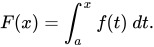
Let Failed to parse (MathML with SVG or PNG fallback (recommended for modern browsers and accessibility tools): Invalid response ("Math extension cannot connect to Restbase.") from server "https://wikimedia.org/api/rest_v1/":): {\displaystyle f} be continuous on Failed to parse (MathML with SVG or PNG fallback (recommended for modern browsers and accessibility tools): Invalid response ("Math extension cannot connect to Restbase.") from server "https://wikimedia.org/api/rest_v1/":): {\displaystyle [a,b]} and let Failed to parse (MathML with SVG or PNG fallback (recommended for modern browsers and accessibility tools): Invalid response ("Math extension cannot connect to Restbase.") from server "https://wikimedia.org/api/rest_v1/":): {\displaystyle F(x)=\int_a^x f(t)~dt.}
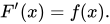
Then, Failed to parse (MathML with SVG or PNG fallback (recommended for modern browsers and accessibility tools): Invalid response ("Math extension cannot connect to Restbase.") from server "https://wikimedia.org/api/rest_v1/":): {\displaystyle F} is a differentiable function on Failed to parse (MathML with SVG or PNG fallback (recommended for modern browsers and accessibility tools): Invalid response ("Math extension cannot connect to Restbase.") from server "https://wikimedia.org/api/rest_v1/":): {\displaystyle (a,b)} and Failed to parse (MathML with SVG or PNG fallback (recommended for modern browsers and accessibility tools): Invalid response ("Math extension cannot connect to Restbase.") from server "https://wikimedia.org/api/rest_v1/":): {\displaystyle F'(x)=f(x).}
The Fundamental Theorem of Calculus, Part 2
Let Failed to parse (MathML with SVG or PNG fallback (recommended for modern browsers and accessibility tools): Invalid response ("Math extension cannot connect to Restbase.") from server "https://wikimedia.org/api/rest_v1/":): {\displaystyle f} be continuous on Failed to parse (MathML with SVG or PNG fallback (recommended for modern browsers and accessibility tools): Invalid response ("Math extension cannot connect to Restbase.") from server "https://wikimedia.org/api/rest_v1/":): {\displaystyle [a,b]} and let Failed to parse (MathML with SVG or PNG fallback (recommended for modern browsers and accessibility tools): Invalid response ("Math extension cannot connect to Restbase.") from server "https://wikimedia.org/api/rest_v1/":): {\displaystyle F} be any antiderivative of Failed to parse (MathML with SVG or PNG fallback (recommended for modern browsers and accessibility tools): Invalid response ("Math extension cannot connect to Restbase.") from server "https://wikimedia.org/api/rest_v1/":): {\displaystyle f.}
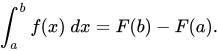
Then, Failed to parse (MathML with SVG or PNG fallback (recommended for modern browsers and accessibility tools): Invalid response ("Math extension cannot connect to Restbase.") from server "https://wikimedia.org/api/rest_v1/":): {\displaystyle \int_a^b f(x)~dx=F(b)-F(a).}
Step 2:  
First, we have
Failed to parse (MathML with SVG or PNG fallback (recommended for modern browsers and accessibility tools): Invalid response ("Math extension cannot connect to Restbase.") from server "https://wikimedia.org/api/rest_v1/":): {\displaystyle F(x)=-\int_5^{\cos (x)} \frac{1}{1+u^{10}}~du.}
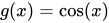
Now, let Failed to parse (MathML with SVG or PNG fallback (recommended for modern browsers and accessibility tools): Invalid response ("Math extension cannot connect to Restbase.") from server "https://wikimedia.org/api/rest_v1/":): {\displaystyle g(x)=\cos(x)} and Failed to parse (MathML with SVG or PNG fallback (recommended for modern browsers and accessibility tools): Invalid response ("Math extension cannot connect to Restbase.") from server "https://wikimedia.org/api/rest_v1/":): {\displaystyle G(x)=\int_5^x \frac{1}{1+u^{10}}~du.}
So,
Failed to parse (MathML with SVG or PNG fallback (recommended for modern browsers and accessibility tools): Invalid response ("Math extension cannot connect to Restbase.") from server "https://wikimedia.org/api/rest_v1/":): {\displaystyle F(x)=-G(g(x)).}
Hence, Failed to parse (MathML with SVG or PNG fallback (recommended for modern browsers and accessibility tools): Invalid response ("Math extension cannot connect to Restbase.") from server "https://wikimedia.org/api/rest_v1/":): {\displaystyle F'(x)=-G'(g(x))g'(x)} by the Chain Rule.
Step 3:  
Now, Failed to parse (MathML with SVG or PNG fallback (recommended for modern browsers and accessibility tools): Invalid response ("Math extension cannot connect to Restbase.") from server "https://wikimedia.org/api/rest_v1/":): {\displaystyle g'(x)=-\sin(x).}
By the Fundamental Theorem of Calculus,
Failed to parse (MathML with SVG or PNG fallback (recommended for modern browsers and accessibility tools): Invalid response ("Math extension cannot connect to Restbase.") from server "https://wikimedia.org/api/rest_v1/":): {\displaystyle G'(x)=\frac{1}{1+x^{10}}.}
Hence,
Failed to parse (MathML with SVG or PNG fallback (recommended for modern browsers and accessibility tools): Invalid response ("Math extension cannot connect to Restbase.") from server "https://wikimedia.org/api/rest_v1/":): {\displaystyle \begin{array}{rcl} \displaystyle{F'(x)} & = & \displaystyle{-\frac{1}{1+\cos^{10}x}(-\sin(x))}\\ &&\\ & = & \displaystyle{\frac{\sin(x)}{1+\cos^{10}x}.}\\ \end{array}}
Final Answer:  
   The Fundamental Theorem of Calculus, Part 1
   Let Failed to parse (MathML with SVG or PNG fallback (recommended for modern browsers and accessibility tools): Invalid response ("Math extension cannot connect to Restbase.") from server "https://wikimedia.org/api/rest_v1/":): {\displaystyle f} be continuous on Failed to parse (MathML with SVG or PNG fallback (recommended for modern browsers and accessibility tools): Invalid response ("Math extension cannot connect to Restbase.") from server "https://wikimedia.org/api/rest_v1/":): {\displaystyle [a,b]} and let Failed to parse (MathML with SVG or PNG fallback (recommended for modern browsers and accessibility tools): Invalid response ("Math extension cannot connect to Restbase.") from server "https://wikimedia.org/api/rest_v1/":): {\displaystyle F(x)=\int_a^x f(t)~dt.}
   Then, Failed to parse (MathML with SVG or PNG fallback (recommended for modern browsers and accessibility tools): Invalid response ("Math extension cannot connect to Restbase.") from server "https://wikimedia.org/api/rest_v1/":): {\displaystyle F} is a differentiable function on Failed to parse (MathML with SVG or PNG fallback (recommended for modern browsers and accessibility tools): Invalid response ("Math extension cannot connect to Restbase.") from server "https://wikimedia.org/api/rest_v1/":): {\displaystyle (a,b)} and Failed to parse (MathML with SVG or PNG fallback (recommended for modern browsers and accessibility tools): Invalid response ("Math extension cannot connect to Restbase.") from server "https://wikimedia.org/api/rest_v1/":): {\displaystyle F'(x)=f(x).}
   The Fundamental Theorem of Calculus, Part 2
   Let Failed to parse (MathML with SVG or PNG fallback (recommended for modern browsers and accessibility tools): Invalid response ("Math extension cannot connect to Restbase.") from server "https://wikimedia.org/api/rest_v1/":): {\displaystyle f} be continuous on Failed to parse (MathML with SVG or PNG fallback (recommended for modern browsers and accessibility tools): Invalid response ("Math extension cannot connect to Restbase.") from server "https://wikimedia.org/api/rest_v1/":): {\displaystyle [a,b]} and let Failed to parse (MathML with SVG or PNG fallback (recommended for modern browsers and accessibility tools): Invalid response ("Math extension cannot connect to Restbase.") from server "https://wikimedia.org/api/rest_v1/":): {\displaystyle F} be any antiderivative of Failed to parse (MathML with SVG or PNG fallback (recommended for modern browsers and accessibility tools): Invalid response ("Math extension cannot connect to Restbase.") from server "https://wikimedia.org/api/rest_v1/":): {\displaystyle f.}
   Then, Failed to parse (MathML with SVG or PNG fallback (recommended for modern browsers and accessibility tools): Invalid response ("Math extension cannot connect to Restbase.") from server "https://wikimedia.org/api/rest_v1/":): {\displaystyle \int_a^b f(x)~dx=F(b)-F(a).}
   Failed to parse (MathML with SVG or PNG fallback (recommended for modern browsers and accessibility tools): Invalid response ("Math extension cannot connect to Restbase.") from server "https://wikimedia.org/api/rest_v1/":): {\displaystyle F'(x)=\frac{\sin(x)}{1+\cos^{10}x}}

Return to Sample Exam