|
|
| Line 24: |
Line 24: |
| | |- | | |- |
| | | | | | |
| − | ::Thus, <math>\int \tan x~dx=\int \frac{-1}{u}~du=-\ln(u)+C=-\ln|\cos(x)|+C</math>. | + | ::Thus, <math>\int \tan x~dx=\int \frac{-1}{u}~du=-\ln(u)+C=-\ln|\cos x|+C</math>. |
| | |} | | |} |
| | | | |
Revision as of 18:02, 28 March 2016
Evaluate the indefinite and definite integrals.
- a)

- b)

| Foundations:
|
| Recall the trig identities:
|
1. 
|
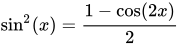
2. 
|
How would you integrate 
|
- You could use
 -substitution. First, write Failed to parse (MathML with SVG or PNG fallback (recommended for modern browsers and accessibility tools): Invalid response ("Math extension cannot connect to Restbase.") from server "https://wikimedia.org/api/rest_v1/":): {\displaystyle \int \tan x~dx=\int \frac{\sin x}{\cos x}~dx}
. -substitution. First, write Failed to parse (MathML with SVG or PNG fallback (recommended for modern browsers and accessibility tools): Invalid response ("Math extension cannot connect to Restbase.") from server "https://wikimedia.org/api/rest_v1/":): {\displaystyle \int \tan x~dx=\int \frac{\sin x}{\cos x}~dx}
.
|
- Now, let Failed to parse (MathML with SVG or PNG fallback (recommended for modern browsers and accessibility tools): Invalid response ("Math extension cannot connect to Restbase.") from server "https://wikimedia.org/api/rest_v1/":): {\displaystyle u=\cos(x)}
. Then, Failed to parse (MathML with SVG or PNG fallback (recommended for modern browsers and accessibility tools): Invalid response ("Math extension cannot connect to Restbase.") from server "https://wikimedia.org/api/rest_v1/":): {\displaystyle du=-\sin(x)dx}
.
|
- Thus, Failed to parse (MathML with SVG or PNG fallback (recommended for modern browsers and accessibility tools): Invalid response ("Math extension cannot connect to Restbase.") from server "https://wikimedia.org/api/rest_v1/":): {\displaystyle \int \tan x~dx=\int \frac{-1}{u}~du=-\ln(u)+C=-\ln|\cos x|+C}
.
|
Solution:
(a)
| Step 1:
|
| We start by writing Failed to parse (MathML with SVG or PNG fallback (recommended for modern browsers and accessibility tools): Invalid response ("Math extension cannot connect to Restbase.") from server "https://wikimedia.org/api/rest_v1/":): {\displaystyle \int \tan^3x~dx=\int \tan^2x\tan x ~dx}
.
|
| Since Failed to parse (MathML with SVG or PNG fallback (recommended for modern browsers and accessibility tools): Invalid response ("Math extension cannot connect to Restbase.") from server "https://wikimedia.org/api/rest_v1/":): {\displaystyle \tan^2x=\sec^2x-1}
, we have Failed to parse (MathML with SVG or PNG fallback (recommended for modern browsers and accessibility tools): Invalid response ("Math extension cannot connect to Restbase.") from server "https://wikimedia.org/api/rest_v1/":): {\displaystyle \int \tan^3x~dx=\int (\sec^2x-1)\tan x ~dx=\int \sec^2x\tan x~dx-\int \tan x~dx}
.
|
| Step 2:
|
| Now, we need to use Failed to parse (MathML with SVG or PNG fallback (recommended for modern browsers and accessibility tools): Invalid response ("Math extension cannot connect to Restbase.") from server "https://wikimedia.org/api/rest_v1/":): {\displaystyle u}
-substitution for the first integral. Let Failed to parse (MathML with SVG or PNG fallback (recommended for modern browsers and accessibility tools): Invalid response ("Math extension cannot connect to Restbase.") from server "https://wikimedia.org/api/rest_v1/":): {\displaystyle u=\tan(x)}
. Then, Failed to parse (MathML with SVG or PNG fallback (recommended for modern browsers and accessibility tools): Invalid response ("Math extension cannot connect to Restbase.") from server "https://wikimedia.org/api/rest_v1/":): {\displaystyle du=\sec^2xdx}
. So, we have
|
| Failed to parse (MathML with SVG or PNG fallback (recommended for modern browsers and accessibility tools): Invalid response ("Math extension cannot connect to Restbase.") from server "https://wikimedia.org/api/rest_v1/":): {\displaystyle \int \tan^3x~dx=\int u~du-\int \tan x~dx=\frac{u^2}{2}-\int \tan x~dx=\frac{\tan^2x}{2}-\int \tan x~dx}
.
|
| Step 3:
|
| For the remaining integral, we also need to use Failed to parse (MathML with SVG or PNG fallback (recommended for modern browsers and accessibility tools): Invalid response ("Math extension cannot connect to Restbase.") from server "https://wikimedia.org/api/rest_v1/":): {\displaystyle u}
-substitution. First, we write Failed to parse (MathML with SVG or PNG fallback (recommended for modern browsers and accessibility tools): Invalid response ("Math extension cannot connect to Restbase.") from server "https://wikimedia.org/api/rest_v1/":): {\displaystyle \int \tan^3x~dx=\frac{\tan^2x}{2}-\int \frac{\sin x}{\cos x}~dx}
.
|
| Now, we let Failed to parse (MathML with SVG or PNG fallback (recommended for modern browsers and accessibility tools): Invalid response ("Math extension cannot connect to Restbase.") from server "https://wikimedia.org/api/rest_v1/":): {\displaystyle u=\cos x}
. Then, Failed to parse (MathML with SVG or PNG fallback (recommended for modern browsers and accessibility tools): Invalid response ("Math extension cannot connect to Restbase.") from server "https://wikimedia.org/api/rest_v1/":): {\displaystyle du=-\sin xdx}
. So, we get
|
| Failed to parse (MathML with SVG or PNG fallback (recommended for modern browsers and accessibility tools): Invalid response ("Math extension cannot connect to Restbase.") from server "https://wikimedia.org/api/rest_v1/":): {\displaystyle \int \tan^3x~dx=\frac{\tan^2x}{2}+\int \frac{1}{u}~dx=\frac{\tan^2x}{2}+\ln |u|+C=\frac{\tan^2x}{2}+\ln |\cos x|+C}
.
|
(b)
| Step 1:
|
| One of the double angle formulas is Failed to parse (MathML with SVG or PNG fallback (recommended for modern browsers and accessibility tools): Invalid response ("Math extension cannot connect to Restbase.") from server "https://wikimedia.org/api/rest_v1/":): {\displaystyle \cos(2x)=1-2\sin^2(x)}
. Solving for Failed to parse (MathML with SVG or PNG fallback (recommended for modern browsers and accessibility tools): Invalid response ("Math extension cannot connect to Restbase.") from server "https://wikimedia.org/api/rest_v1/":): {\displaystyle \sin^2(x)}
, we get Failed to parse (MathML with SVG or PNG fallback (recommended for modern browsers and accessibility tools): Invalid response ("Math extension cannot connect to Restbase.") from server "https://wikimedia.org/api/rest_v1/":): {\displaystyle \sin^2(x)=\frac{1-\cos(2x)}{2}}
.
|
| Plugging this identity into our integral, we get Failed to parse (MathML with SVG or PNG fallback (recommended for modern browsers and accessibility tools): Invalid response ("Math extension cannot connect to Restbase.") from server "https://wikimedia.org/api/rest_v1/":): {\displaystyle \int_0^\pi \sin^2x~dx=\int_0^\pi \frac{1-\cos(2x)}{2}~dx=\int_0^\pi \frac{1}{2}~dx-\int_0^\pi \frac{\cos(2x)}{2}~dx}
.
|
| Step 2:
|
| If we integrate the first integral, we get
|
| Failed to parse (MathML with SVG or PNG fallback (recommended for modern browsers and accessibility tools): Invalid response ("Math extension cannot connect to Restbase.") from server "https://wikimedia.org/api/rest_v1/":): {\displaystyle \int_0^\pi \sin^2x~dx=\left.\frac{x}{2}\right|_{0}^\pi-\int_0^\pi \frac{\cos(2x)}{2}~dx=\frac{\pi}{2}-\int_0^\pi \frac{\cos(2x)}{2}~dx}
.
|
|
|
| Step 3:
|
| For the remaining integral, we need to use Failed to parse (MathML with SVG or PNG fallback (recommended for modern browsers and accessibility tools): Invalid response ("Math extension cannot connect to Restbase.") from server "https://wikimedia.org/api/rest_v1/":): {\displaystyle u}
-substitution. Let Failed to parse (MathML with SVG or PNG fallback (recommended for modern browsers and accessibility tools): Invalid response ("Math extension cannot connect to Restbase.") from server "https://wikimedia.org/api/rest_v1/":): {\displaystyle u=2x}
. Then, Failed to parse (MathML with SVG or PNG fallback (recommended for modern browsers and accessibility tools): Invalid response ("Math extension cannot connect to Restbase.") from server "https://wikimedia.org/api/rest_v1/":): {\displaystyle du=2dx}
and Failed to parse (MathML with SVG or PNG fallback (recommended for modern browsers and accessibility tools): Invalid response ("Math extension cannot connect to Restbase.") from server "https://wikimedia.org/api/rest_v1/":): {\displaystyle \frac{du}{2}=dx}
. Also, since this is a definite integral
|
| and we are using Failed to parse (MathML with SVG or PNG fallback (recommended for modern browsers and accessibility tools): Invalid response ("Math extension cannot connect to Restbase.") from server "https://wikimedia.org/api/rest_v1/":): {\displaystyle u}
-substitution, we need to change the bounds of integration. We have Failed to parse (MathML with SVG or PNG fallback (recommended for modern browsers and accessibility tools): Invalid response ("Math extension cannot connect to Restbase.") from server "https://wikimedia.org/api/rest_v1/":): {\displaystyle u_1=2(0)=0}
and Failed to parse (MathML with SVG or PNG fallback (recommended for modern browsers and accessibility tools): Invalid response ("Math extension cannot connect to Restbase.") from server "https://wikimedia.org/api/rest_v1/":): {\displaystyle u_2=2(\pi)=2\pi}
.
|
| So, the integral becomes
|
| Failed to parse (MathML with SVG or PNG fallback (recommended for modern browsers and accessibility tools): Invalid response ("Math extension cannot connect to Restbase.") from server "https://wikimedia.org/api/rest_v1/":): {\displaystyle \int_0^\pi \sin^2x~dx=\frac{\pi}{2}-\int_0^{2\pi} \frac{\cos(u)}{4}~du=\frac{\pi}{2}-\left.\frac{\sin(u)}{4}\right|_0^{2\pi}=\frac{\pi}{2}-\bigg(\frac{\sin(2\pi)}{4}-\frac{\sin(0)}{4}\bigg)=\frac{\pi}{2}}
|
| Final Answer:
|
| (a) Failed to parse (MathML with SVG or PNG fallback (recommended for modern browsers and accessibility tools): Invalid response ("Math extension cannot connect to Restbase.") from server "https://wikimedia.org/api/rest_v1/":): {\displaystyle \frac{\tan^2x}{2}+\ln |\cos x|+C}
|
| (b) Failed to parse (MathML with SVG or PNG fallback (recommended for modern browsers and accessibility tools): Invalid response ("Math extension cannot connect to Restbase.") from server "https://wikimedia.org/api/rest_v1/":): {\displaystyle \frac{\pi}{2}}
|
Return to Sample Exam