Difference between revisions of "009A Sample Final 1, Problem 1"
Jump to navigation
Jump to search
Kayla Murray (talk | contribs) |
Kayla Murray (talk | contribs) |
||
| Line 14: | Line 14: | ||
|'''L'Hopital's Rule''' | |'''L'Hopital's Rule''' | ||
|- | |- | ||
| − | |Suppose that <math>\lim_{x\rightarrow \infty} f(x)</math> and <math>\lim_{x\rightarrow \infty} g(x)</math> are both zero or both <math style="vertical-align: -1px">\pm \infty</math> | + | |Suppose that <math>\lim_{x\rightarrow \infty} f(x)</math> and <math>\lim_{x\rightarrow \infty} g(x)</math> are both zero or both <math style="vertical-align: -1px">\pm \infty .</math> |
|- | |- | ||
| | | | ||
| − | ::If <math>\lim_{x\rightarrow \infty} \frac{f'(x)}{g'(x)}</math> is finite or <math style="vertical-align: -1px">\pm \infty</math> | + | ::If <math>\lim_{x\rightarrow \infty} \frac{f'(x)}{g'(x)}</math> is finite or <math style="vertical-align: -1px">\pm \infty ,</math> |
|- | |- | ||
| | | | ||
| − | ::then <math>\lim_{x\rightarrow \infty} \frac{f(x)}{g(x)}=\lim_{x\rightarrow \infty} \frac{f'(x)}{g'(x)}</math> | + | ::then <math>\lim_{x\rightarrow \infty} \frac{f(x)}{g(x)}=\lim_{x\rightarrow \infty} \frac{f'(x)}{g'(x)}.</math> |
|} | |} | ||
| Line 33: | Line 33: | ||
|- | |- | ||
| | | | ||
| − | ::<math>\lim_{x\rightarrow -3} \frac{x^3-9x}{6+2x}=\lim_{x\rightarrow -3}\frac{x(x-3)(x+3)}{2(x+3)}</math> | + | ::<math>\lim_{x\rightarrow -3} \frac{x^3-9x}{6+2x}=\lim_{x\rightarrow -3}\frac{x(x-3)(x+3)}{2(x+3)}.</math> |
|- | |- | ||
|So, we can cancel <math style="vertical-align: -2px">x+3</math> in the numerator and denominator. Thus, we have | |So, we can cancel <math style="vertical-align: -2px">x+3</math> in the numerator and denominator. Thus, we have | ||
|- | |- | ||
| | | | ||
| − | ::<math>\lim_{x\rightarrow -3} \frac{x^3-9x}{6+2x}=\lim_{x\rightarrow -3}\frac{x(x-3)}{2}</math> | + | ::<math>\lim_{x\rightarrow -3} \frac{x^3-9x}{6+2x}=\lim_{x\rightarrow -3}\frac{x(x-3)}{2}.</math> |
|} | |} | ||
| Line 47: | Line 47: | ||
|- | |- | ||
| | | | ||
| − | ::<math>\lim_{x\rightarrow -3} \frac{x^3-9x}{6+2x}=\frac{(-3)(-3-3)}{2}=\frac{18}{2}=9</math> | + | ::<math>\lim_{x\rightarrow -3} \frac{x^3-9x}{6+2x}=\frac{(-3)(-3-3)}{2}=\frac{18}{2}=9.</math> |
|} | |} | ||
| Line 61: | Line 61: | ||
\displaystyle{\lim_{x\rightarrow 0^+} \frac{\sin (2x)}{x^2}} & = & \displaystyle{\lim_{x\rightarrow 0^+}\frac{2\cos(2x)}{2x}}\\ | \displaystyle{\lim_{x\rightarrow 0^+} \frac{\sin (2x)}{x^2}} & = & \displaystyle{\lim_{x\rightarrow 0^+}\frac{2\cos(2x)}{2x}}\\ | ||
&&\\ | &&\\ | ||
| − | & = & \displaystyle{\lim_{x\rightarrow 0^+}\frac{\cos(2x)}{x}}\\ | + | & = & \displaystyle{\lim_{x\rightarrow 0^+}\frac{\cos(2x)}{x}.}\\ |
\end{array}</math> | \end{array}</math> | ||
| − | |||
| − | |||
|} | |} | ||
| Line 70: | Line 68: | ||
!Step 2: | !Step 2: | ||
|- | |- | ||
| − | |This limit is <math>+\infty</math> | + | |This limit is <math>+\infty.</math> |
|} | |} | ||
| Line 81: | Line 79: | ||
|- | |- | ||
| | | | ||
| − | ::<math>\lim_{x\rightarrow -\infty} \frac{3x}{\sqrt{4x^2+x+5}}=\lim_{x\rightarrow -\infty} \frac{3x}{\sqrt{x^2(4+\frac{1}{x}+\frac{5}{x^2}})}</math> | + | ::<math>\lim_{x\rightarrow -\infty} \frac{3x}{\sqrt{4x^2+x+5}}=\lim_{x\rightarrow -\infty} \frac{3x}{\sqrt{x^2(4+\frac{1}{x}+\frac{5}{x^2}})}.</math> |
|- | |- | ||
| − | |Since we are looking at the limit as <math>x</math> goes to negative infinity, we have <math style="vertical-align: -3px">\sqrt{x^2}=-x</math> | + | |Since we are looking at the limit as <math>x</math> goes to negative infinity, we have <math style="vertical-align: -3px">\sqrt{x^2}=-x.</math> |
|- | |- | ||
|So, we have | |So, we have | ||
|- | |- | ||
| | | | ||
| − | ::<math>\lim_{x\rightarrow -\infty} \frac{3x}{\sqrt{4x^2+x+5}}=\lim_{x\rightarrow -\infty} \frac{3x}{-x\sqrt{4+\frac{1}{x}+\frac{5}{x^2}}}</math> | + | ::<math>\lim_{x\rightarrow -\infty} \frac{3x}{\sqrt{4x^2+x+5}}=\lim_{x\rightarrow -\infty} \frac{3x}{-x\sqrt{4+\frac{1}{x}+\frac{5}{x^2}}}.</math> |
|} | |} | ||
| Line 97: | Line 95: | ||
|- | |- | ||
| | | | ||
| − | ::<math>\lim_{x\rightarrow -\infty} \frac{3x}{\sqrt{4x^2+x+5}}=\lim_{x\rightarrow -\infty} \frac{-3}{\sqrt{4+\frac{1}{x}+\frac{5}{x^2}}}</math> | + | ::<math>\lim_{x\rightarrow -\infty} \frac{3x}{\sqrt{4x^2+x+5}}=\lim_{x\rightarrow -\infty} \frac{-3}{\sqrt{4+\frac{1}{x}+\frac{5}{x^2}}}.</math> |
|- | |- | ||
|So, we have | |So, we have | ||
|- | |- | ||
| | | | ||
| − | ::<math>\lim_{x\rightarrow -\infty} \frac{3x}{\sqrt{4x^2+x+5}}=\frac{-3}{\sqrt{4}}=\frac{-3}{2}</math> | + | ::<math>\lim_{x\rightarrow -\infty} \frac{3x}{\sqrt{4x^2+x+5}}=\frac{-3}{\sqrt{4}}=\frac{-3}{2}.</math> |
|} | |} | ||
Revision as of 12:25, 29 February 2016
In each part, compute the limit. If the limit is infinite, be sure to specify positive or negative infinity.
a)

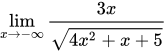
b)

c)
| Foundations: |
|---|
| Recall: |
| L'Hopital's Rule |
| Suppose that Failed to parse (MathML with SVG or PNG fallback (recommended for modern browsers and accessibility tools): Invalid response ("Math extension cannot connect to Restbase.") from server "https://wikimedia.org/api/rest_v1/":): {\displaystyle \lim_{x\rightarrow \infty} f(x)} and Failed to parse (MathML with SVG or PNG fallback (recommended for modern browsers and accessibility tools): Invalid response ("Math extension cannot connect to Restbase.") from server "https://wikimedia.org/api/rest_v1/":): {\displaystyle \lim_{x\rightarrow \infty} g(x)} are both zero or both Failed to parse (MathML with SVG or PNG fallback (recommended for modern browsers and accessibility tools): Invalid response ("Math extension cannot connect to Restbase.") from server "https://wikimedia.org/api/rest_v1/":): {\displaystyle \pm \infty .} |
|
|
Solution:
(a)
| Step 1: |
|---|
| We begin by factoring the numerator. We have |
|
| So, we can cancel Failed to parse (MathML with SVG or PNG fallback (recommended for modern browsers and accessibility tools): Invalid response ("Math extension cannot connect to Restbase.") from server "https://wikimedia.org/api/rest_v1/":): {\displaystyle x+3} in the numerator and denominator. Thus, we have |
|
| Step 2: |
|---|
| Now, we can just plug in Failed to parse (MathML with SVG or PNG fallback (recommended for modern browsers and accessibility tools): Invalid response ("Math extension cannot connect to Restbase.") from server "https://wikimedia.org/api/rest_v1/":): {\displaystyle x=-3} to get |
|
(b)
| Step 1: |
|---|
| We proceed using L'Hopital's Rule. So, we have |
|
| Step 2: |
|---|
| This limit is Failed to parse (MathML with SVG or PNG fallback (recommended for modern browsers and accessibility tools): Invalid response ("Math extension cannot connect to Restbase.") from server "https://wikimedia.org/api/rest_v1/":): {\displaystyle +\infty.} |
(c)
| Step 1: |
|---|
| We have |
|
| Since we are looking at the limit as Failed to parse (MathML with SVG or PNG fallback (recommended for modern browsers and accessibility tools): Invalid response ("Math extension cannot connect to Restbase.") from server "https://wikimedia.org/api/rest_v1/":): {\displaystyle x} goes to negative infinity, we have Failed to parse (MathML with SVG or PNG fallback (recommended for modern browsers and accessibility tools): Invalid response ("Math extension cannot connect to Restbase.") from server "https://wikimedia.org/api/rest_v1/":): {\displaystyle \sqrt{x^2}=-x.} |
| So, we have |
|
| Step 2: |
|---|
| We simplify to get |
|
| So, we have |
|
| Final Answer: |
|---|
| (a) Failed to parse (MathML with SVG or PNG fallback (recommended for modern browsers and accessibility tools): Invalid response ("Math extension cannot connect to Restbase.") from server "https://wikimedia.org/api/rest_v1/":): {\displaystyle 9} . |
| (b) Failed to parse (MathML with SVG or PNG fallback (recommended for modern browsers and accessibility tools): Invalid response ("Math extension cannot connect to Restbase.") from server "https://wikimedia.org/api/rest_v1/":): {\displaystyle +\infty} |
| (c) Failed to parse (MathML with SVG or PNG fallback (recommended for modern browsers and accessibility tools): Invalid response ("Math extension cannot connect to Restbase.") from server "https://wikimedia.org/api/rest_v1/":): {\displaystyle \frac{-3}{2}} |