Difference between revisions of "Chain Rule"
Kayla Murray (talk | contribs) |
Kayla Murray (talk | contribs) |
||
| Line 32: | Line 32: | ||
!Solution: | !Solution: | ||
|- | |- | ||
| − | | | + | |Let <math>f(x)=\sin (x)</math> and <math>g(x)=3x.</math> |
|- | |- | ||
| − | | | + | |Then, <math>f'(x)=\cos(x)</math> and <math>g'(x)=3.</math> |
| − | |||
|- | |- | ||
| − | | | + | |Now, <math>h(x)=f(g(x)).</math> |
|- | |- | ||
| − | | | + | |Using the Chain Rule, we have |
| − | |||
| − | |||
| − | |||
| − | |||
| − | |||
| − | |||
| − | |||
| − | |||
|- | |- | ||
| | | | ||
::<math>\begin{array}{rcl} | ::<math>\begin{array}{rcl} | ||
| − | \displaystyle{ | + | \displaystyle{h'(x)} & = & \displaystyle{f'(g(x))\cdot g'(x)}\\ |
| − | |||
| − | |||
&&\\ | &&\\ | ||
| − | & = & \displaystyle{ | + | & = & \displaystyle{\cos (3x)\cdot 3}\\ |
&&\\ | &&\\ | ||
| − | & = & \displaystyle{ | + | & = & \displaystyle{3\cos (3x).} |
\end{array}</math> | \end{array}</math> | ||
| − | |||
| − | |||
| − | |||
| − | |||
| − | |||
| − | |||
| − | |||
|} | |} | ||
| Line 71: | Line 53: | ||
!Final Answer: | !Final Answer: | ||
|- | |- | ||
| − | | <math> | + | | <math>h'(x)=3\cos (3x)</math> |
| − | |||
| − | |||
| − | |||
| − | |||
|} | |} | ||
| Line 83: | Line 61: | ||
!Solution: | !Solution: | ||
|- | |- | ||
| − | | | + | |Let <math>f(x)=x^8</math> and <math>g(x)=x+1.</math> |
| − | |||
|- | |- | ||
| − | | | + | |Then, <math>f'(x)=8x^7</math> and <math>g'(x)=1.</math> |
| − | |||
| − | |||
| − | |||
| − | |||
| − | |||
| − | |||
|- | |- | ||
| − | |< | + | |Now, <math>h(x)=f(g(x)).</math> |
|- | |- | ||
| − | | | + | |Using the Chain Rule, we have |
| − | |||
| − | |||
|- | |- | ||
| | | | ||
::<math>\begin{array}{rcl} | ::<math>\begin{array}{rcl} | ||
| − | \displaystyle{ | + | \displaystyle{h'(x)} & = & \displaystyle{f'(g(x))\cdot g'(x)}\\ |
&&\\ | &&\\ | ||
| − | & = & \displaystyle{ | + | & = & \displaystyle{8(x+1)^7\cdot 1}\\ |
&&\\ | &&\\ | ||
| − | & = & \displaystyle{x+ | + | & = & \displaystyle{8(x+1)^7.} |
\end{array}</math> | \end{array}</math> | ||
| − | |||
| − | |||
| − | |||
| − | |||
| − | |||
|} | |} | ||
| Line 118: | Line 82: | ||
!Final Answer: | !Final Answer: | ||
|- | |- | ||
| − | || <math> | + | || <math>h'(x)=8(x+1)^7.</math> |
| − | |||
| − | |||
| − | |||
| − | |||
| − | |||
| − | |||
|} | |} | ||
| Line 132: | Line 90: | ||
!Solution: | !Solution: | ||
|- | |- | ||
| − | |Using the | + | |Let <math>f(x)=\ln (x)</math> and <math>g(x)=x^2.</math> |
| + | |- | ||
| + | |Then, <math>f'(x)=\frac{1}{x}</math> and <math>g'(x)=2x.</math> | ||
| + | |- | ||
| + | |Now, <math>h(x)=f(g(x)).</math> | ||
| + | |- | ||
| + | |Using the Chain Rule, we have | ||
|- | |- | ||
| | | | ||
::<math>\begin{array}{rcl} | ::<math>\begin{array}{rcl} | ||
| − | \displaystyle{ | + | \displaystyle{h'(x)} & = & \displaystyle{f'(g(x))\cdot g'(x)}\\ |
| − | |||
| − | |||
| − | |||
| − | |||
&&\\ | &&\\ | ||
| − | & = & \displaystyle{\frac{1}{ | + | & = & \displaystyle{\frac{1}{x^2}\cdot 2x}\\ |
&&\\ | &&\\ | ||
| − | & = & \displaystyle{\ | + | & = & \displaystyle{\frac{2}{x}.} |
\end{array}</math> | \end{array}</math> | ||
| − | |||
| − | |||
| − | |||
| − | |||
| − | |||
| − | |||
| − | |||
|} | |} | ||
| Line 158: | Line 111: | ||
!Final Answer: | !Final Answer: | ||
|- | |- | ||
| − | | <math> | + | | <math>h'(x)=\frac{2}{x}</math> |
|- | |- | ||
|} | |} | ||
Revision as of 09:47, 9 October 2017
Introduction
It is relatively easy to calculate the derivatives of simple functions, like polynomials or trigonometric functions.
But, what about more complicated functions?
For example, or


Well, the key to calculating the derivatives of these functions is to recognize that these functions are compositions.
For Failed to parse (Conversion error. Server ("https://wikimedia.org/api/rest_") reported: "Cannot get mml. Server problem."): {\displaystyle f(x)=\sin(3x),} it is the composition of the function Failed to parse (Conversion error. Server ("https://wikimedia.org/api/rest_") reported: "Cannot get mml. Server problem."): {\displaystyle y=3x} with

Similarly, for it is the composition of Failed to parse (Conversion error. Server ("https://wikimedia.org/api/rest_") reported: "Cannot get mml. Server problem."): {\displaystyle y=x+1} and Failed to parse (Conversion error. Server ("https://wikimedia.org/api/rest_") reported: "Cannot get mml. Server problem."): {\displaystyle y=x^{8}.}

So, how do we take the derivative of compositions?
The answer to this question is exactly the Chain Rule.
Chain Rule
Let Failed to parse (Conversion error. Server ("https://wikimedia.org/api/rest_") reported: "Cannot get mml. Server problem."): {\displaystyle y=f(u)} be a differentiable function of and let be a differentiable function of


Then, is a differentiable function of and


- Failed to parse (Conversion error. Server ("https://wikimedia.org/api/rest_") reported: "Cannot get mml. Server problem."): {\displaystyle y'=f'(g(x))\cdot g'(x).}
Warm-Up
Calculate Failed to parse (Conversion error. Server ("https://wikimedia.org/api/rest_") reported: "Cannot get mml. Server problem."): {\displaystyle h'(x).}
1) Failed to parse (Conversion error. Server ("https://wikimedia.org/api/rest_") reported: "Cannot get mml. Server problem."): {\displaystyle h(x)=\sin(3x)}
| Solution: |
|---|
| Let Failed to parse (Conversion error. Server ("https://wikimedia.org/api/rest_") reported: "Cannot get mml. Server problem."): {\displaystyle f(x)=\sin(x)} and |
| Then, Failed to parse (Conversion error. Server ("https://wikimedia.org/api/rest_") reported: "Cannot get mml. Server problem."): {\displaystyle f'(x)=\cos(x)} and Failed to parse (Conversion error. Server ("https://wikimedia.org/api/rest_") reported: "Cannot get mml. Server problem."): {\displaystyle g'(x)=3.} |
| Now, Failed to parse (Conversion error. Server ("https://wikimedia.org/api/rest_") reported: "Cannot get mml. Server problem."): {\displaystyle h(x)=f(g(x)).} |
| Using the Chain Rule, we have |
|

| Final Answer: |
|---|
| Failed to parse (Conversion error. Server ("https://wikimedia.org/api/rest_") reported: "Cannot get mml. Server problem."): {\displaystyle h'(x)=3\cos(3x)} |
2) Failed to parse (Conversion error. Server ("https://wikimedia.org/api/rest_") reported: "Cannot get mml. Server problem."): {\displaystyle h(x)=(x+1)^{8}}
| Solution: |
|---|
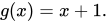
| Let Failed to parse (Conversion error. Server ("https://wikimedia.org/api/rest_") reported: "Cannot get mml. Server problem."): {\displaystyle f(x)=x^{8}} and |
| Then, Failed to parse (Conversion error. Server ("https://wikimedia.org/api/rest_") reported: "Cannot get mml. Server problem."): {\displaystyle f'(x)=8x^{7}} and Failed to parse (Conversion error. Server ("https://wikimedia.org/api/rest_") reported: "Cannot get mml. Server problem."): {\displaystyle g'(x)=1.} |
| Now, Failed to parse (Conversion error. Server ("https://wikimedia.org/api/rest_") reported: "Cannot get mml. Server problem."): {\displaystyle h(x)=f(g(x)).} |
| Using the Chain Rule, we have |
|
| Final Answer: |
|---|
| Failed to parse (Conversion error. Server ("https://wikimedia.org/api/rest_") reported: "Cannot get mml. Server problem."): {\displaystyle h'(x)=8(x+1)^{7}.} |
3) Failed to parse (Conversion error. Server ("https://wikimedia.org/api/rest_") reported: "Cannot get mml. Server problem."): {\displaystyle h(x)=\ln(x^{2})}
| Solution: |
|---|
| Let Failed to parse (Conversion error. Server ("https://wikimedia.org/api/rest_") reported: "Cannot get mml. Server problem."): {\displaystyle f(x)=\ln(x)} and |
| Then, Failed to parse (Conversion error. Server ("https://wikimedia.org/api/rest_") reported: "Cannot get mml. Server problem."): {\displaystyle f'(x)={\frac {1}{x}}} and Failed to parse (Conversion error. Server ("https://wikimedia.org/api/rest_") reported: "Cannot get mml. Server problem."): {\displaystyle g'(x)=2x.} |
| Now, Failed to parse (Conversion error. Server ("https://wikimedia.org/api/rest_") reported: "Cannot get mml. Server problem."): {\displaystyle h(x)=f(g(x)).} |
| Using the Chain Rule, we have |
|

| Final Answer: |
|---|
| Failed to parse (Conversion error. Server ("https://wikimedia.org/api/rest_") reported: "Cannot get mml. Server problem."): {\displaystyle h'(x)={\frac {2}{x}}} |
Exercise 1
Calculate the derivative of

First, we need to know the derivative of Recall


Now, using the Quotient Rule, we have

Using the Product Rule and Power Rule, we have

So, we have

Exercise 2
Calculate the derivative of

Notice that the function is the product of three functions.

We start by grouping two of the functions together. So, we have Failed to parse (MathML with SVG or PNG fallback (recommended for modern browsers and accessibility tools): Invalid response ("Math extension cannot connect to Restbase.") from server "https://wikimedia.org/api/rest_v1/":): {\displaystyle g(x)=(2x\sin x)\sec x.}
Using the Product Rule, we get
- Failed to parse (MathML with SVG or PNG fallback (recommended for modern browsers and accessibility tools): Invalid response ("Math extension cannot connect to Restbase.") from server "https://wikimedia.org/api/rest_v1/":): {\displaystyle \begin{array}{rcl} \displaystyle{g'(x)} & = & \displaystyle{(2x\sin x)(\sec x)'+(2x\sin x)'\sec x}\\ &&\\ & = & \displaystyle{(2x\sin x)(\tan^2 x)+(2x\sin x)'\sec x.} \end{array}}
Now, we need to use the Product Rule again. So,
- Failed to parse (MathML with SVG or PNG fallback (recommended for modern browsers and accessibility tools): Invalid response ("Math extension cannot connect to Restbase.") from server "https://wikimedia.org/api/rest_v1/":): {\displaystyle \begin{array}{rcl} \displaystyle{g'(x)} & = & \displaystyle{2x\sin x\tan^2 x+(2x(\sin x)'+(2x)'\sin x)\sec x}\\ &&\\ & = & \displaystyle{2x\sin x\tan^2 x+(2x\cos x+2\sin x)\sec x.} \end{array}}
So, we have
- Failed to parse (MathML with SVG or PNG fallback (recommended for modern browsers and accessibility tools): Invalid response ("Math extension cannot connect to Restbase.") from server "https://wikimedia.org/api/rest_v1/":): {\displaystyle g'(x)=2x\sin x\tan^2 x+(2x\cos x+2\sin x)\sec x.}
But, there is another way to do this problem. Notice
- Failed to parse (MathML with SVG or PNG fallback (recommended for modern browsers and accessibility tools): Invalid response ("Math extension cannot connect to Restbase.") from server "https://wikimedia.org/api/rest_v1/":): {\displaystyle \begin{array}{rcl} \displaystyle{g(x)} & = & \displaystyle{2x\sin x\sec x}\\ &&\\ & = & \displaystyle{2x\sin x\frac{1}{\cos x}}\\ &&\\ & = & \displaystyle{2x\tan x.} \end{array}}
Now, you would only need to use the Product Rule once instead of twice.
Exercise 3
Calculate the derivative of Failed to parse (MathML with SVG or PNG fallback (recommended for modern browsers and accessibility tools): Invalid response ("Math extension cannot connect to Restbase.") from server "https://wikimedia.org/api/rest_v1/":): {\displaystyle h(x)=\frac{x^2\sin x+1}{x^2\cos x+3}.}
Using the Quotient Rule, we have
- Failed to parse (MathML with SVG or PNG fallback (recommended for modern browsers and accessibility tools): Invalid response ("Math extension cannot connect to Restbase.") from server "https://wikimedia.org/api/rest_v1/":): {\displaystyle h'(x)=\frac{(x^2\cos x+3)(x^2\sin x+1)'-(x^2\sin x+1)(x^2\cos x+3)'}{(x^2\cos x+3)^2}.}
Now, we need to use the Product Rule. So, we have
- Failed to parse (MathML with SVG or PNG fallback (recommended for modern browsers and accessibility tools): Invalid response ("Math extension cannot connect to Restbase.") from server "https://wikimedia.org/api/rest_v1/":): {\displaystyle \begin{array}{rcl} \displaystyle{h'(x)} & = & \displaystyle{\frac{(x^2\cos x+3)(x^2(\sin x)'+(x^2)'\sin x)-(x^2\sin x+1)(x^2(\cos x)'+(x^2)'\cos x)}{(x^2\cos x+3)^2}}\\ &&\\ & = & \displaystyle{\frac{(x^2\cos x+3)(x^2\cos x+2x\sin x)-(x^2\sin x+1)(-x^2\sin x+2x\cos x)}{(x^2\cos x+3)^2}.} \end{array}}
So, we get
- Failed to parse (MathML with SVG or PNG fallback (recommended for modern browsers and accessibility tools): Invalid response ("Math extension cannot connect to Restbase.") from server "https://wikimedia.org/api/rest_v1/":): {\displaystyle h'(x)=\frac{(x^2\cos x+3)(x^2\cos x+2x\sin x)-(x^2\sin x+1)(-x^2\sin x+2x\cos x)}{(x^2\cos x+3)^2}.}
Exercise 4
Calculate the derivative of Failed to parse (MathML with SVG or PNG fallback (recommended for modern browsers and accessibility tools): Invalid response ("Math extension cannot connect to Restbase.") from server "https://wikimedia.org/api/rest_v1/":): {\displaystyle f(x)=\frac{e^x}{x^2\sin x}.}
First, using the Quotient Rule, we have
- Failed to parse (MathML with SVG or PNG fallback (recommended for modern browsers and accessibility tools): Invalid response ("Math extension cannot connect to Restbase.") from server "https://wikimedia.org/api/rest_v1/":): {\displaystyle \begin{array}{rcl} \displaystyle{f'(x)} & = & \displaystyle{\frac{x^2\sin x (e^x)'-e^x(x^2\sin x)'}{(x^2\sin x)^2}}\\ &&\\ & = & \displaystyle{\frac{x^2\sin x e^x - e^x(x^2\sin x)'}{x^4\sin^2 x}.} \end{array}}
Now, we need to use the Product Rule. So, we have
- Failed to parse (MathML with SVG or PNG fallback (recommended for modern browsers and accessibility tools): Invalid response ("Math extension cannot connect to Restbase.") from server "https://wikimedia.org/api/rest_v1/":): {\displaystyle \begin{array}{rcl} \displaystyle{f'(x)} & = & \displaystyle{\frac{x^2\sin x e^x - e^x(x^2(\sin x)'+(x^2)'\sin x)}{x^4\sin^2 x}}\\ &&\\ & = & \displaystyle{\frac{x^2\sin x e^x - e^x(x^2\cos x+2x\sin x)}{x^4\sin^2 x}.} \end{array}}
So, we have
- Failed to parse (MathML with SVG or PNG fallback (recommended for modern browsers and accessibility tools): Invalid response ("Math extension cannot connect to Restbase.") from server "https://wikimedia.org/api/rest_v1/":): {\displaystyle f'(x)=\frac{x^2\sin x e^x - e^x(x^2\cos x+2x\sin x)}{x^4\sin^2 x}.}