Difference between revisions of "009C Sample Midterm 1, Problem 5"

From Grad Wiki
Jump to navigation Jump to search
(Replaced content with "<span class="exam"> Find the radius of convergence and interval of convergence of the series. <span class="exam">(a)  <math>\sum_{n=0}^\infty \sqrt{n}x^n</math> <sp...")
Line 5: Line 5:
 
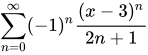
<span class="exam">(b) &nbsp;<math>\sum_{n=0}^\infty (-1)^n \frac{(x-3)^n}{2n+1}</math>
 
<span class="exam">(b) &nbsp;<math>\sum_{n=0}^\infty (-1)^n \frac{(x-3)^n}{2n+1}</math>
  
{| class="mw-collapsible mw-collapsed" style = "text-align:left;"
+
<hr>
!Foundations: &nbsp;
+
(insert picture of handwritten solution)
|-
 
|'''Ratio Test'''
 
|-
 
|&nbsp; &nbsp; &nbsp; &nbsp; Let &nbsp;<math style="vertical-align: -7px">\sum a_n</math>&nbsp; be a series and &nbsp;<math>L=\lim_{n\rightarrow \infty}\bigg|\frac{a_{n+1}}{a_n}\bigg|.</math>
 
|-
 
|&nbsp; &nbsp; &nbsp; &nbsp; Then,
 
|-
 
|
 
&nbsp; &nbsp; &nbsp; &nbsp; If &nbsp;<math style="vertical-align: -4px">L<1,</math>&nbsp; the series is absolutely convergent.
 
|-
 
|
 
&nbsp; &nbsp; &nbsp; &nbsp; If &nbsp;<math style="vertical-align: -4px">L>1,</math>&nbsp; the series is divergent.
 
|-
 
|
 
&nbsp; &nbsp; &nbsp; &nbsp; If &nbsp;<math style="vertical-align: -4px">L=1,</math>&nbsp; the test is inconclusive.
 
|}
 
  
 +
[[009C Sample Midterm 1, Problem 5 Detailed Solution|'''<u>Detailed Solution for this Problem</u>''']]
  
'''Solution:'''
 
 
'''(a)'''
 
{| class="mw-collapsible mw-collapsed" style = "text-align:left;"
 
!Step 1: &nbsp;
 
|-
 
|We first use the Ratio Test to determine the radius of convergence.
 
|-
 
|We have
 
|-
 
|&nbsp; &nbsp; &nbsp; &nbsp; <math>\begin{array}{rcl}
 
\displaystyle{\lim_{n\rightarrow \infty}\bigg|\frac{a_{n+1}}{a_n}\bigg|} & = & \displaystyle{\lim_{n\rightarrow \infty} \bigg|\frac{\sqrt{n+1}x^{n+1}}{\sqrt{n}x^n}\bigg|}\\
 
&&\\
 
& = & \displaystyle{\lim_{n\rightarrow \infty} \bigg|\frac{\sqrt{n+1}}{\sqrt{n}}x\bigg|}\\
 
&&\\
 
& = & \displaystyle{\lim_{n\rightarrow \infty} \sqrt{\frac{n+1}{n}}|x|}\\
 
&&\\
 
& = & \displaystyle{|x|\lim_{n\rightarrow \infty} \sqrt{\frac{n+1}{n}}}\\
 
&&\\
 
& = & \displaystyle{|x|\sqrt{\lim_{n\rightarrow \infty} \frac{n+1}{n}}}\\
 
&&\\
 
& = & \displaystyle{|x|\sqrt{1}}\\
 
&&\\
 
&=& \displaystyle{|x|.}
 
\end{array}</math>
 
|}
 
 
{| class="mw-collapsible mw-collapsed" style = "text-align:left;"
 
!Step 2: &nbsp;
 
|-
 
|The Ratio Test tells us this series is absolutely convergent if &nbsp;<math style="vertical-align: -5px">|x|<1.</math>
 
|-
 
|Hence, the Radius of Convergence of this series is &nbsp;<math style="vertical-align: -2px">R=1.</math>
 
|}
 
 
{| class="mw-collapsible mw-collapsed" style = "text-align:left;"
 
!Step 3: &nbsp;
 
|-
 
|Now, we need to determine the interval of convergence.
 
|-
 
|First, note that &nbsp;<math style="vertical-align: -5px">|x|<1</math>&nbsp; corresponds to the interval &nbsp;<math style="vertical-align: -4px">(-1,1).</math>
 
|-
 
|To obtain the interval of convergence, we need to test the endpoints of this interval
 
|-
 
|for convergence since the Ratio Test is inconclusive when &nbsp;<math style="vertical-align: -2px">L=1.</math>
 
|}
 
 
{| class="mw-collapsible mw-collapsed" style = "text-align:left;"
 
!Step 4: &nbsp;
 
|-
 
|First, let &nbsp;<math style="vertical-align: -1px">x=1.</math>
 
|-
 
|Then, the series becomes &nbsp;<math>\sum_{n=0}^\infty \sqrt{n}.</math>
 
|-
 
|We note that
 
|-
 
|&nbsp; &nbsp; &nbsp; &nbsp; <math>\lim_{n\rightarrow \infty} \sqrt{n}=\infty.</math>
 
|-
 
|Therefore, the series diverges by the &nbsp;<math style="vertical-align: 0px">n</math>th term test.
 
|-
 
|Hence, we do not include &nbsp;<math style="vertical-align: -1px">x=1</math>&nbsp; in the interval.
 
|}
 
 
{| class="mw-collapsible mw-collapsed" style = "text-align:left;"
 
!Step 5: &nbsp;
 
|-
 
|Now, let &nbsp;<math style="vertical-align: -1px">x=-1.</math>
 
|-
 
|Then, the series becomes &nbsp;<math>\sum_{n=0}^\infty (-1)^n \sqrt{n}.</math>
 
|-
 
|Since &nbsp;<math>\lim_{n\rightarrow \infty} \sqrt{n}=\infty,</math>
 
|-
 
|we have
 
|-
 
|&nbsp; &nbsp; &nbsp; &nbsp; <math>\lim_{n\rightarrow \infty} (-1)^n\sqrt{n}=\text{DNE}.</math>
 
|-
 
|Therefore, the series diverges by the &nbsp;<math style="vertical-align: 0px">n</math>th term test.
 
|-
 
|Hence, we do not include &nbsp;<math style="vertical-align: -1px">x=-1 </math>&nbsp; in the interval.
 
|}
 
 
{| class="mw-collapsible mw-collapsed" style = "text-align:left;"
 
!Step 6: &nbsp;
 
|-
 
|The interval of convergence is &nbsp;<math style="vertical-align: -4px">(-1,1).</math>
 
|}
 
 
'''(b)'''
 
{| class="mw-collapsible mw-collapsed" style = "text-align:left;"
 
!Step 1: &nbsp;
 
|-
 
|We first use the Ratio Test to determine the radius of convergence.
 
|-
 
|We have
 
|-
 
|
 
&nbsp; &nbsp; &nbsp; &nbsp; <math>\begin{array}{rcl}
 
\displaystyle{\lim_{n\rightarrow \infty}\bigg|\frac{a_{n+1}}{a_n}\bigg|} & = & \displaystyle{\lim_{n\rightarrow \infty} \bigg|\frac{(-1)^{n+1}(x-3)^{n+1}}{2(n+1)+1}\frac{2n+1}{(-1)^n(x-3)^n}\bigg|}\\
 
&&\\
 
& = & \displaystyle{\lim_{n\rightarrow \infty} \bigg|(-1)(x-3)\frac{2n+1}{2n+3}\bigg|}\\
 
&&\\
 
& = & \displaystyle{\lim_{n\rightarrow \infty} |x-3|\frac{2n+1}{2n+3}}\\
 
&&\\
 
& = & \displaystyle{|x-3|\lim_{n\rightarrow \infty} \frac{2n+1}{2n+3}}\\
 
&&\\
 
& = & \displaystyle{|x-3|.}
 
\end{array}</math>
 
|}
 
 
{| class="mw-collapsible mw-collapsed" style = "text-align:left;"
 
!Step 2: &nbsp;
 
|-
 
|The Ratio Test tells us this series is absolutely convergent if &nbsp;<math style="vertical-align: -5px">|x-3|<1.</math>
 
|-
 
|Hence, the Radius of Convergence of this series is &nbsp;<math style="vertical-align: -2px">R=1.</math>
 
|}
 
 
{| class="mw-collapsible mw-collapsed" style = "text-align:left;"
 
!Step 3: &nbsp;
 
|-
 
|Now, we need to determine the interval of convergence.
 
|-
 
|First, note that &nbsp;<math style="vertical-align: -5px">|x-3|<1</math>&nbsp; corresponds to the interval &nbsp;<math style="vertical-align: -4px">(2,4).</math>
 
|-
 
|To obtain the interval of convergence, we need to test the endpoints of this interval
 
|-
 
|for convergence since the Ratio Test is inconclusive when &nbsp;<math style="vertical-align: -2px">R=1.</math>
 
|}
 
 
{| class="mw-collapsible mw-collapsed" style = "text-align:left;"
 
!Step 4: &nbsp;
 
|-
 
|First, let &nbsp;<math style="vertical-align: -1px">x=4.</math> 
 
|-
 
|Then, the series becomes &nbsp;<math>\sum_{n=0}^\infty (-1)^n \frac{1}{2n+1}.</math>
 
|-
 
|This is an alternating series.
 
|-
 
|Let &nbsp;<math style="vertical-align: -16px">b_n=\frac{1}{2n+1}.</math>.
 
|-
 
|First, we have
 
|-
 
|&nbsp; &nbsp; &nbsp; &nbsp;<math>\frac{1}{2n+1}\ge 0</math>
 
|-
 
|for all &nbsp;<math style="vertical-align: -3px">n\ge 0.</math>
 
|-
 
|The sequence &nbsp;<math>\{b_n\}</math>&nbsp; is decreasing since
 
|-
 
|&nbsp; &nbsp; &nbsp; &nbsp; <math>\frac{1}{2(n+1)+1}<\frac{1}{2n+1}</math>
 
|-
 
|for all &nbsp;<math style="vertical-align: -3px">n\ge 0.</math>
 
|-
 
|Also,
 
|-
 
|&nbsp; &nbsp; &nbsp; &nbsp; <math>\lim_{n\rightarrow \infty} b_n=\lim_{n\rightarrow \infty} \frac{1}{2n+1}=0.</math>
 
|-
 
|Therefore, this series converges by the Alternating Series Test
 
|-
 
|and we include &nbsp;<math style="vertical-align: -1px">x=4</math>&nbsp; in our interval.
 
|}
 
 
{| class="mw-collapsible mw-collapsed" style = "text-align:left;"
 
!Step 5: &nbsp;
 
|-
 
|Now, let &nbsp;<math style="vertical-align: -1px">x=2.</math>
 
|-
 
|Then, the series becomes &nbsp;<math>\sum_{n=0}^\infty \frac{1}{2n+1}.</math>
 
|-
 
|First, we note that &nbsp;<math>\frac{1}{2n+1}>0</math>&nbsp; for all &nbsp;<math style="vertical-align: -3px">n\ge 0.</math>
 
|-
 
|Thus, we can use the Limit Comparison Test.
 
|-
 
|We compare this series with the series &nbsp;<math>\sum_{n=1}^\infty \frac{1}{n},</math>
 
|-
 
|which is the harmonic series and divergent.
 
|-
 
|Now, we have
 
|-
 
|
 
&nbsp; &nbsp; &nbsp; &nbsp; <math>\begin{array}{rcl}
 
\displaystyle{\lim_{n\rightarrow \infty} \frac{\frac{1}{2n+1}}{\frac{1}{n}}} & = & \displaystyle{\lim_{n\rightarrow \infty} \frac{n}{2n+1}}\\
 
&&\\
 
& = & \displaystyle{\frac{1}{2}.}
 
\end{array}</math>
 
|-
 
|Since this limit is a finite number greater than zero,
 
|-
 
|&nbsp; &nbsp; &nbsp; &nbsp;<math>\sum_{n=0}^\infty \frac{1}{2n+1}</math>&nbsp; 
 
|-
 
|diverges by the Limit Comparison Test. 
 
|-
 
|Therefore, we do not include &nbsp;<math style="vertical-align: -1px">x=2</math>&nbsp; in our interval.
 
|}
 
 
{| class="mw-collapsible mw-collapsed" style = "text-align:left;"
 
!Step 6: &nbsp;
 
|-
 
|The interval of convergence is &nbsp;<math style="vertical-align: -4px">(2,4].</math>
 
|}


{| class="mw-collapsible mw-collapsed" style = "text-align:left;"
 
!Final Answer: &nbsp;
 
|-
 
|&nbsp; &nbsp; '''(a)''' &nbsp; &nbsp; The radius of convergence is &nbsp;<math style="vertical-align: -2px">R=1</math>&nbsp; and the interval of convergence is &nbsp;<math style="vertical-align: -4px">(-1,1).</math>
 
|-
 
|&nbsp; &nbsp; '''(b)''' &nbsp; &nbsp; The radius of convergence is &nbsp;<math style="vertical-align: -2px">R=1</math>&nbsp; and the interval of convergence is &nbsp;<math style="vertical-align: -4px">(2,4].</math>
 
|}
 
 
[[009C_Sample_Midterm_1|'''<u>Return to Sample Exam</u>''']]
 
[[009C_Sample_Midterm_1|'''<u>Return to Sample Exam</u>''']]

Revision as of 18:07, 4 November 2017

Find the radius of convergence and interval of convergence of the series.

(a)  Failed to parse (MathML with SVG or PNG fallback (recommended for modern browsers and accessibility tools): Invalid response ("Math extension cannot connect to Restbase.") from server "https://wikimedia.org/api/rest_v1/":): {\displaystyle \sum_{n=0}^\infty \sqrt{n}x^n}

(b)  

(insert picture of handwritten solution)

Detailed Solution for this Problem

Return to Sample Exam