Difference between revisions of "009C Sample Final 2, Problem 3"
Jump to navigation
Jump to search
Kayla Murray (talk | contribs) |
Kayla Murray (talk | contribs) |
||
| Line 1: | Line 1: | ||
| − | <span class="exam">Determine if the following series converges or diverges. Please give your reason(s). | + | <span class="exam"> Determine if the following series converges or diverges. Please give your reason(s). |
| − | <span class="exam">(a) <math>\sum_{n=1}^{\infty} \frac{n!}{(2n)!}</math> | + | <span class="exam">(a) <math>\sum_{n=1}^{\infty} \frac{n!}{(2n)!}</math> |
| − | <span class="exam">(b) <math>\sum_{n=1}^{\infty} (-1)^n \frac{1}{n+1}</math> | + | <span class="exam">(b) <math>\sum_{n=1}^{\infty} (-1)^n\frac{1}{n+1}</math> |
{| class="mw-collapsible mw-collapsed" style = "text-align:left;" | {| class="mw-collapsible mw-collapsed" style = "text-align:left;" | ||
| Line 48: | Line 48: | ||
| | | | ||
<math>\begin{array}{rcl} | <math>\begin{array}{rcl} | ||
| − | \displaystyle{\lim_{n\rightarrow \infty}\bigg|\frac{a_{n+1}}{a_n}\bigg|} & = & \displaystyle{\lim_{n\rightarrow \infty} \bigg| \frac{(n+1)!}{(2(n+1))!} | + | \displaystyle{\lim_{n\rightarrow \infty}\bigg|\frac{a_{n+1}}{a_n}\bigg|} & = & \displaystyle{\lim_{n\rightarrow \infty} \bigg| \frac{(n+1)!}{(2(n+1))!} \frac{(2n)!}{n!}\bigg|}\\ |
&&\\ | &&\\ | ||
| − | & = & \displaystyle{\lim_{n\rightarrow \infty} \bigg| \frac{(n+1)n!}{(2n+2)(2n+1)(2n)!} | + | & = & \displaystyle{\lim_{n\rightarrow \infty} \bigg| \frac{(n+1)n!}{(2n+2)(2n+1)(2n)!} \frac{(2n)!}{n!}\bigg|}\\ |
&&\\ | &&\\ | ||
& = & \displaystyle{\lim_{n\rightarrow \infty} \frac{n+1}{(2n+2)(2n+1)}}\\ | & = & \displaystyle{\lim_{n\rightarrow \infty} \frac{n+1}{(2n+2)(2n+1)}}\\ | ||
| Line 82: | Line 82: | ||
|- | |- | ||
|Let <math style="vertical-align: -16px"> b_n=\frac{1}{n+1}.</math> | |Let <math style="vertical-align: -16px"> b_n=\frac{1}{n+1}.</math> | ||
| + | |- | ||
| + | |First, we have | ||
| + | |- | ||
| + | | <math>\frac{1}{n+1}\ge 0</math> | ||
| + | |- | ||
| + | |for all <math style="vertical-align: -3px">n\ge 1.</math> | ||
|- | |- | ||
|The sequence <math style="vertical-align: -5px">\{b_n\}</math> is decreasing since | |The sequence <math style="vertical-align: -5px">\{b_n\}</math> is decreasing since | ||
| Line 87: | Line 93: | ||
| <math>\frac{1}{n+2}<\frac{1}{n+1}</math> | | <math>\frac{1}{n+2}<\frac{1}{n+1}</math> | ||
|- | |- | ||
| − | |for all <math style="vertical-align: -3px">n\ge | + | |for all <math style="vertical-align: -3px">n\ge 1.</math> |
|} | |} | ||
| Line 106: | Line 112: | ||
!Final Answer: | !Final Answer: | ||
|- | |- | ||
| − | | '''(a)''' converges | + | | '''(a)''' converges (by the Ratio Test) |
|- | |- | ||
| − | | '''(b)''' converges | + | | '''(b)''' converges (by the Alternating Series Test) |
|} | |} | ||
[[009C_Sample_Final_2|'''<u>Return to Sample Exam</u>''']] | [[009C_Sample_Final_2|'''<u>Return to Sample Exam</u>''']] | ||
Revision as of 11:16, 17 March 2017
Determine if the following series converges or diverges. Please give your reason(s).
(a)

(b)

| Foundations: |
|---|
| 1. Ratio Test |
| Let be a series and |
| Then, |
|
If the series is absolutely convergent. |
|
If the series is divergent. |
|
If the test is inconclusive. |
| 2. If a series absolutely converges, then it also converges. |
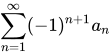
| 3. Alternating Series Test |
| Let be a positive, decreasing sequence where |
| Then, and |
| converge. |


Solution:
(a)
| Step 1: |
|---|
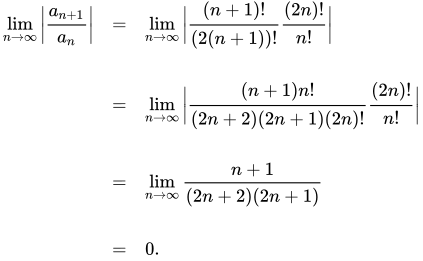
| We begin by using the Ratio Test. |
| We have |
|
|
| Step 2: |
|---|
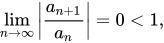
| Since |
| the series is absolutely convergent by the Ratio Test. |
| Therefore, the series converges. |
(b)
| Step 1: |
|---|
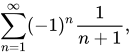
| For |
| we notice that this series is alternating. |
| Let |
| First, we have |
| for all |
| The sequence is decreasing since |
| for all |


| Step 2: |
|---|
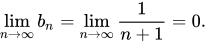
| Also, |
| Therefore, the series converges |
| by the Alternating Series Test. |
| Final Answer: |
|---|
| (a) converges (by the Ratio Test) |
| (b) converges (by the Alternating Series Test) |