Difference between revisions of "009C Sample Final 3, Problem 1"
Kayla Murray (talk | contribs) |
Kayla Murray (talk | contribs) |
||
| Line 28: | Line 28: | ||
!Step 1: | !Step 1: | ||
|- | |- | ||
| − | | | + | |Let |
| + | <math>\begin{array}{rcl} | ||
| + | \displaystyle{y} & = & \displaystyle{\lim_{n\rightarrow \infty} \bigg(1+\frac{1}{2n}\bigg)^n.} | ||
| + | \end{array}</math> | ||
|- | |- | ||
| − | | | + | |We then take the natural log of both sides to get |
|- | |- | ||
| − | | | + | | <math>\ln y = \ln\bigg(\lim_{n\rightarrow \infty} \bigg(1+\frac{1}{2n}\bigg)^n\bigg).</math> |
|} | |} | ||
{| class="mw-collapsible mw-collapsed" style = "text-align:left;" | {| class="mw-collapsible mw-collapsed" style = "text-align:left;" | ||
!Step 2: | !Step 2: | ||
| + | |- | ||
| + | |We can interchange limits and continuous functions. | ||
| + | |- | ||
| + | |Therefore, we have | ||
|- | |- | ||
| | | | ||
| + | <math>\begin{array}{rcl} | ||
| + | \displaystyle{\ln y} & = & \displaystyle{\lim_{n\rightarrow \infty} \ln \bigg(1+\frac{1}{2n}\bigg)^n}\\ | ||
| + | &&\\ | ||
| + | & = & \displaystyle{\lim_{n\rightarrow \infty} n\ln\bigg(1+\frac{1}{2n}\bigg)}\\ | ||
| + | &&\\ | ||
| + | & = & \displaystyle{\lim_{n\rightarrow \infty} \frac{\ln \bigg(1+\frac{1}{2n}\bigg)}{\frac{1}{n}}.} | ||
| + | \end{array}</math> | ||
| + | |- | ||
| + | |Now, this limit has the form <math style="vertical-align: -13px">\frac{0}{0}.</math> | ||
| + | |- | ||
| + | |Hence, we can use L'Hopital's Rule to calculate this limit. | ||
|- | |- | ||
| | | | ||
Revision as of 17:25, 5 March 2017
Which of the following sequences converges? Which diverges? Give reasons for your answers!

(a)
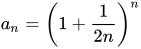
(b) Failed to parse (MathML with SVG or PNG fallback (recommended for modern browsers and accessibility tools): Invalid response ("Math extension cannot connect to Restbase.") from server "https://wikimedia.org/api/rest_v1/":): {\displaystyle a_n=\cos(n\pi)\bigg(\frac{1+n}{n}\bigg)^n}
| Foundations: |
|---|
| L'Hôpital's Rule |
|
Suppose that Failed to parse (MathML with SVG or PNG fallback (recommended for modern browsers and accessibility tools): Invalid response ("Math extension cannot connect to Restbase.") from server "https://wikimedia.org/api/rest_v1/":): {\displaystyle \lim_{x\rightarrow \infty} f(x)} and Failed to parse (MathML with SVG or PNG fallback (recommended for modern browsers and accessibility tools): Invalid response ("Math extension cannot connect to Restbase.") from server "https://wikimedia.org/api/rest_v1/":): {\displaystyle \lim_{x\rightarrow \infty} g(x)} are both zero or both Failed to parse (MathML with SVG or PNG fallback (recommended for modern browsers and accessibility tools): Invalid response ("Math extension cannot connect to Restbase.") from server "https://wikimedia.org/api/rest_v1/":): {\displaystyle \pm \infty .} |
|
If Failed to parse (MathML with SVG or PNG fallback (recommended for modern browsers and accessibility tools): Invalid response ("Math extension cannot connect to Restbase.") from server "https://wikimedia.org/api/rest_v1/":): {\displaystyle \lim_{x\rightarrow \infty} \frac{f'(x)}{g'(x)}} is finite or Failed to parse (MathML with SVG or PNG fallback (recommended for modern browsers and accessibility tools): Invalid response ("Math extension cannot connect to Restbase.") from server "https://wikimedia.org/api/rest_v1/":): {\displaystyle \pm \infty ,} |
|
then Failed to parse (MathML with SVG or PNG fallback (recommended for modern browsers and accessibility tools): Invalid response ("Math extension cannot connect to Restbase.") from server "https://wikimedia.org/api/rest_v1/":): {\displaystyle \lim_{x\rightarrow \infty} \frac{f(x)}{g(x)}\,=\,\lim_{x\rightarrow \infty} \frac{f'(x)}{g'(x)}.} |
Solution:
(a)
| Step 1: |
|---|
| Let
Failed to parse (MathML with SVG or PNG fallback (recommended for modern browsers and accessibility tools): Invalid response ("Math extension cannot connect to Restbase.") from server "https://wikimedia.org/api/rest_v1/":): {\displaystyle \begin{array}{rcl} \displaystyle{y} & = & \displaystyle{\lim_{n\rightarrow \infty} \bigg(1+\frac{1}{2n}\bigg)^n.} \end{array}} |
| We then take the natural log of both sides to get |
| Failed to parse (MathML with SVG or PNG fallback (recommended for modern browsers and accessibility tools): Invalid response ("Math extension cannot connect to Restbase.") from server "https://wikimedia.org/api/rest_v1/":): {\displaystyle \ln y = \ln\bigg(\lim_{n\rightarrow \infty} \bigg(1+\frac{1}{2n}\bigg)^n\bigg).} |
| Step 2: |
|---|
| We can interchange limits and continuous functions. |
| Therefore, we have |
|
Failed to parse (MathML with SVG or PNG fallback (recommended for modern browsers and accessibility tools): Invalid response ("Math extension cannot connect to Restbase.") from server "https://wikimedia.org/api/rest_v1/":): {\displaystyle \begin{array}{rcl} \displaystyle{\ln y} & = & \displaystyle{\lim_{n\rightarrow \infty} \ln \bigg(1+\frac{1}{2n}\bigg)^n}\\ &&\\ & = & \displaystyle{\lim_{n\rightarrow \infty} n\ln\bigg(1+\frac{1}{2n}\bigg)}\\ &&\\ & = & \displaystyle{\lim_{n\rightarrow \infty} \frac{\ln \bigg(1+\frac{1}{2n}\bigg)}{\frac{1}{n}}.} \end{array}} |
| Now, this limit has the form Failed to parse (MathML with SVG or PNG fallback (recommended for modern browsers and accessibility tools): Invalid response ("Math extension cannot connect to Restbase.") from server "https://wikimedia.org/api/rest_v1/":): {\displaystyle \frac{0}{0}.} |
| Hence, we can use L'Hopital's Rule to calculate this limit. |
(b)
| Step 1: |
|---|
| Step 2: |
|---|
| Final Answer: |
|---|
| (a) |
| (b) |