Difference between revisions of "009C Sample Final 3, Problem 6"
Jump to navigation
Jump to search
Kayla Murray (talk | contribs) |
Kayla Murray (talk | contribs) |
||
| Line 197: | Line 197: | ||
!Step 2: | !Step 2: | ||
|- | |- | ||
| − | | | + | |Thus, |
|- | |- | ||
| <math>\begin{array}{rcl} | | <math>\begin{array}{rcl} | ||
| Line 205: | Line 205: | ||
\end{array}</math> | \end{array}</math> | ||
|- | |- | ||
| − | |Since there is no constant term in the series <math>\sum_{n=0}^\infty (-1)^n \frac{x^{n+1}}{n+1}, | + | |Since there is no constant term in the series <math style="vertical-align: -20px">\sum_{n=0}^\infty (-1)^n \frac{x^{n+1}}{n+1},~C=0.</math> |
| − | |||
| − | |||
|- | |- | ||
|Hence, | |Hence, | ||
Revision as of 17:19, 5 March 2017
Consider the power series
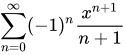
(a) Find the radius of convergence of the above power series.
(b) Find the interval of convergence of the above power series.
(c) Find the closed formula for the function to which the power series converges.

(d) Does the series
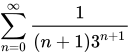
converge? If so, find its sum.
| Foundations: |
|---|
| 1. Ratio Test |
| Let be a series and |
| Then, |
|
If the series is absolutely convergent. |
|
If the series is divergent. |
|
If the test is inconclusive. |
| 2. Direct Comparison Test |
| Let and be positive sequences where Failed to parse (Conversion error. Server ("https://wikimedia.org/api/rest_") reported: "Cannot get mml. Server problem."): {\displaystyle a_{n}\leq b_{n}} |
| for all Failed to parse (Conversion error. Server ("https://wikimedia.org/api/rest_") reported: "Cannot get mml. Server problem."): {\displaystyle n\geq N} for some Failed to parse (Conversion error. Server ("https://wikimedia.org/api/rest_") reported: "Cannot get mml. Server problem."): {\displaystyle N\geq 1.} |
| 1. If converges, then converges. |
| 2. If diverges, then diverges. |


Solution:
(a)
| Step 1: |
|---|
| We use the Ratio Test to determine the radius of convergence. |
| We have |
|
|

| Step 2: |
|---|
| The Ratio Test tells us this series is absolutely convergent if |
| Hence, the Radius of Convergence of this series is |


(b)
| Step 1: |
|---|
| First, note that corresponds to the interval |
| To obtain the interval of convergence, we need to test the endpoints of this interval |
| for convergence since the Ratio Test is inconclusive when |


| Step 2: |
|---|
| First, let |
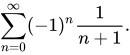
| Then, the series becomes |
| This is an alternating series. |
| Let . |
| The sequence is decreasing since |
| for all |
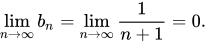
| Also, |
| Therefore, this series converges by the Alternating Series Test |
| and we include in our interval. |




| Step 3: |
|---|
| Now, let |
| Then, the series becomes |
| Failed to parse (MathML with SVG or PNG fallback (recommended for modern browsers and accessibility tools): Invalid response ("Math extension cannot connect to Restbase.") from server "https://wikimedia.org/api/rest_v1/":): {\displaystyle \begin{array}{rcl} \displaystyle{\sum_{n=0}^\infty \frac{(-1)^{2n+1}}{n+1}} & = & \displaystyle{\sum_{n=1}^\infty \frac{-1}{n+1}}\\ &&\\ & = & \displaystyle{(-1)\sum_{n=1}^\infty \frac{1}{n+1}.} \end{array}} |
| Now, we note that |
| Failed to parse (MathML with SVG or PNG fallback (recommended for modern browsers and accessibility tools): Invalid response ("Math extension cannot connect to Restbase.") from server "https://wikimedia.org/api/rest_v1/":): {\displaystyle \frac{1}{n+1}>0} |
| for all Failed to parse (MathML with SVG or PNG fallback (recommended for modern browsers and accessibility tools): Invalid response ("Math extension cannot connect to Restbase.") from server "https://wikimedia.org/api/rest_v1/":): {\displaystyle n\ge 0.} |
| This means that we can use the limit comparison test on this series. |
| Let Failed to parse (MathML with SVG or PNG fallback (recommended for modern browsers and accessibility tools): Invalid response ("Math extension cannot connect to Restbase.") from server "https://wikimedia.org/api/rest_v1/":): {\displaystyle a_n=\frac{1}{n+1}.} |
| Let Failed to parse (MathML with SVG or PNG fallback (recommended for modern browsers and accessibility tools): Invalid response ("Math extension cannot connect to Restbase.") from server "https://wikimedia.org/api/rest_v1/":): {\displaystyle b_n=\frac{1}{n}.} |
| Then, Failed to parse (MathML with SVG or PNG fallback (recommended for modern browsers and accessibility tools): Invalid response ("Math extension cannot connect to Restbase.") from server "https://wikimedia.org/api/rest_v1/":): {\displaystyle \sum_{n=1}^\infty b_n} diverges since it is the harmonic series. |
| We have |
| Failed to parse (MathML with SVG or PNG fallback (recommended for modern browsers and accessibility tools): Invalid response ("Math extension cannot connect to Restbase.") from server "https://wikimedia.org/api/rest_v1/":): {\displaystyle \begin{array}{rcl} \displaystyle{\lim_{n\rightarrow \infty} \frac{a_n}{b_n}} & = & \displaystyle{\lim_{n\rightarrow \infty} \frac{(\frac{1}{n+1})}{(\frac{1}{n})}}\\ &&\\ & = & \displaystyle{\lim_{n\rightarrow \infty} \frac{n}{n+1}}\\ &&\\ & = & \displaystyle{\lim_{n\rightarrow \infty} 1.} \end{array}} |
| Therefore, the series |
| Failed to parse (MathML with SVG or PNG fallback (recommended for modern browsers and accessibility tools): Invalid response ("Math extension cannot connect to Restbase.") from server "https://wikimedia.org/api/rest_v1/":): {\displaystyle \sum_{n=1}^{\infty} \frac{1}{n+1}} |
| diverges by the Limit Comparison Test. |
| Therefore, we do not include Failed to parse (MathML with SVG or PNG fallback (recommended for modern browsers and accessibility tools): Invalid response ("Math extension cannot connect to Restbase.") from server "https://wikimedia.org/api/rest_v1/":): {\displaystyle x=-1} in our interval. |

| Step 4: |
|---|
| The interval of convergence is Failed to parse (MathML with SVG or PNG fallback (recommended for modern browsers and accessibility tools): Invalid response ("Math extension cannot connect to Restbase.") from server "https://wikimedia.org/api/rest_v1/":): {\displaystyle (-1,1].} |
(c)
| Step 1: |
|---|
| Let |
| Failed to parse (MathML with SVG or PNG fallback (recommended for modern browsers and accessibility tools): Invalid response ("Math extension cannot connect to Restbase.") from server "https://wikimedia.org/api/rest_v1/":): {\displaystyle f(x)=\sum_{n=0}^\infty (-1)^n \frac{x^{n+1}}{n+1}.} |
| Then, |
| Failed to parse (MathML with SVG or PNG fallback (recommended for modern browsers and accessibility tools): Invalid response ("Math extension cannot connect to Restbase.") from server "https://wikimedia.org/api/rest_v1/":): {\displaystyle \begin{array}{rcl} \displaystyle{f'(x)} & = & \displaystyle{\frac{d}{dx}\bigg(\sum_{n=0}^\infty (-1)^n \frac{x^{n+1}}{n+1}\bigg)}\\ &&\\ & = & \displaystyle{\sum_{n=0}^\infty \frac{d}{dx}\bigg( (-1)^n \frac{x^{n+1}}{n+1}\bigg)}\\ &&\\ & = & \displaystyle{\sum_{n=0}^\infty (-1)^n x^n}\\ &&\\ & = & \displaystyle{\sum_{n=0}^\infty (-x)^n}\\ &&\\ & = & \displaystyle{\frac{1}{1-(-x)}}\\ &&\\ & = & \displaystyle{\frac{1}{1+x}.} \end{array}} |
| Step 2: |
|---|
| Thus, |
| Failed to parse (MathML with SVG or PNG fallback (recommended for modern browsers and accessibility tools): Invalid response ("Math extension cannot connect to Restbase.") from server "https://wikimedia.org/api/rest_v1/":): {\displaystyle \begin{array}{rcl} \displaystyle{f(x)} & = & \displaystyle{\int \frac{1}{1+x}~dx}\\ &&\\ & = & \displaystyle{\ln(1+x)+C.} \end{array}} |
| Since there is no constant term in the series Failed to parse (MathML with SVG or PNG fallback (recommended for modern browsers and accessibility tools): Invalid response ("Math extension cannot connect to Restbase.") from server "https://wikimedia.org/api/rest_v1/":): {\displaystyle \sum_{n=0}^\infty (-1)^n \frac{x^{n+1}}{n+1},~C=0.} |
| Hence, |
| Failed to parse (MathML with SVG or PNG fallback (recommended for modern browsers and accessibility tools): Invalid response ("Math extension cannot connect to Restbase.") from server "https://wikimedia.org/api/rest_v1/":): {\displaystyle f(x)=\ln(1+x).} |
(d)
| Step 1: |
|---|
| First, we note that |
| Failed to parse (MathML with SVG or PNG fallback (recommended for modern browsers and accessibility tools): Invalid response ("Math extension cannot connect to Restbase.") from server "https://wikimedia.org/api/rest_v1/":): {\displaystyle \frac{1}{(n+1)3^{n+1}}>0} |
| for all Failed to parse (MathML with SVG or PNG fallback (recommended for modern browsers and accessibility tools): Invalid response ("Math extension cannot connect to Restbase.") from server "https://wikimedia.org/api/rest_v1/":): {\displaystyle n\ge 0.} |
| This means that we can use a comparison test on this series. |
| Let Failed to parse (MathML with SVG or PNG fallback (recommended for modern browsers and accessibility tools): Invalid response ("Math extension cannot connect to Restbase.") from server "https://wikimedia.org/api/rest_v1/":): {\displaystyle a_n=\frac{1}{(n+1)3^{n+1}}.} |
| Step 2: |
|---|
| Let Failed to parse (MathML with SVG or PNG fallback (recommended for modern browsers and accessibility tools): Invalid response ("Math extension cannot connect to Restbase.") from server "https://wikimedia.org/api/rest_v1/":): {\displaystyle b_n=\frac{1}{3^{n+1}}.} |
| We want to compare the series in this problem with |
| Failed to parse (MathML with SVG or PNG fallback (recommended for modern browsers and accessibility tools): Invalid response ("Math extension cannot connect to Restbase.") from server "https://wikimedia.org/api/rest_v1/":): {\displaystyle \sum_{n=1}^\infty b_n=\sum_{n=1}^\infty \frac{1}{3}\bigg(\frac{1}{3}\bigg)^n.} |
| This is a geometric series with Failed to parse (MathML with SVG or PNG fallback (recommended for modern browsers and accessibility tools): Invalid response ("Math extension cannot connect to Restbase.") from server "https://wikimedia.org/api/rest_v1/":): {\displaystyle r=\frac{1}{3}.} |
| Since Failed to parse (MathML with SVG or PNG fallback (recommended for modern browsers and accessibility tools): Invalid response ("Math extension cannot connect to Restbase.") from server "https://wikimedia.org/api/rest_v1/":): {\displaystyle |r|<1,} the series Failed to parse (MathML with SVG or PNG fallback (recommended for modern browsers and accessibility tools): Invalid response ("Math extension cannot connect to Restbase.") from server "https://wikimedia.org/api/rest_v1/":): {\displaystyle \sum_{n=1}^\infty b_n} converges. |
| Step 3: |
|---|
| Also, we have Failed to parse (MathML with SVG or PNG fallback (recommended for modern browsers and accessibility tools): Invalid response ("Math extension cannot connect to Restbase.") from server "https://wikimedia.org/api/rest_v1/":): {\displaystyle a_n<b_n} since |
| Failed to parse (MathML with SVG or PNG fallback (recommended for modern browsers and accessibility tools): Invalid response ("Math extension cannot connect to Restbase.") from server "https://wikimedia.org/api/rest_v1/":): {\displaystyle \frac{1}{(n+1)3^{n+1}}<\frac{1}{3^{n+1}}} |
| for all Failed to parse (MathML with SVG or PNG fallback (recommended for modern browsers and accessibility tools): Invalid response ("Math extension cannot connect to Restbase.") from server "https://wikimedia.org/api/rest_v1/":): {\displaystyle n\ge 0.} |
| Therefore, the series Failed to parse (MathML with SVG or PNG fallback (recommended for modern browsers and accessibility tools): Invalid response ("Math extension cannot connect to Restbase.") from server "https://wikimedia.org/api/rest_v1/":): {\displaystyle \sum_{n=1}^\infty a_n} converges |
| by the Direct Comparison Test. |
| Final Answer: |
|---|
| (a) The radius of convergence is Failed to parse (MathML with SVG or PNG fallback (recommended for modern browsers and accessibility tools): Invalid response ("Math extension cannot connect to Restbase.") from server "https://wikimedia.org/api/rest_v1/":): {\displaystyle R=1.} |
| (b) Failed to parse (MathML with SVG or PNG fallback (recommended for modern browsers and accessibility tools): Invalid response ("Math extension cannot connect to Restbase.") from server "https://wikimedia.org/api/rest_v1/":): {\displaystyle (-1,1]} |
| (c) Failed to parse (MathML with SVG or PNG fallback (recommended for modern browsers and accessibility tools): Invalid response ("Math extension cannot connect to Restbase.") from server "https://wikimedia.org/api/rest_v1/":): {\displaystyle f(x)=\ln(1+x)} |
| (d) converges |