|
|
| Line 7: |
Line 7: |
| | <span class="exam">(b) Find the interval of convergence of the above power series. | | <span class="exam">(b) Find the interval of convergence of the above power series. |
| | | | |
| − | <span class="exam">(c) Find the closed formula for the function <math>f(x)</math> to which the power series converges. | + | <span class="exam">(c) Find the closed formula for the function <math style="vertical-align: -5px">f(x)</math> to which the power series converges. |
| | | | |
| | <span class="exam">(d) Does the series | | <span class="exam">(d) Does the series |
Revision as of 18:20, 4 March 2017
Consider the power series
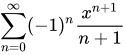
(a) Find the radius of convergence of the above power series.
(b) Find the interval of convergence of the above power series.
(c) Find the closed formula for the function Failed to parse (MathML with SVG or PNG fallback (recommended for modern browsers and accessibility tools): Invalid response ("Math extension cannot connect to Restbase.") from server "https://wikimedia.org/api/rest_v1/":): {\displaystyle f(x)}
to which the power series converges.
(d) Does the series
- Failed to parse (MathML with SVG or PNG fallback (recommended for modern browsers and accessibility tools): Invalid response ("Math extension cannot connect to Restbase.") from server "https://wikimedia.org/api/rest_v1/":): {\displaystyle \sum_{n=0}^\infty \frac{1}{(n+1)3^{n+1}}}
converge? If so, find its sum.
Solution:
(a)
(b)
(c)
(d)
| Final Answer:
|
| (a)
|
| (b)
|
| (c)
|
| (d)
|
Return to Sample Exam