Difference between revisions of "009B Sample Final 2, Problem 6"

From Grad Wiki
Jump to navigation Jump to search
Line 12: Line 12:
 
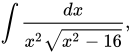
|'''1.''' For &nbsp;<math>\int \frac{dx}{x^2\sqrt{x^2-16}},</math>&nbsp; what would be the correct trig substitution?
 
|'''1.''' For &nbsp;<math>\int \frac{dx}{x^2\sqrt{x^2-16}},</math>&nbsp; what would be the correct trig substitution?
 
|-
 
|-
|&nbsp; &nbsp; &nbsp; &nbsp;The correct substitution is &nbsp;<math>x=4\sec^2\theta.</math>
+
|&nbsp; &nbsp; &nbsp; &nbsp;The correct substitution is &nbsp;<math style="vertical-align: -1px">x=4\sec^2\theta.</math>
 
|-
 
|-
 
|'''2.''' We have the Pythagorean identity  
 
|'''2.''' We have the Pythagorean identity  
Line 35: Line 35:
 
|We start by using trig substitution.  
 
|We start by using trig substitution.  
 
|-
 
|-
|Let &nbsp;<math>x=4\sec \theta.</math>
+
|Let &nbsp;<math style="vertical-align: -1px">x=4\sec \theta.</math>
 
|-
 
|-
|Then, &nbsp;<math>dx=4\sec \theta \tan \theta ~d\theta.</math>
+
|Then, &nbsp;<math style="vertical-align: -2px">dx=4\sec \theta \tan \theta ~d\theta.</math>
 
|-
 
|-
 
|So, the integral becomes
 
|So, the integral becomes
Line 81: Line 81:
 
!Step 2: &nbsp;
 
!Step 2: &nbsp;
 
|-
 
|-
|Now, we use &nbsp;<math>u</math>-substitution.
+
|Now, we use &nbsp;<math style="vertical-align: 0px">u</math>-substitution.
 
|-
 
|-
|Let &nbsp;<math>u=\sin x.</math>&nbsp; Then, &nbsp;<math>du=\cos x ~dx.</math>
+
|Let &nbsp;<math style="vertical-align: -1px">u=\sin x.</math>&nbsp; Then, &nbsp;<math style="vertical-align: -1px">du=\cos x ~dx.</math>
 
|-
 
|-
 
|Since this is a definite integral, we need to change the bounds of integration.
 
|Since this is a definite integral, we need to change the bounds of integration.
Line 89: Line 89:
 
|Then, we have
 
|Then, we have
 
|-
 
|-
|&nbsp;<math>u_1=\sin(-\pi)=0</math>&nbsp; and &nbsp;<math>u_2=\sin(\pi)=0.</math>
+
|&nbsp;<math style="vertical-align: -5px">u_1=\sin(-\pi)=0</math>&nbsp; and &nbsp;<math style="vertical-align: -5px">u_2=\sin(\pi)=0.</math>
 
|-
 
|-
 
|So, we have
 
|So, we have
Line 113: Line 113:
 
|&nbsp; &nbsp; &nbsp; &nbsp;<math>\frac{x-3}{(x+1)(x+5)}=\frac{A}{x+1}+\frac{B}{x+5}.</math>
 
|&nbsp; &nbsp; &nbsp; &nbsp;<math>\frac{x-3}{(x+1)(x+5)}=\frac{A}{x+1}+\frac{B}{x+5}.</math>
 
|-
 
|-
|If we multiply both sides of this equation by &nbsp;<math>(x+1)(x+5),</math>&nbsp; we get
+
|If we multiply both sides of this equation by &nbsp;<math style="vertical-align: -5px">(x+1)(x+5),</math>&nbsp; we get
 
|-
 
|-
 
|&nbsp; &nbsp; &nbsp; &nbsp;<math>x-3=A(x+5)+B(x+1).</math>
 
|&nbsp; &nbsp; &nbsp; &nbsp;<math>x-3=A(x+5)+B(x+1).</math>
 
|-
 
|-
|If we  let &nbsp;<math>x=-1,</math>&nbsp; we get &nbsp;<math>A=-1.</math>
+
|If we  let &nbsp;<math style="vertical-align: -4px">x=-1,</math>&nbsp; we get &nbsp;<math style="vertical-align: -1px">A=-1.</math>
 
|-
 
|-
|If we  let &nbsp;<math>x=-5,</math>&nbsp; we get &nbsp;<math>B=2.</math>
+
|If we  let &nbsp;<math style="vertical-align: -4px">x=-5,</math>&nbsp; we get &nbsp;<math style="vertical-align: -1px">B=2.</math>
 
|-
 
|-
 
|So, we have
 
|So, we have
Line 140: Line 140:
 
\end{array}</math>
 
\end{array}</math>
 
|-
 
|-
|Now, we use &nbsp;<math>u</math>-substitution for both of these integrals.  
+
|Now, we use &nbsp;<math style="vertical-align: 0px">u</math>-substitution for both of these integrals.  
 
|-
 
|-
|Let &nbsp;<math>u=x+1.</math>&nbsp; Then, &nbsp;<math>du=dx.</math>  
+
|Let &nbsp;<math style="vertical-align: -2px">u=x+1.</math>&nbsp; Then, &nbsp;<math style="vertical-align: -1px">du=dx.</math>  
 
|-
 
|-
|Let &nbsp;<math>t=x+5.</math>&nbsp; Then, &nbsp;<math>dt=dx.</math>
+
|Let &nbsp;<math style="vertical-align: -3px">t=x+5.</math>&nbsp; Then, &nbsp;<math style="vertical-align: -1px">dt=dx.</math>
 
|-
 
|-
 
|Since these are definite integrals, we need to change the bounds of integration.
 
|Since these are definite integrals, we need to change the bounds of integration.
 
|-
 
|-
|We have &nbsp;<math>u_1=0+1=1</math>&nbsp; and &nbsp;<math>u_2=1+1=2.</math>
+
|We have &nbsp;<math style="vertical-align: -4px">u_1=0+1=1</math>&nbsp; and &nbsp;<math style="vertical-align: -4px">u_2=1+1=2.</math>
 
|-
 
|-
|Also, &nbsp;<math>t_1=0+5=5</math>&nbsp; and &nbsp;<math>u_2=1+5=6.</math>   
+
|Also, &nbsp;<math style="vertical-align: -4px">t_1=0+5=5</math>&nbsp; and &nbsp;<math style="vertical-align: -4px">t_2=1+5=6.</math>   
 
|-
 
|-
 
|Therefore, we get
 
|Therefore, we get

Revision as of 13:26, 4 March 2017

Evaluate the following integrals:

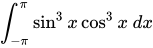
(a)  
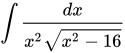
(b)  
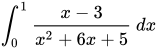
(c)  
Foundations:  
1. For    what would be the correct trig substitution?
       The correct substitution is  
2. We have the Pythagorean identity
       
3. Through partial fraction decomposition, we can write the fraction
       
       for some constants


Solution:

(a)

Step 1:  
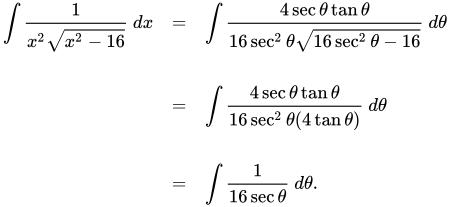
We start by using trig substitution.
Let  
Then,  
So, the integral becomes
        Failed to parse (MathML with SVG or PNG fallback (recommended for modern browsers and accessibility tools): Invalid response ("Math extension cannot connect to Restbase.") from server "https://wikimedia.org/api/rest_v1/":): {\displaystyle \begin{array}{rcl} \displaystyle{\int \frac{1}{x^2\sqrt{x^2-16}}~dx} & = & \displaystyle{\int \frac{4\sec \theta \tan \theta}{16\sec^2\theta \sqrt{16\sec^2 \theta -16}}~d\theta}\\ &&\\ & = & \displaystyle{\int \frac{4\sec \theta \tan \theta}{16\sec^2\theta (4\tan \theta)} ~d\theta}\\ &&\\ & = & \displaystyle{\int \frac{1}{16\sec \theta} ~d\theta.} \end{array}}
Step 2:  
Now, we integrate to get
        Failed to parse (MathML with SVG or PNG fallback (recommended for modern browsers and accessibility tools): Invalid response ("Math extension cannot connect to Restbase.") from server "https://wikimedia.org/api/rest_v1/":): {\displaystyle \begin{array}{rcl} \displaystyle{\int \frac{1}{x^2\sqrt{x^2-16}}~dx} & = & \displaystyle{\frac{1}{16}\cos\theta~d\theta}\\ &&\\ & = & \displaystyle{\frac{1}{16}\sin \theta +C}\\ &&\\ & = & \displaystyle{\frac{1}{16}\bigg(\frac{\sqrt{x^2-16}}{x}\bigg)+C.} \end{array}}

(b)

Step 1:  
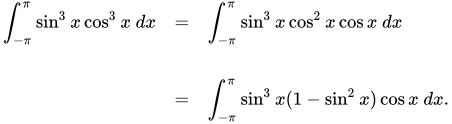
First, we write
        Failed to parse (MathML with SVG or PNG fallback (recommended for modern browsers and accessibility tools): Invalid response ("Math extension cannot connect to Restbase.") from server "https://wikimedia.org/api/rest_v1/":): {\displaystyle \begin{array}{rcl} \displaystyle{\int_{-\pi}^\pi \sin^3x\cos^3x~dx} & = & \displaystyle{\int_{-\pi}^{\pi} \sin^3x \cos^2x \cos x~dx}\\ &&\\ & = & \displaystyle{\int_{-\pi}^{\pi} \sin^3x (1-\sin^2x)\cos x~dx.} \end{array}}
Step 2:  
Now, we use  Failed to parse (MathML with SVG or PNG fallback (recommended for modern browsers and accessibility tools): Invalid response ("Math extension cannot connect to Restbase.") from server "https://wikimedia.org/api/rest_v1/":): {\displaystyle u} -substitution.
Let  Failed to parse (MathML with SVG or PNG fallback (recommended for modern browsers and accessibility tools): Invalid response ("Math extension cannot connect to Restbase.") from server "https://wikimedia.org/api/rest_v1/":): {\displaystyle u=\sin x.}   Then,  Failed to parse (MathML with SVG or PNG fallback (recommended for modern browsers and accessibility tools): Invalid response ("Math extension cannot connect to Restbase.") from server "https://wikimedia.org/api/rest_v1/":): {\displaystyle du=\cos x ~dx.}
Since this is a definite integral, we need to change the bounds of integration.
Then, we have
 Failed to parse (MathML with SVG or PNG fallback (recommended for modern browsers and accessibility tools): Invalid response ("Math extension cannot connect to Restbase.") from server "https://wikimedia.org/api/rest_v1/":): {\displaystyle u_1=\sin(-\pi)=0}   and  Failed to parse (MathML with SVG or PNG fallback (recommended for modern browsers and accessibility tools): Invalid response ("Math extension cannot connect to Restbase.") from server "https://wikimedia.org/api/rest_v1/":): {\displaystyle u_2=\sin(\pi)=0.}
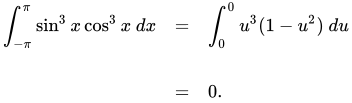
So, we have
        Failed to parse (MathML with SVG or PNG fallback (recommended for modern browsers and accessibility tools): Invalid response ("Math extension cannot connect to Restbase.") from server "https://wikimedia.org/api/rest_v1/":): {\displaystyle \begin{array}{rcl} \displaystyle{\int_{-\pi}^\pi \sin^3x\cos^3x~dx} & = & \displaystyle{\int_0^0 u^3(1-u^2)~du}\\ &&\\ & = & \displaystyle{0.} \end{array}}

(c)

Step 1:  
First, we write
       Failed to parse (MathML with SVG or PNG fallback (recommended for modern browsers and accessibility tools): Invalid response ("Math extension cannot connect to Restbase.") from server "https://wikimedia.org/api/rest_v1/":): {\displaystyle \int_0^1 \frac{x-3}{x^2+6x+5}~dx=\int_0^1 \frac{x-3}{(x+1)(x+5)}~dx.}
Now, we use partial fraction decomposition. Wet set
       Failed to parse (MathML with SVG or PNG fallback (recommended for modern browsers and accessibility tools): Invalid response ("Math extension cannot connect to Restbase.") from server "https://wikimedia.org/api/rest_v1/":): {\displaystyle \frac{x-3}{(x+1)(x+5)}=\frac{A}{x+1}+\frac{B}{x+5}.}
If we multiply both sides of this equation by  Failed to parse (MathML with SVG or PNG fallback (recommended for modern browsers and accessibility tools): Invalid response ("Math extension cannot connect to Restbase.") from server "https://wikimedia.org/api/rest_v1/":): {\displaystyle (x+1)(x+5),}   we get
       Failed to parse (MathML with SVG or PNG fallback (recommended for modern browsers and accessibility tools): Invalid response ("Math extension cannot connect to Restbase.") from server "https://wikimedia.org/api/rest_v1/":): {\displaystyle x-3=A(x+5)+B(x+1).}
If we let  Failed to parse (MathML with SVG or PNG fallback (recommended for modern browsers and accessibility tools): Invalid response ("Math extension cannot connect to Restbase.") from server "https://wikimedia.org/api/rest_v1/":): {\displaystyle x=-1,}   we get  Failed to parse (MathML with SVG or PNG fallback (recommended for modern browsers and accessibility tools): Invalid response ("Math extension cannot connect to Restbase.") from server "https://wikimedia.org/api/rest_v1/":): {\displaystyle A=-1.}
If we let  Failed to parse (MathML with SVG or PNG fallback (recommended for modern browsers and accessibility tools): Invalid response ("Math extension cannot connect to Restbase.") from server "https://wikimedia.org/api/rest_v1/":): {\displaystyle x=-5,}   we get  Failed to parse (MathML with SVG or PNG fallback (recommended for modern browsers and accessibility tools): Invalid response ("Math extension cannot connect to Restbase.") from server "https://wikimedia.org/api/rest_v1/":): {\displaystyle B=2.}
So, we have
       Failed to parse (MathML with SVG or PNG fallback (recommended for modern browsers and accessibility tools): Invalid response ("Math extension cannot connect to Restbase.") from server "https://wikimedia.org/api/rest_v1/":): {\displaystyle \frac{x-3}{(x+1)(x+5)}=\frac{-1}{x+1}+\frac{2}{x+5}.}
Step 2:  
Now, we have

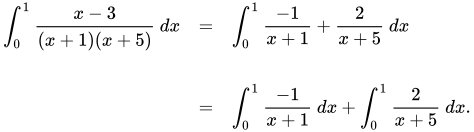
        Failed to parse (MathML with SVG or PNG fallback (recommended for modern browsers and accessibility tools): Invalid response ("Math extension cannot connect to Restbase.") from server "https://wikimedia.org/api/rest_v1/":): {\displaystyle \begin{array}{rcl} \displaystyle{\int_0^1 \frac{x-3}{(x+1)(x+5)}~dx} & = & \displaystyle{\int_0^1 \frac{-1}{x+1}+\frac{2}{x+5}~dx}\\ &&\\ & = & \displaystyle{\int_0^1 \frac{-1}{x+1}~dx+\int_0^1 \frac{2}{x+5}~dx.} \end{array}}

Now, we use  Failed to parse (MathML with SVG or PNG fallback (recommended for modern browsers and accessibility tools): Invalid response ("Math extension cannot connect to Restbase.") from server "https://wikimedia.org/api/rest_v1/":): {\displaystyle u} -substitution for both of these integrals.
Let  Failed to parse (MathML with SVG or PNG fallback (recommended for modern browsers and accessibility tools): Invalid response ("Math extension cannot connect to Restbase.") from server "https://wikimedia.org/api/rest_v1/":): {\displaystyle u=x+1.}   Then,  Failed to parse (MathML with SVG or PNG fallback (recommended for modern browsers and accessibility tools): Invalid response ("Math extension cannot connect to Restbase.") from server "https://wikimedia.org/api/rest_v1/":): {\displaystyle du=dx.}
Let  Failed to parse (MathML with SVG or PNG fallback (recommended for modern browsers and accessibility tools): Invalid response ("Math extension cannot connect to Restbase.") from server "https://wikimedia.org/api/rest_v1/":): {\displaystyle t=x+5.}   Then,  Failed to parse (MathML with SVG or PNG fallback (recommended for modern browsers and accessibility tools): Invalid response ("Math extension cannot connect to Restbase.") from server "https://wikimedia.org/api/rest_v1/":): {\displaystyle dt=dx.}
Since these are definite integrals, we need to change the bounds of integration.
We have  Failed to parse (MathML with SVG or PNG fallback (recommended for modern browsers and accessibility tools): Invalid response ("Math extension cannot connect to Restbase.") from server "https://wikimedia.org/api/rest_v1/":): {\displaystyle u_1=0+1=1}   and  Failed to parse (MathML with SVG or PNG fallback (recommended for modern browsers and accessibility tools): Invalid response ("Math extension cannot connect to Restbase.") from server "https://wikimedia.org/api/rest_v1/":): {\displaystyle u_2=1+1=2.}
Also,  Failed to parse (MathML with SVG or PNG fallback (recommended for modern browsers and accessibility tools): Invalid response ("Math extension cannot connect to Restbase.") from server "https://wikimedia.org/api/rest_v1/":): {\displaystyle t_1=0+5=5}   and  Failed to parse (MathML with SVG or PNG fallback (recommended for modern browsers and accessibility tools): Invalid response ("Math extension cannot connect to Restbase.") from server "https://wikimedia.org/api/rest_v1/":): {\displaystyle t_2=1+5=6.}
Therefore, we get
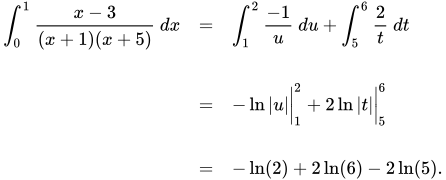
        Failed to parse (MathML with SVG or PNG fallback (recommended for modern browsers and accessibility tools): Invalid response ("Math extension cannot connect to Restbase.") from server "https://wikimedia.org/api/rest_v1/":): {\displaystyle \begin{array}{rcl} \displaystyle{\int_0^1 \frac{x-3}{(x+1)(x+5)}~dx} & = & \displaystyle{\int_1^2 \frac{-1}{u}~du+\int_5^6 \frac{2}{t}~dt}\\ &&\\ & = & \displaystyle{-\ln|u|\bigg|_1^2+2\ln|t|\bigg|_5^6}\\ &&\\ & = & \displaystyle{-\ln(2)+2\ln(6)-2\ln(5).} \end{array}}


Final Answer:  
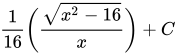
   (a)    Failed to parse (MathML with SVG or PNG fallback (recommended for modern browsers and accessibility tools): Invalid response ("Math extension cannot connect to Restbase.") from server "https://wikimedia.org/api/rest_v1/":): {\displaystyle \frac{1}{16}\bigg(\frac{\sqrt{x^2-16}}{x}\bigg)+C}
   (b)    Failed to parse (MathML with SVG or PNG fallback (recommended for modern browsers and accessibility tools): Invalid response ("Math extension cannot connect to Restbase.") from server "https://wikimedia.org/api/rest_v1/":): {\displaystyle 0}
   (c)    Failed to parse (MathML with SVG or PNG fallback (recommended for modern browsers and accessibility tools): Invalid response ("Math extension cannot connect to Restbase.") from server "https://wikimedia.org/api/rest_v1/":): {\displaystyle -\ln(2)+2\ln(6)-2\ln(5)}

Return to Sample Exam