Difference between revisions of "009B Sample Final 3, Problem 2"
Kayla Murray (talk | contribs) |
Kayla Murray (talk | contribs) |
||
| Line 45: | Line 45: | ||
!Step 1: | !Step 1: | ||
|- | |- | ||
| − | | | + | |First, we notice |
| + | |- | ||
| + | | <math>\int_0^{\frac{\sqrt{3}}{4}} \frac{1}{1+16x^2}~dx=\int_0^{\frac{\sqrt{3}}{4}} \frac{1}{1+(4x)^2}~dx.</math> | ||
| + | |- | ||
| + | |Now, we use <math>u</math>-substitution. | ||
| + | |- | ||
| + | |Let <math style="vertical-align: -5px">u=4x.</math> | ||
| + | |- | ||
| + | |Then, <math style="vertical-align: -5px">du=4dx</math> and <math>\frac{du}{4}=dx.</math> | ||
| + | |- | ||
| + | |Also, we need to change the bounds of integration. | ||
| + | |- | ||
| + | |Plugging in our values into the equation <math style="vertical-align: -5px">u=4x,</math> | ||
| + | |- | ||
| + | |we get <math style="vertical-align: -15px">u_1=4(0)=0</math> and <math style="vertical-align: -16px">u_2=4\bigg(\frac{\sqrt{3}}{4}\bigg)=\sqrt{3}.</math> | ||
|- | |- | ||
| − | | | + | |Therefore, the integral becomes |
|- | |- | ||
| − | | | + | | <math style="vertical-align: -19px">\frac{1}{4}\int_0^{\sqrt{3}} \frac{1}{1+u^2}~du.</math> |
|- | |- | ||
| | | | ||
| Line 57: | Line 71: | ||
!Step 2: | !Step 2: | ||
|- | |- | ||
| − | | | + | |We now have |
| − | |||
| − | |||
| − | |||
| − | |||
|- | |- | ||
| | | | ||
| + | <math>\begin{array}{rcl} | ||
| + | \displaystyle{\int_0^{\frac{\sqrt{3}}{4}} \frac{1}{1+16x^2}~dx} & = & \displaystyle{\frac{1}{4}\int_0^{\sqrt{3}} \frac{1}{1+u^2}~du}\\ | ||
| + | &&\\ | ||
| + | & = & \displaystyle{\frac{1}{4}\arctan(u)\bigg|_0^{\sqrt{3}}}\\ | ||
| + | &&\\ | ||
| + | & = & \displaystyle{\frac{1}{4}\arctan(\sqrt{3})-\frac{1}{4}\arctan(0)}\\ | ||
| + | &&\\ | ||
| + | & = & \displaystyle{\frac{1}{4}\bigg(\frac{\pi}{3}\bigg)-0}\\ | ||
| + | &&\\ | ||
| + | & = & \displaystyle{\frac{\pi}{12}.} | ||
| + | \end{array}</math> | ||
|} | |} | ||
| Line 106: | Line 127: | ||
!Final Answer: | !Final Answer: | ||
|- | |- | ||
| − | |'''(a)''' | + | | '''(a)''' <math>\frac{\pi}{12}</math> |
|- | |- | ||
| − | |'''(b)''' | + | | '''(b)''' |
|- | |- | ||
| − | |'''(c)''' | + | | '''(c)''' |
|} | |} | ||
[[009B_Sample_Final_3|'''<u>Return to Sample Exam</u>''']] | [[009B_Sample_Final_3|'''<u>Return to Sample Exam</u>''']] | ||
Revision as of 16:18, 1 March 2017
Evaluate the following integrals.
(a)
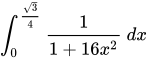
(b)

(c) Failed to parse (MathML with SVG or PNG fallback (recommended for modern browsers and accessibility tools): Invalid response ("Math extension cannot connect to Restbase.") from server "https://wikimedia.org/api/rest_v1/":): {\displaystyle \int_1^e \frac{\cos(\ln(x))}{x}~dx}
| Foundations: |
|---|
| 1. |
| Failed to parse (MathML with SVG or PNG fallback (recommended for modern browsers and accessibility tools): Invalid response ("Math extension cannot connect to Restbase.") from server "https://wikimedia.org/api/rest_v1/":): {\displaystyle \int \frac{1}{1+x^2}~dx=\arctan(x)+C} |
| 2. How would you integrate Failed to parse (MathML with SVG or PNG fallback (recommended for modern browsers and accessibility tools): Invalid response ("Math extension cannot connect to Restbase.") from server "https://wikimedia.org/api/rest_v1/":): {\displaystyle \int \frac{\ln x}{x}~dx?} |
|
You could use Failed to parse (MathML with SVG or PNG fallback (recommended for modern browsers and accessibility tools): Invalid response ("Math extension cannot connect to Restbase.") from server "https://wikimedia.org/api/rest_v1/":): {\displaystyle u} -substitution. |
| Let Failed to parse (MathML with SVG or PNG fallback (recommended for modern browsers and accessibility tools): Invalid response ("Math extension cannot connect to Restbase.") from server "https://wikimedia.org/api/rest_v1/":): {\displaystyle u=\ln(x).} |
| Then, Failed to parse (MathML with SVG or PNG fallback (recommended for modern browsers and accessibility tools): Invalid response ("Math extension cannot connect to Restbase.") from server "https://wikimedia.org/api/rest_v1/":): {\displaystyle du=\frac{1}{x}dx.} |
|
Thus, |
|
Failed to parse (MathML with SVG or PNG fallback (recommended for modern browsers and accessibility tools): Invalid response ("Math extension cannot connect to Restbase.") from server "https://wikimedia.org/api/rest_v1/":): {\displaystyle \begin{array}{rcl} \displaystyle{\int \frac{\ln x}{x}~dx} & = & \displaystyle{\int u~du}\\ &&\\ & = & \displaystyle{\frac{u^2}{2}+C}\\ &&\\ & = & \displaystyle{\frac{(\ln x)^2}{2}+C.} \end{array}} |
Solution:
(a)
| Step 1: |
|---|
| First, we notice |
| Failed to parse (MathML with SVG or PNG fallback (recommended for modern browsers and accessibility tools): Invalid response ("Math extension cannot connect to Restbase.") from server "https://wikimedia.org/api/rest_v1/":): {\displaystyle \int_0^{\frac{\sqrt{3}}{4}} \frac{1}{1+16x^2}~dx=\int_0^{\frac{\sqrt{3}}{4}} \frac{1}{1+(4x)^2}~dx.} |
| Now, we use Failed to parse (MathML with SVG or PNG fallback (recommended for modern browsers and accessibility tools): Invalid response ("Math extension cannot connect to Restbase.") from server "https://wikimedia.org/api/rest_v1/":): {\displaystyle u} -substitution. |
| Let Failed to parse (MathML with SVG or PNG fallback (recommended for modern browsers and accessibility tools): Invalid response ("Math extension cannot connect to Restbase.") from server "https://wikimedia.org/api/rest_v1/":): {\displaystyle u=4x.} |
| Then, Failed to parse (MathML with SVG or PNG fallback (recommended for modern browsers and accessibility tools): Invalid response ("Math extension cannot connect to Restbase.") from server "https://wikimedia.org/api/rest_v1/":): {\displaystyle du=4dx} and Failed to parse (MathML with SVG or PNG fallback (recommended for modern browsers and accessibility tools): Invalid response ("Math extension cannot connect to Restbase.") from server "https://wikimedia.org/api/rest_v1/":): {\displaystyle \frac{du}{4}=dx.} |
| Also, we need to change the bounds of integration. |
| Plugging in our values into the equation Failed to parse (MathML with SVG or PNG fallback (recommended for modern browsers and accessibility tools): Invalid response ("Math extension cannot connect to Restbase.") from server "https://wikimedia.org/api/rest_v1/":): {\displaystyle u=4x,} |
| we get Failed to parse (MathML with SVG or PNG fallback (recommended for modern browsers and accessibility tools): Invalid response ("Math extension cannot connect to Restbase.") from server "https://wikimedia.org/api/rest_v1/":): {\displaystyle u_1=4(0)=0} and Failed to parse (MathML with SVG or PNG fallback (recommended for modern browsers and accessibility tools): Invalid response ("Math extension cannot connect to Restbase.") from server "https://wikimedia.org/api/rest_v1/":): {\displaystyle u_2=4\bigg(\frac{\sqrt{3}}{4}\bigg)=\sqrt{3}.} |
| Therefore, the integral becomes |
| Failed to parse (MathML with SVG or PNG fallback (recommended for modern browsers and accessibility tools): Invalid response ("Math extension cannot connect to Restbase.") from server "https://wikimedia.org/api/rest_v1/":): {\displaystyle \frac{1}{4}\int_0^{\sqrt{3}} \frac{1}{1+u^2}~du.} |
| Step 2: |
|---|
| We now have |
|
Failed to parse (MathML with SVG or PNG fallback (recommended for modern browsers and accessibility tools): Invalid response ("Math extension cannot connect to Restbase.") from server "https://wikimedia.org/api/rest_v1/":): {\displaystyle \begin{array}{rcl} \displaystyle{\int_0^{\frac{\sqrt{3}}{4}} \frac{1}{1+16x^2}~dx} & = & \displaystyle{\frac{1}{4}\int_0^{\sqrt{3}} \frac{1}{1+u^2}~du}\\ &&\\ & = & \displaystyle{\frac{1}{4}\arctan(u)\bigg|_0^{\sqrt{3}}}\\ &&\\ & = & \displaystyle{\frac{1}{4}\arctan(\sqrt{3})-\frac{1}{4}\arctan(0)}\\ &&\\ & = & \displaystyle{\frac{1}{4}\bigg(\frac{\pi}{3}\bigg)-0}\\ &&\\ & = & \displaystyle{\frac{\pi}{12}.} \end{array}} |
(b)
| Step 1: |
|---|
| Step 2: |
|---|
(c)
| Step 1: |
|---|
| Step 2: |
|---|
| Final Answer: |
|---|
| (a) Failed to parse (MathML with SVG or PNG fallback (recommended for modern browsers and accessibility tools): Invalid response ("Math extension cannot connect to Restbase.") from server "https://wikimedia.org/api/rest_v1/":): {\displaystyle \frac{\pi}{12}} |
| (b) |
| (c) |