Difference between revisions of "009C Sample Midterm 1, Problem 1"
Kayla Murray (talk | contribs) |
Kayla Murray (talk | contribs) |
||
| Line 37: | Line 37: | ||
| <math>\lim_{n\rightarrow \infty} n=\infty.</math> | | <math>\lim_{n\rightarrow \infty} n=\infty.</math> | ||
|- | |- | ||
| − | |Therefore, the limit has the form <math>\frac{\infty}{\infty},</math> | + | |Therefore, the limit has the form <math style="vertical-align: -11px">\frac{\infty}{\infty},</math> |
|- | |- | ||
|which means we can use L'Hopital's Rule to calculate this limit. | |which means we can use L'Hopital's Rule to calculate this limit. | ||
| Line 45: | Line 45: | ||
!Step 2: | !Step 2: | ||
|- | |- | ||
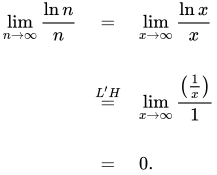
| − | |First, we switch to the variable <math>x</math> so we have functions and | + | |First, we switch to the variable <math style="vertical-align: 0px">x</math> so we have functions and |
|- | |- | ||
|can take derivatives. Thus, using L'Hopital's Rule, we have | |can take derivatives. Thus, using L'Hopital's Rule, we have | ||
Revision as of 09:25, 14 February 2017
Does the following sequence converge or diverge?
If the sequence converges, also find the limit of the sequence.
Be sure to jusify your answers!
- Failed to parse (MathML with SVG or PNG fallback (recommended for modern browsers and accessibility tools): Invalid response ("Math extension cannot connect to Restbase.") from server "https://wikimedia.org/api/rest_v1/":): {\displaystyle a_n=\frac{\ln n}{n}}
| Foundations: |
|---|
| L'Hôpital's Rule |
|
Suppose that Failed to parse (MathML with SVG or PNG fallback (recommended for modern browsers and accessibility tools): Invalid response ("Math extension cannot connect to Restbase.") from server "https://wikimedia.org/api/rest_v1/":): {\displaystyle \lim_{x\rightarrow \infty} f(x)} and Failed to parse (MathML with SVG or PNG fallback (recommended for modern browsers and accessibility tools): Invalid response ("Math extension cannot connect to Restbase.") from server "https://wikimedia.org/api/rest_v1/":): {\displaystyle \lim_{x\rightarrow \infty} g(x)} are both zero or both Failed to parse (MathML with SVG or PNG fallback (recommended for modern browsers and accessibility tools): Invalid response ("Math extension cannot connect to Restbase.") from server "https://wikimedia.org/api/rest_v1/":): {\displaystyle \pm \infty .} |
|
If Failed to parse (MathML with SVG or PNG fallback (recommended for modern browsers and accessibility tools): Invalid response ("Math extension cannot connect to Restbase.") from server "https://wikimedia.org/api/rest_v1/":): {\displaystyle \lim_{x\rightarrow \infty} \frac{f'(x)}{g'(x)}} is finite or Failed to parse (MathML with SVG or PNG fallback (recommended for modern browsers and accessibility tools): Invalid response ("Math extension cannot connect to Restbase.") from server "https://wikimedia.org/api/rest_v1/":): {\displaystyle \pm \infty ,} |
|
then Failed to parse (MathML with SVG or PNG fallback (recommended for modern browsers and accessibility tools): Invalid response ("Math extension cannot connect to Restbase.") from server "https://wikimedia.org/api/rest_v1/":): {\displaystyle \lim_{x\rightarrow \infty} \frac{f(x)}{g(x)}\,=\,\lim_{x\rightarrow \infty} \frac{f'(x)}{g'(x)}.} |
Solution:
| Step 1: |
|---|
| First, we notice that |
| Failed to parse (MathML with SVG or PNG fallback (recommended for modern browsers and accessibility tools): Invalid response ("Math extension cannot connect to Restbase.") from server "https://wikimedia.org/api/rest_v1/":): {\displaystyle \lim_{n\rightarrow \infty} \ln n =\infty} |
| and |
| Failed to parse (MathML with SVG or PNG fallback (recommended for modern browsers and accessibility tools): Invalid response ("Math extension cannot connect to Restbase.") from server "https://wikimedia.org/api/rest_v1/":): {\displaystyle \lim_{n\rightarrow \infty} n=\infty.} |
| Therefore, the limit has the form Failed to parse (MathML with SVG or PNG fallback (recommended for modern browsers and accessibility tools): Invalid response ("Math extension cannot connect to Restbase.") from server "https://wikimedia.org/api/rest_v1/":): {\displaystyle \frac{\infty}{\infty},} |
| which means we can use L'Hopital's Rule to calculate this limit. |
| Step 2: |
|---|
| First, we switch to the variable Failed to parse (MathML with SVG or PNG fallback (recommended for modern browsers and accessibility tools): Invalid response ("Math extension cannot connect to Restbase.") from server "https://wikimedia.org/api/rest_v1/":): {\displaystyle x} so we have functions and |
| can take derivatives. Thus, using L'Hopital's Rule, we have |
| Final Answer: |
|---|
| Failed to parse (MathML with SVG or PNG fallback (recommended for modern browsers and accessibility tools): Invalid response ("Math extension cannot connect to Restbase.") from server "https://wikimedia.org/api/rest_v1/":): {\displaystyle 0} |