|
|
| Line 174: |
Line 174: |
| | | | | | |
| | |} | | |} |
| − | == 5 ==
| + | |
| | {| class="mw-collapsible mw-collapsed" style = "text-align:left;" | | {| class="mw-collapsible mw-collapsed" style = "text-align:left;" |
| | !Final Answer: | | !Final Answer: |
Revision as of 23:56, 25 February 2016
Compute the following integrals.
a) 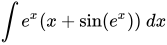
b) 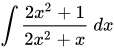
c) 
| Foundations:
|
| Recall:
|
| 1. Integration by parts tells us that Failed to parse (Conversion error. Server ("https://wikimedia.org/api/rest_") reported: "Cannot get mml. Server problem."): {\displaystyle \int u~dv=uv-\int v~du}
.
|
2. Through partial fraction decomposition, we can write the fraction  for some constants for some constants  . .
|
| 3. We have the Pythagorean identity Failed to parse (Conversion error. Server ("https://wikimedia.org/api/rest_") reported: "Cannot get mml. Server problem."): {\displaystyle \sin ^{2}(x)=1-\cos ^{2}(x)}
.
|
Solution:
(a)
| Step 1:
|
| We first distribute to get
|
- Failed to parse (Conversion error. Server ("https://wikimedia.org/api/rest_") reported: "Cannot get mml. Server problem."): {\displaystyle \int e^{x}(x+\sin(e^{x}))~dx\,=\,\int e^{x}x~dx+\int e^{x}\sin(e^{x})~dx.}
|
| Now, for the first integral on the right hand side of the last equation, we use integration by parts.
|
Let Failed to parse (Conversion error. Server ("https://wikimedia.org/api/rest_") reported: "Cannot get mml. Server problem."): {\displaystyle u=x}
and Failed to parse (Conversion error. Server ("https://wikimedia.org/api/rest_") reported: "Cannot get mml. Server problem."): {\displaystyle dv=e^{x}dx}
. Then, Failed to parse (Conversion error. Server ("https://wikimedia.org/api/rest_") reported: "Cannot get mml. Server problem."): {\displaystyle du=dx}
and  . .
|
| So, we have
|
- Failed to parse (Conversion error. Server ("https://wikimedia.org/api/rest_") reported: "Cannot get mml. Server problem."): {\displaystyle {\begin{array}{rcl}\displaystyle {\int e^{x}(x+\sin(e^{x}))~dx}&=&\displaystyle {{\bigg (}xe^{x}-\int e^{x}~dx{\bigg )}+\int e^{x}\sin(e^{x})~dx}\\&&\\&=&\displaystyle {xe^{x}-e^{x}+\int e^{x}\sin(e^{x})~dx}.\\\end{array}}}
|
| Step 2:
|
Now, for the one remaining integral, we use  -substitution. -substitution.
|
| Let Failed to parse (Conversion error. Server ("https://wikimedia.org/api/rest_") reported: "Cannot get mml. Server problem."): {\displaystyle u=e^{x}}
. Then, Failed to parse (Conversion error. Server ("https://wikimedia.org/api/rest_") reported: "Cannot get mml. Server problem."): {\displaystyle du=e^{x}dx}
.
|
| So, we have
|
- Failed to parse (Conversion error. Server ("https://wikimedia.org/api/rest_") reported: "Cannot get mml. Server problem."): {\displaystyle {\begin{array}{rcl}\displaystyle {\int e^{x}(x+\sin(e^{x}))~dx}&=&\displaystyle {xe^{x}-e^{x}+\int \sin(u)~du}\\&&\\&=&\displaystyle {xe^{x}-e^{x}-\cos(u)+C}\\&&\\&=&\displaystyle {xe^{x}-e^{x}-\cos(e^{x})+C}.\\\end{array}}}
|
3
(b)
| Step 1:
|
First, we add and subtract  from the numerator. from the numerator.
|
| So, we have
|
- Failed to parse (Conversion error. Server ("https://wikimedia.org/api/rest_") reported: "Cannot get mml. Server problem."): {\displaystyle {\begin{array}{rcl}\displaystyle {\int {\frac {2x^{2}+1}{2x^{2}+x}}~dx}&=&\displaystyle {\int {\frac {2x^{2}+x-x+1}{2x^{2}+x}}~dx}\\&&\\&=&\displaystyle {\int {\frac {2x^{2}+x}{2x^{2}+x}}~dx+\int {\frac {1-x}{2x^{2}+x}}~dx}\\&&\\&=&\displaystyle {\int ~dx+\int {\frac {1-x}{2x^{2}+x}}~dx}.\\\end{array}}}
|
| Step 2:
|
| Now, we need to use partial fraction decomposition for the second integral.
|
Since  , we let , we let 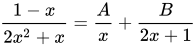 . .
|
Multiplying both sides of the last equation by  , ,
|
we get  . .
|
If we let  , the last equation becomes , the last equation becomes  . .
|
If we let  , then we get Failed to parse (Conversion error. Server ("https://wikimedia.org/api/rest_") reported: "Cannot get mml. Server problem."): {\displaystyle {\frac {3}{2}}=-{\frac {1}{2}}\,B}
. Thus, , then we get Failed to parse (Conversion error. Server ("https://wikimedia.org/api/rest_") reported: "Cannot get mml. Server problem."): {\displaystyle {\frac {3}{2}}=-{\frac {1}{2}}\,B}
. Thus,  . .
|
So, in summation, we have 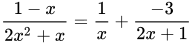 . .
|
| Step 3:
|
| If we plug in the last equation from Step 2 into our final integral in Step 1, we have
|
- Failed to parse (Conversion error. Server ("https://wikimedia.org/api/rest_") reported: "Cannot get mml. Server problem."): {\displaystyle {\begin{array}{rcl}\displaystyle {\int {\frac {2x^{2}+1}{2x^{2}+x}}~dx}&=&\displaystyle {\int ~dx+\int {\frac {1}{x}}~dx+\int {\frac {-3}{2x+1}}~dx}\\&&\\&=&\displaystyle {x+\ln x+\int {\frac {-3}{2x+1}}~dx}.\\\end{array}}}
|
| Step 4:
|
| For the final remaining integral, we use -substitution.
|
Let  . Then, . Then,  and and  . .
|
| Thus, our final integral becomes
|
- Failed to parse (Conversion error. Server ("https://wikimedia.org/api/rest_") reported: "Cannot get mml. Server problem."): {\displaystyle {\begin{array}{rcl}\displaystyle {\int {\frac {2x^{2}+1}{2x^{2}+x}}~dx}&=&\displaystyle {x+\ln x+\int {\frac {-3}{2x+1}}~dx}\\&&\\&=&\displaystyle {x+\ln x+\int {\frac {-3}{2u}}~du}\\&&\\&=&\displaystyle {x+\ln x-{\frac {3}{2}}\ln u+C}.\\\end{array}}}
|
| Therefore, the final answer is
|
- Failed to parse (Conversion error. Server ("https://wikimedia.org/api/rest_") reported: "Cannot get mml. Server problem."): {\displaystyle \int {\frac {2x^{2}+1}{2x^{2}+x}}~dx\,=\,x+\ln x-{\frac {3}{2}}\ln(2x+1)+C.}
|
4
(c)
| Step 1:
|
First, we write  . .
|
Using the identity  , we get , we get  . .
|
| If we use this identity, we have
|
 . .
|
|
|
| Step 2:
|
Now, we proceed by -substitution. Let  . Then, . Then,  . .
|
| So we have
|
- Failed to parse (Conversion error. Server ("https://wikimedia.org/api/rest_") reported: "Cannot get mml. Server problem."): {\displaystyle {\begin{array}{rcl}\displaystyle {\int \sin ^{3}x~dx}&=&\displaystyle {\int -(1-u^{2})~du}\\&&\\&=&\displaystyle {-u+{\frac {u^{3}}{3}}+C}\\&&\\&=&\displaystyle {-\cos x+{\frac {\cos ^{3}x}{3}}+C}\\\end{array}}}
|
|
|
| Final Answer:
|
(a) 
|
(b) 
|
(c) 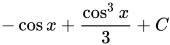
|
Return to Sample Exam