Difference between revisions of "005 Sample Final A, Question 15"
Jump to navigation
Jump to search
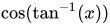
Failed to parse (MathML with SVG or PNG fallback (recommended for modern browsers and accessibility tools): Invalid response ("Math extension cannot connect to Restbase.") from server "https://wikimedia.org/api/rest_v1/":): {\displaystyle \cos(\tan^{-1}(x))}
Kayla Murray (talk | contribs) |
|||
| (One intermediate revision by one other user not shown) | |||
| Line 2: | Line 2: | ||
{| class="mw-collapsible mw-collapsed" style = "text-align:left;" | {| class="mw-collapsible mw-collapsed" style = "text-align:left;" | ||
| − | ! | + | ! Foundations |
| + | |- | ||
| + | |1) <math>\tan^{-1}(x)</math> can be thought of as <math>\tan^{-1}\left(\frac{x}{1}\right),</math> and this now refers to an angle in a triangle. What are the side lengths of this triangle? | ||
|- | |- | ||
| − | | | + | |Answers: |
| − | |||
| − | |||
| − | |||
| − | |||
|- | |- | ||
| − | | | + | |1) The side lengths are 1, x, and <math>\sqrt{1 + x^2}.</math> |
|} | |} | ||
{| class="mw-collapsible mw-collapsed" style = "text-align:left;" | {| class="mw-collapsible mw-collapsed" style = "text-align:left;" | ||
| − | ! Step | + | ! Step 1: |
|- | |- | ||
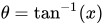
| − | | | + | |First, let <math>\theta=\tan^{-1}(x)</math>. Then, <math>\tan(\theta)=x</math>. |
| − | |||
| − | |||
|} | |} | ||
{| class="mw-collapsible mw-collapsed" style = "text-align:left;" | {| class="mw-collapsible mw-collapsed" style = "text-align:left;" | ||
| − | ! Step | + | ! Step 2: |
|- | |- | ||
| − | | | + | | Now, we draw the right triangle corresponding to <math>\theta</math>. Two of the side lengths are 1 and x and the hypotenuse has length <math>\sqrt{x^2+1}</math>. |
|} | |} | ||
{| class="mw-collapsible mw-collapsed" style = "text-align:left;" | {| class="mw-collapsible mw-collapsed" style = "text-align:left;" | ||
| − | ! Step | + | ! Step 3: |
|- | |- | ||
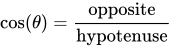
| − | | | + | | Since <math>\cos(\theta)=\frac{\mathrm{opposite}}{\mathrm{hypotenuse}}</math>, <math>\cos(\tan^{-1}(x))=\cos(\theta)=\frac{1}{\sqrt{x^2+1}}</math>. |
|- | |- | ||
| − | + | | | |
| − | |||
| − | | | ||
|} | |} | ||
| Line 40: | Line 34: | ||
! Final Answer: | ! Final Answer: | ||
|- | |- | ||
| − | | | + | | <math>\frac{1}{\sqrt{x^2+1}}</math> |
|} | |} | ||
Latest revision as of 20:13, 21 May 2015
Question Find an equivalent algebraic expression for the following,
| Foundations |
|---|
| 1) Failed to parse (MathML with SVG or PNG fallback (recommended for modern browsers and accessibility tools): Invalid response ("Math extension cannot connect to Restbase.") from server "https://wikimedia.org/api/rest_v1/":): {\displaystyle \tan^{-1}(x)} can be thought of as Failed to parse (MathML with SVG or PNG fallback (recommended for modern browsers and accessibility tools): Invalid response ("Math extension cannot connect to Restbase.") from server "https://wikimedia.org/api/rest_v1/":): {\displaystyle \tan^{-1}\left(\frac{x}{1}\right),} and this now refers to an angle in a triangle. What are the side lengths of this triangle? |
| Answers: |
| 1) The side lengths are 1, x, and Failed to parse (MathML with SVG or PNG fallback (recommended for modern browsers and accessibility tools): Invalid response ("Math extension cannot connect to Restbase.") from server "https://wikimedia.org/api/rest_v1/":): {\displaystyle \sqrt{1 + x^2}.} |
| Step 1: |
|---|
| First, let Failed to parse (MathML with SVG or PNG fallback (recommended for modern browsers and accessibility tools): Invalid response ("Math extension cannot connect to Restbase.") from server "https://wikimedia.org/api/rest_v1/":): {\displaystyle \theta=\tan^{-1}(x)} . Then, Failed to parse (MathML with SVG or PNG fallback (recommended for modern browsers and accessibility tools): Invalid response ("Math extension cannot connect to Restbase.") from server "https://wikimedia.org/api/rest_v1/":): {\displaystyle \tan(\theta)=x} . |
| Step 2: |
|---|
| Now, we draw the right triangle corresponding to Failed to parse (MathML with SVG or PNG fallback (recommended for modern browsers and accessibility tools): Invalid response ("Math extension cannot connect to Restbase.") from server "https://wikimedia.org/api/rest_v1/":): {\displaystyle \theta} . Two of the side lengths are 1 and x and the hypotenuse has length Failed to parse (MathML with SVG or PNG fallback (recommended for modern browsers and accessibility tools): Invalid response ("Math extension cannot connect to Restbase.") from server "https://wikimedia.org/api/rest_v1/":): {\displaystyle \sqrt{x^2+1}} . |
| Step 3: |
|---|
| Since Failed to parse (MathML with SVG or PNG fallback (recommended for modern browsers and accessibility tools): Invalid response ("Math extension cannot connect to Restbase.") from server "https://wikimedia.org/api/rest_v1/":): {\displaystyle \cos(\theta)=\frac{\mathrm{opposite}}{\mathrm{hypotenuse}}} , Failed to parse (MathML with SVG or PNG fallback (recommended for modern browsers and accessibility tools): Invalid response ("Math extension cannot connect to Restbase.") from server "https://wikimedia.org/api/rest_v1/":): {\displaystyle \cos(\tan^{-1}(x))=\cos(\theta)=\frac{1}{\sqrt{x^2+1}}} . |
| Final Answer: |
|---|
| Failed to parse (MathML with SVG or PNG fallback (recommended for modern browsers and accessibility tools): Invalid response ("Math extension cannot connect to Restbase.") from server "https://wikimedia.org/api/rest_v1/":): {\displaystyle \frac{1}{\sqrt{x^2+1}}} |