Difference between revisions of "004 Sample Final A, Problem 13"
Jump to navigation
Jump to search
Kayla Murray (talk | contribs) (Created page with "<span class="exam"> Compute <math>\displaystyle{\sum_{n = 1}^6 4\left(\frac{1}{2}\right)^n}</math>") |
Kayla Murray (talk | contribs) |
||
| (2 intermediate revisions by the same user not shown) | |||
| Line 1: | Line 1: | ||
<span class="exam"> Compute <math>\displaystyle{\sum_{n = 1}^6 4\left(\frac{1}{2}\right)^n}</math> | <span class="exam"> Compute <math>\displaystyle{\sum_{n = 1}^6 4\left(\frac{1}{2}\right)^n}</math> | ||
| + | {| class="mw-collapsible mw-collapsed" style = "text-align:left;" | ||
| + | ! Foundations | ||
| + | |- | ||
| + | | What is the formula for the sum of the first n terms of a geometric sequence? | ||
| + | |- | ||
| + | |Answer: | ||
| + | |- | ||
| + | |The sum of the first n terms of a geometric sequence is <math> S_n=\frac{A_1(1-r^n)}{1-r}</math> | ||
| + | |- | ||
| + | |where <math>r</math> is the common ratio and <math>A_1</math> is the first term of the geometric sequence. | ||
| + | |} | ||
| + | |||
| + | |||
| + | Solution: | ||
| + | |||
| + | {| class = "mw-collapsible mw-collapsed" style = "text-align:left;" | ||
| + | ! Step 1: | ||
| + | |- | ||
| + | |The common ratio for this geometric sequence is <math>r=\frac{1}{2}</math>. | ||
| + | |- | ||
| + | |The first term of the geometric sequence is <math>4\frac{1}{2}=2</math>. | ||
| + | |} | ||
| + | |||
| + | {|class = "mw-collapsible mw-collapsed" style = "text-align:left;" | ||
| + | ! Step 2: | ||
| + | |- | ||
| + | |Using the above formula, we have | ||
| + | |- | ||
| + | |<math>\displaystyle{\sum_{n = 1}^6 4\left(\frac{1}{2}\right)^n}=S_6=\frac{2(1-(\frac{1}{2})^6)}{(1-\frac{1}{2})}</math> | ||
| + | |} | ||
| + | |||
| + | {|class = "mw-collapsible mw-collapsed" style = "text-align:left;" | ||
| + | ! Step 3: | ||
| + | |- | ||
| + | |If we simplify, we get | ||
| + | |- | ||
| + | |<math>\displaystyle{\sum_{n = 1}^6 4\left(\frac{1}{2}\right)^n}=\frac{2(1-\frac{1}{64})}{\frac{1}{2}}=4\frac{63}{64}=\frac{63}{16}</math>. | ||
| + | |} | ||
| + | |||
| + | {|class = "mw-collapsible mw-collapsed" style = "text-align:left;" | ||
| + | ! Final Answer: | ||
| + | |- | ||
| + | |<math>\frac{63}{16}</math> | ||
| + | |} | ||
| + | |||
| + | [[004 Sample Final A|<u>'''Return to Sample Exam</u>''']] | ||
Latest revision as of 15:05, 4 May 2015
Compute

| Foundations |
|---|
| What is the formula for the sum of the first n terms of a geometric sequence? |
| Answer: |
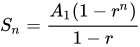
| The sum of the first n terms of a geometric sequence is |
| where is the common ratio and is the first term of the geometric sequence. |


Solution:
| Step 1: |
|---|
| The common ratio for this geometric sequence is . |
| The first term of the geometric sequence is . |


| Step 2: |
|---|
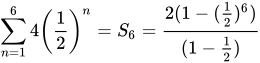
| Using the above formula, we have |
| Step 3: |
|---|
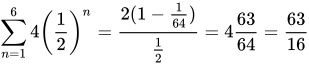
| If we simplify, we get |
| . |
| Final Answer: |
|---|
