Difference between revisions of "004 Sample Final A, Problem 5"
Jump to navigation
Jump to search
Kayla Murray (talk | contribs) (Created page with "<span class="exam"> Describe how the graph of <math style="vertical-align:-17%"> f(x) = 3^{(x+1)} - 2</math> can be obtained from a basic graph. Then sketch the graph....") |
Kayla Murray (talk | contribs) |
||
| (2 intermediate revisions by the same user not shown) | |||
| Line 1: | Line 1: | ||
<span class="exam"> Describe how the graph of <math style="vertical-align:-17%"> f(x) = 3^{(x+1)} - 2</math>  can be obtained from a basic graph. Then sketch the graph. Provide at least two ordered pairs, and the equation of any asymptote. | <span class="exam"> Describe how the graph of <math style="vertical-align:-17%"> f(x) = 3^{(x+1)} - 2</math>  can be obtained from a basic graph. Then sketch the graph. Provide at least two ordered pairs, and the equation of any asymptote. | ||
| + | {| class="mw-collapsible mw-collapsed" style = "text-align:left;" | ||
| + | ! Foundations | ||
| + | |- | ||
| + | |1) What is the basic graph of <math> f(x) = 3^{(x+1)} - 2</math>? | ||
| + | |- | ||
| + | |2) How is the graph <math>g(x)=x+1</math> obtained from <math>f(x)=x</math>? | ||
| + | |- | ||
| + | |3) How is the graph <math>g(x)=(x-3)^2</math> obtained from <math>f(x)=x^2</math>? | ||
| + | |- | ||
| + | |Answer: | ||
| + | |- | ||
| + | |1) The basic graph is <math>y=3^x</math>. | ||
| + | |- | ||
| + | |2) The graph of <math>g(x)</math> is obtained by shifting the graph of <math>f(x)</math> up 1 unit. | ||
| + | |- | ||
| + | |3) The graph of <math>g(x)</math> is obtained by shifting the graph of <math>f(x)</math> to the right by 3 units. | ||
| + | |} | ||
| + | |||
| + | |||
| + | Solution: | ||
| + | |||
| + | {| class = "mw-collapsible mw-collapsed" style = "text-align:left;" | ||
| + | ! Step 1: | ||
| + | |- | ||
| + | |We start with the basic graph of <math>g(x)=3^x</math>. | ||
| + | |- | ||
| + | |To get the graph of <math>f(x)</math> from <math>g(x)</math>, we shift the graph of <math>g(x)</math> down 2 and to the left by 1. | ||
| + | |} | ||
| + | |||
| + | {|class = "mw-collapsible mw-collapsed" style = "text-align:left;" | ||
| + | ! Step 2: | ||
| + | |- | ||
| + | |Two ordered pairs are (-1,-1), and (0,1). There is a horizontal asymptote at <math>y=-2</math>. | ||
| + | |} | ||
| + | |||
| + | {|class = "mw-collapsible mw-collapsed" style = "text-align:left;" | ||
| + | ! Final Answer: | ||
| + | |- | ||
| + | |To get the graph of <math>f(x)</math> from <math>3^x</math>, we shift the graph of <math>3^x</math> down 2 and to the left by 1. | ||
| + | |- | ||
| + | |Two ordered pairs are (-1,-1), and (0,1). There is a horizontal asymptote at <math>y=-2</math> | ||
| + | |} | ||
| + | |||
| + | [[004 Sample Final A|<u>'''Return to Sample Exam</u>''']] | ||
Latest revision as of 14:33, 11 May 2015
Describe how the graph of can be obtained from a basic graph. Then sketch the graph. Provide at least two ordered pairs, and the equation of any asymptote.

| Foundations |
|---|
| 1) What is the basic graph of ? |
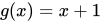
| 2) How is the graph obtained from Failed to parse (MathML with SVG or PNG fallback (recommended for modern browsers and accessibility tools): Invalid response ("Math extension cannot connect to Restbase.") from server "https://wikimedia.org/api/rest_v1/":): {\displaystyle f(x)=x} ? |
| 3) How is the graph Failed to parse (MathML with SVG or PNG fallback (recommended for modern browsers and accessibility tools): Invalid response ("Math extension cannot connect to Restbase.") from server "https://wikimedia.org/api/rest_v1/":): {\displaystyle g(x)=(x-3)^2} obtained from Failed to parse (MathML with SVG or PNG fallback (recommended for modern browsers and accessibility tools): Invalid response ("Math extension cannot connect to Restbase.") from server "https://wikimedia.org/api/rest_v1/":): {\displaystyle f(x)=x^2} ? |
| Answer: |
| 1) The basic graph is Failed to parse (MathML with SVG or PNG fallback (recommended for modern browsers and accessibility tools): Invalid response ("Math extension cannot connect to Restbase.") from server "https://wikimedia.org/api/rest_v1/":): {\displaystyle y=3^x} . |
| 2) The graph of Failed to parse (MathML with SVG or PNG fallback (recommended for modern browsers and accessibility tools): Invalid response ("Math extension cannot connect to Restbase.") from server "https://wikimedia.org/api/rest_v1/":): {\displaystyle g(x)} is obtained by shifting the graph of Failed to parse (MathML with SVG or PNG fallback (recommended for modern browsers and accessibility tools): Invalid response ("Math extension cannot connect to Restbase.") from server "https://wikimedia.org/api/rest_v1/":): {\displaystyle f(x)} up 1 unit. |
| 3) The graph of Failed to parse (MathML with SVG or PNG fallback (recommended for modern browsers and accessibility tools): Invalid response ("Math extension cannot connect to Restbase.") from server "https://wikimedia.org/api/rest_v1/":): {\displaystyle g(x)} is obtained by shifting the graph of Failed to parse (MathML with SVG or PNG fallback (recommended for modern browsers and accessibility tools): Invalid response ("Math extension cannot connect to Restbase.") from server "https://wikimedia.org/api/rest_v1/":): {\displaystyle f(x)} to the right by 3 units. |
Solution:
| Step 1: |
|---|
| We start with the basic graph of Failed to parse (MathML with SVG or PNG fallback (recommended for modern browsers and accessibility tools): Invalid response ("Math extension cannot connect to Restbase.") from server "https://wikimedia.org/api/rest_v1/":): {\displaystyle g(x)=3^x} . |
| To get the graph of Failed to parse (MathML with SVG or PNG fallback (recommended for modern browsers and accessibility tools): Invalid response ("Math extension cannot connect to Restbase.") from server "https://wikimedia.org/api/rest_v1/":): {\displaystyle f(x)} from Failed to parse (MathML with SVG or PNG fallback (recommended for modern browsers and accessibility tools): Invalid response ("Math extension cannot connect to Restbase.") from server "https://wikimedia.org/api/rest_v1/":): {\displaystyle g(x)} , we shift the graph of Failed to parse (MathML with SVG or PNG fallback (recommended for modern browsers and accessibility tools): Invalid response ("Math extension cannot connect to Restbase.") from server "https://wikimedia.org/api/rest_v1/":): {\displaystyle g(x)} down 2 and to the left by 1. |
| Step 2: |
|---|
| Two ordered pairs are (-1,-1), and (0,1). There is a horizontal asymptote at Failed to parse (MathML with SVG or PNG fallback (recommended for modern browsers and accessibility tools): Invalid response ("Math extension cannot connect to Restbase.") from server "https://wikimedia.org/api/rest_v1/":): {\displaystyle y=-2} . |
| Final Answer: |
|---|
| To get the graph of Failed to parse (MathML with SVG or PNG fallback (recommended for modern browsers and accessibility tools): Invalid response ("Math extension cannot connect to Restbase.") from server "https://wikimedia.org/api/rest_v1/":): {\displaystyle f(x)} from Failed to parse (MathML with SVG or PNG fallback (recommended for modern browsers and accessibility tools): Invalid response ("Math extension cannot connect to Restbase.") from server "https://wikimedia.org/api/rest_v1/":): {\displaystyle 3^x} , we shift the graph of Failed to parse (MathML with SVG or PNG fallback (recommended for modern browsers and accessibility tools): Invalid response ("Math extension cannot connect to Restbase.") from server "https://wikimedia.org/api/rest_v1/":): {\displaystyle 3^x} down 2 and to the left by 1. |
| Two ordered pairs are (-1,-1), and (0,1). There is a horizontal asymptote at Failed to parse (MathML with SVG or PNG fallback (recommended for modern browsers and accessibility tools): Invalid response ("Math extension cannot connect to Restbase.") from server "https://wikimedia.org/api/rest_v1/":): {\displaystyle y=-2} |