Difference between revisions of "Series - Tests for Convergence/Divergence"
| (20 intermediate revisions by the same user not shown) | |||
| Line 24: | Line 24: | ||
== The Divergence Test == | == The Divergence Test == | ||
| − | If <math style="vertical-align: -65%">{\displaystyle \lim_{k\rightarrow\infty}a_{k}\neq0,}</math> | + | If <math style="vertical-align: -65%">{\displaystyle \lim_{k\rightarrow\infty}a_{k}\neq0,}</math> then the series/sum <math style="vertical-align: -98%">\sum_{k=0}^{\infty}a_{k}</math> diverges. |
| − | |||
| − | |||
| − | |||
| − | |||
| − | |||
'''<u>Note</u>:''' The opposite result <u>''doesn't''</u> allow you to conclude a series converges. If <math style="vertical-align: -60%">{\displaystyle \lim_{k\rightarrow\infty}a_{k}=0}</math> , it merely indicates the series <u>''might''</u> converge, and you still need to confirm it through another test. | '''<u>Note</u>:''' The opposite result <u>''doesn't''</u> allow you to conclude a series converges. If <math style="vertical-align: -60%">{\displaystyle \lim_{k\rightarrow\infty}a_{k}=0}</math> , it merely indicates the series <u>''might''</u> converge, and you still need to confirm it through another test. | ||
| − | In particular, the sequence <math style="vertical-align: - | + | In particular, the sequence <math style="vertical-align: -38%">\left\{ \frac{1}{k}\right\} </math> converges to zero, but the sum <math style="vertical-align: -65%">\sum_{k=0}^{\infty}\frac{1}{k}</math> , our harmonic series, diverges. |
== The Integral Test == | == The Integral Test == | ||
| − | Suppose the function <math style="vertical-align: -20%">f(x)</math> is continuous, positive and decreasing on some interval <math style="vertical-align: -22%">[ | + | Suppose the function <math style="vertical-align: -20%">f(x)</math> is continuous, positive and decreasing on some interval <math style="vertical-align: -22%">[c,\infty)</math> with <math style="vertical-align: -13%">c\geq1</math>, |
| − | and let <math style="vertical-align: -21%">a_{k}=f(k)</math>. Then the series <math style="vertical-align: -87%">\sum_{k=b}^{\infty}a_{k}</math> is convergent if and only if | + | and let <math style="vertical-align: -21%">a_{k}=f(k)</math>. Then the series <math style="vertical-align: -87%">\sum_{k=b}^{\infty}a_{k}</math> is convergent if and only if <math style="vertical-align: -13%">c\geq b</math> and |
::<math>\int_{c}^{\infty}f(x)\, dx</math> | ::<math>\int_{c}^{\infty}f(x)\, dx</math> | ||
| Line 45: | Line 40: | ||
is convergent (not infinite). | is convergent (not infinite). | ||
| − | '''<u>Note</u>:''' This test, like many of them has a few requirements. In order to use it on a test, you need to state/show: | + | '''<u>Note</u>:''' This test, like many of them, has a few specific requirements. In order to use it on a test, you need to state/show: |
:* For all <math style="vertical-align: -15%">k\geq c</math> for some <math style="vertical-align: -15%">c\geq b</math>, the function is positive. (Most of the time, <math style="vertical-align: 0%">c</math> is just my starting index <math style="vertical-align: 0%">b</math>). | :* For all <math style="vertical-align: -15%">k\geq c</math> for some <math style="vertical-align: -15%">c\geq b</math>, the function is positive. (Most of the time, <math style="vertical-align: 0%">c</math> is just my starting index <math style="vertical-align: 0%">b</math>). | ||
| Line 61: | Line 56: | ||
:* If for all <math style="vertical-align: -15%">k\geq c</math> for some <math style="vertical-align: 0%">c</math> greater than or equal to our starting index, and <math style="vertical-align: -98%">\sum_{k=1}^{\infty} b_{k}</math> is convergent, then <math style="vertical-align: -98%">\sum_{k=1}^{\infty} a_{k}</math> is convergent. | :* If for all <math style="vertical-align: -15%">k\geq c</math> for some <math style="vertical-align: 0%">c</math> greater than or equal to our starting index, and <math style="vertical-align: -98%">\sum_{k=1}^{\infty} b_{k}</math> is convergent, then <math style="vertical-align: -98%">\sum_{k=1}^{\infty} a_{k}</math> is convergent. | ||
| − | :* If <math style="vertical-align: - | + | :* If <math style="vertical-align: -15%">a_{k}\geq b_{k}</math> for all <math style="vertical-align: 0%">k</math> and <math style="vertical-align: -98%">\sum_{k=1}^{\infty} b_{k}</math> is divergent, then <math style="vertical-align: -98%">\sum_{k=1}^{\infty} a_{k}</math> is divergent. |
| + | |||
'''<u>Note</u>:''' Requirements for this test include showing (or at least stating): | '''<u>Note</u>:''' Requirements for this test include showing (or at least stating): | ||
| Line 68: | Line 64: | ||
:* For all <math style="vertical-align: -15%">k\geq c</math>, <math style="vertical-align: -15%">a_{k}\leq b_{k}</math> for convergence, or <math style="vertical-align: -15%">a_{k}\geq b_{k}</math> for divergence. | :* For all <math style="vertical-align: -15%">k\geq c</math>, <math style="vertical-align: -15%">a_{k}\leq b_{k}</math> for convergence, or <math style="vertical-align: -15%">a_{k}\geq b_{k}</math> for divergence. | ||
| − | :* ''(This is important)'' State why <math style="vertical-align: -98%">\sum_{k=1}^{\infty} b_k</math> is convergent, such as a ''p''-series with <math style="vertical-align: - | + | :* ''(This is important)'' State why <math style="vertical-align: -98%">\sum_{k=1}^{\infty} b_k</math> is convergent, such as a ''p''-series with <math style="vertical-align: -20%">p>1</math>, or a geometric series with <math style="vertical-align: -24%">|r|<1</math>. Obviously, you would need to state why it is divergent if you're showing it's divergent. |
''Then'', you can say, "By the Comparison Test, the series is convergent (or divergent)." | ''Then'', you can say, "By the Comparison Test, the series is convergent (or divergent)." | ||
| Line 74: | Line 70: | ||
== The Limit Comparison Test == | == The Limit Comparison Test == | ||
| − | Suppose | + | Suppose <math style="vertical-align: -100%">\sum_{k=1}^{\infty} a_{k}</math> and <math style="vertical-align: -100%">\sum_{k=1}^{\infty} b_{k}</math> |
| − | are series with positive terms. If | + | are series with positive terms. If <math style="vertical-align: -75%">\lim_{k\rightarrow\infty}\frac{a_{k}}{b_{k}}=c</math> where <math style="vertical-align: -5%">0<c<\infty</math>, then either both series converge, or both series diverge. |
| − | |||
| − | \lim_{k\rightarrow\infty}\frac{a_{k}}{b_{k}}=c | ||
| − | |||
| − | |||
| − | diverge | ||
| − | |||
| − | |||
| − | \ | + | Additionally, if <math style="vertical-align: 0%">c=0</math> and <math style="vertical-align: -100%">\sum_{k=1}^{\infty} b_{k}</math> converges, <math style="vertical-align: -100%">\sum_{k=1}^{\infty} a_{k}</math> also converges. Similarly, if <math style="vertical-align: -5%">c=\infty</math>  and <math style="vertical-align: -100%">\sum_{k=1}^{\infty} b_{k}</math> diverges, then <math style="vertical-align: -100%">\sum_{k=1}^{\infty} a_{k}</math> also diverges. |
| − | |||
| − | \ | ||
| − | |||
| − | |||
| − | |||
| − | |||
| − | |||
| − | |||
| − | \ | ||
| − | |||
| − | |||
| − | |||
| − | |||
| − | |||
| − | |||
| − | |||
| − | |||
| − | Like the Comparison Test and the | + | '''<u>Note</u>''': First of all, let's mention the fundamental idea here. If some series <math style="vertical-align: -100%">\sum_{k=1}^{\infty} b_{k}</math> converges, then <math style="vertical-align: -100%">\sum_{k=1}^{\infty} cb_{k}</math> converges where <math style="vertical-align: -22%">c\neq\pm\infty </math> is a constant. This test shows that one series <u>''eventually''</u> is just like the other one multiplied by a constant, and for that reason it will also converge/diverge |
| − | terms are kind of | + | if the one compared to converges/diverges. To use it, you need to state/show: |
| − | they eventually wind up (for | + | |
| + | :*<math style="vertical-align: -15%">a_{k} </math> is eventually positive (really, non-negative). | ||
| + | |||
| + | :*<math style="vertical-align: -72%">{\displaystyle \lim_{k\rightarrow\infty}\frac{a_{k}}{b_{k}}}=c </math>. | ||
| + | |||
| + | :* State why <math style="vertical-align: -100%">\sum_{k=1}^{\infty} b_{k} </math> is convergent, such as a ''p''-series with <math style="vertical-align: -20%">p>1 </math>, or a geometric series with <math style="vertical-align: -20%">|r|<1 </math>. Obviously, you would need to state why it is divergent if you're showing it's divergent. | ||
| + | ''Then'', you can say, "By the Limit Comparison Test, the series is convergent (or divergent)." | ||
| + | |||
| + | Like the Comparison Test and the Integral Test, it's fine if the first terms are kind of "wrong" - negative, for example - as long as they eventually wind up (for <math style="vertical-align: 0%">k>c</math> for a particular <math style="vertical-align: 0%">c</math> ) meeting | ||
the requirements. | the requirements. | ||
| − | \ | + | == The Alternating Series Test == |
| + | |||
| + | If a series <math>\sum_{k=1}^{\infty} a_{k}</math> is | ||
| + | :*Alternating in sign, and | ||
| − | = | + | :*<math>\lim_{k\rightarrow 0}|a_{k}|=0,</math> |
| − | |||
| − | |||
| − | |||
| − | |||
| − | |||
then the series is convergent. | then the series is convergent. | ||
| − | + | '''<u>Note</u>:''' This is a fairly straightfoward test. You only need to do two things: | |
| − | You only need to do two things: | + | |
| − | + | :*Mention the series is alternating (even though it's usually obvious). | |
| − | + | ||
| − | + | :*Show the limit converges to zero. | |
| − | + | ||
| − | + | ''Then'', you can say, "By the Alternating Series Test, the series is convergent." | |
| − | Test, the series is convergent. | ||
| − | As an additional detail, if it fails to converge to zero, then you | + | As an additional detail, if it fails to converge to zero, then you would say it diverges by the Divergence Test, ''<u>not</u>'' the Alternating Series Test. |
| − | would say it diverges by the Divergence Test, | ||
| − | the Alternating Series Test. | ||
== The Ratio Test == | == The Ratio Test == | ||
| − | Let | + | Let <math style="vertical-align: -98%">\sum_{k=1}^{\infty} a_{k}</math> be a series. Then: |
| − | + | ||
| − | + | :*If <math style="vertical-align: -84%">\lim_{k\rightarrow\infty}\left|\frac{a_{k+1}}{a_{k}}\right|=L<1</math>, the series is absolutely convergent (and therefore convergent). | |
| − | the series is absolutely convergent (and therefore convergent),\\ | + | |
| + | :*If <math style="vertical-align: -84%">\lim_{k\rightarrow\infty}\left|\frac{a_{k+1}}{a_{k}}\right|=L>1</math> or <math style="vertical-align: -83%">\lim_{k\rightarrow\infty}\left|\frac{a_{k+1}}{a_{k}}\right|=L=\infty</math>, the series is divergent. | ||
| + | |||
| + | :*If <math style="vertical-align: -84%">\lim_{k\rightarrow\infty}\left|\frac{a_{k+1}}{a_{k}}\right|=L=1</math>, the Ratio Test is inconclusive. | ||
| + | |||
| + | '''<u>Note</u>:''' Both this and the Root Test have the least requirements. The Ratio Test ''<u>does</u>'' require that such a limit exists, so a series like | ||
| − | + | <math>0+1+0+\frac{1}{4}+0+\frac{1}{9}+\cdots</math> | |
| − | |||
| − | |||
| − | + | could not be assessed as written with the Ratio Test, as division by zero is undefined. You might have to argue it's the same sum as | |
| − | the Ratio Test is | ||
| − | + | <math>1+\frac{1}{4}+\frac{1}{9}+\cdots,</math> | |
| − | |||
| − | |||
| − | |||
| − | |||
| − | |||
| − | |||
| − | |||
| − | |||
| − | |||
| − | |||
| − | |||
| − | |||
| + | and you could then apply the Ratio Test. | ||
== The Root Test == | == The Root Test == | ||
Latest revision as of 13:13, 26 April 2015
This page is meant to provide guidelines for actually applying series convergence tests. Although no examples are given here, the requirements for each test are provided.
Important Series
There are two series that are important to know for a variety of reasons. In particular, they are useful for comparison tests.
Geometric series. These are series with a common ratio between adjacent terms which are usually written


These are convergent if , and divergent if . If it is convergent, we can find the sum by the formula


where is the first term in the series (if the index starts at or , then "" is actually the first term or , respectively).


p-series. These are series of the form

If , then the series is convergent. On the other hand, if , the p-series is divergent.


The Divergence Test
If then the series/sum diverges.


Note: The opposite result doesn't allow you to conclude a series converges. If , it merely indicates the series might converge, and you still need to confirm it through another test.

In particular, the sequence converges to zero, but the sum , our harmonic series, diverges.


The Integral Test
Suppose the function is continuous, positive and decreasing on some interval with , and let . Then the series is convergent if and only if and


is convergent (not infinite).
Note: This test, like many of them, has a few specific requirements. In order to use it on a test, you need to state/show:
- For all for some , the function is positive. (Most of the time, is just my starting index ).
- For all , the function is decreasing.
- The integral is convergent (or divergent, if you're proving divergence).


Then, you can say, "By the Integral Test, the series is convergent (or divergent)."
I wrote this with instead of for a lower bound to indicate you only need to show the series and function are "eventually" decreasing, positive, etc. In other words, we don't care what happens at the beginning (or head) of a series - only at the end (or tail).
The Comparison Test
Suppose is a series with positive terms, and is a series with eventually positive terms. Then


- If for all for some greater than or equal to our starting index, and is convergent, then is convergent.
- If for all and is divergent, then is divergent.


Note: Requirements for this test include showing (or at least stating):
- For all for some greater than or equal to our starting index, is positive. (Most of the time, is just the starting index.)

- For all , for convergence, or for divergence.
- (This is important) State why is convergent, such as a p-series with , or a geometric series with . Obviously, you would need to state why it is divergent if you're showing it's divergent.

Then, you can say, "By the Comparison Test, the series is convergent (or divergent)."
The Limit Comparison Test
Suppose and are series with positive terms. If where , then either both series converge, or both series diverge.


Additionally, if and converges, also converges. Similarly, if and diverges, then also diverges.


Note: First of all, let's mention the fundamental idea here. If some series converges, then converges where is a constant. This test shows that one series eventually is just like the other one multiplied by a constant, and for that reason it will also converge/diverge if the one compared to converges/diverges. To use it, you need to state/show:


- is eventually positive (really, non-negative).
- .

- State why is convergent, such as a p-series with , or a geometric series with . Obviously, you would need to state why it is divergent if you're showing it's divergent.
Then, you can say, "By the Limit Comparison Test, the series is convergent (or divergent)."
Like the Comparison Test and the Integral Test, it's fine if the first terms are kind of "wrong" - negative, for example - as long as they eventually wind up (for for a particular ) meeting the requirements.

The Alternating Series Test
If a series is
- Alternating in sign, and

then the series is convergent.
Note: This is a fairly straightfoward test. You only need to do two things:
- Mention the series is alternating (even though it's usually obvious).
- Show the limit converges to zero.
Then, you can say, "By the Alternating Series Test, the series is convergent."
As an additional detail, if it fails to converge to zero, then you would say it diverges by the Divergence Test, not the Alternating Series Test.
The Ratio Test
Let be a series. Then:
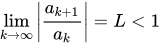
- If , the series is absolutely convergent (and therefore convergent).
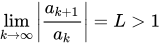
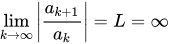
- If or , the series is divergent.
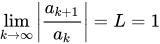
- If , the Ratio Test is inconclusive.
Note: Both this and the Root Test have the least requirements. The Ratio Test does require that such a limit exists, so a series like

could not be assessed as written with the Ratio Test, as division by zero is undefined. You might have to argue it's the same sum as
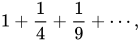
and you could then apply the Ratio Test.
The Root Test
Let be a series. Then:

- If the series is absolutely convergent (and therefore convergent).
![{\displaystyle {\displaystyle \lim _{k\rightarrow \infty }{\sqrt[{k}]{|a_{k}|}}}=L<1,}](https://wikimedia.org/api/rest_v1/media/math/render/svg/262c99ae724bf32a6ba62f9d5273976e19255873)
- If or
![{\displaystyle {\displaystyle \lim _{k\rightarrow \infty }{\sqrt[{k}]{|a_{k}|}}}=L>1}](https://wikimedia.org/api/rest_v1/media/math/render/svg/a9be61c7fb185cc186be00dd0a999b375c2988e1)
![{\displaystyle {\displaystyle \lim _{k\rightarrow \infty }{\sqrt[{k}]{|a_{k}|}}}=L=\infty ,}](https://wikimedia.org/api/rest_v1/media/math/render/svg/44624c365dd4c08e43befb31c469bb72b012c773)
the series is divergent.
- If , the Root Test is inconclusive.
![{\displaystyle {\displaystyle \lim _{k\rightarrow \infty }{\sqrt[{k}]{|a_{k}|}}}=L=1}](https://wikimedia.org/api/rest_v1/media/math/render/svg/1b274902e14ea740ef2b9006f8ecdfdb2c3a7e13)