Difference between revisions of "009A Sample Midterm 2, Problem 4"
Jump to navigation
Jump to search
Kayla Murray (talk | contribs) |
Kayla Murray (talk | contribs) |
||
| (3 intermediate revisions by the same user not shown) | |||
| Line 1: | Line 1: | ||
| − | <span class="exam"> | + | <span class="exam"> To determine drug dosages, doctors estimate a person's body surface area (BSA) (in meters squared) using the formula: |
| − | <span class="exam"> | + | ::<span class="exam"><math>\text{BSA}=\frac{\sqrt{hm}}{60}</math> |
| − | <span class="exam"> | + | <span class="exam">where <math style="vertical-align: 0px">h</math> is the height in centimeters and <math style="vertical-align: 0px">m</math> is the mass in kilograms. Calculate the rate of change of BSA with respect to height for a person of a constant mass of <math style="vertical-align: 0px">m=85.</math> What is the rate at <math style="vertical-align: -1px">h=170</math> and <math style="vertical-align: -1px">h=190?</math> Express your results in the correct units. Does the BSA increase more rapidly with respect to height at lower or higher heights? |
| + | <hr> | ||
| + | [[009A Sample Midterm 2, Problem 4 Solution|'''<u>Solution</u>''']] | ||
| + | [[009A Sample Midterm 2, Problem 4 Detailed Solution|'''<u>Detailed Solution</u>''']] | ||
| − | |||
| − | |||
| − | |||
| − | |||
| − | |||
| − | |||
| − | |||
| − | |||
| − | |||
| − | |||
| − | |||
| − | |||
| − | |||
| − | |||
| − | |||
| − | |||
| − | |||
| − | |||
| − | |||
| − | |||
| − | |||
| − | |||
| − | |||
| − | |||
| − | |||
| − | |||
| − | |||
| − | |||
| − | |||
| − | |||
| − | |||
| − | |||
| − | |||
| − | |||
| − | |||
| − | |||
| − | |||
| − | |||
| − | |||
| − | |||
| − | |||
| − | |||
| − | |||
| − | |||
| − | |||
| − | |||
| − | |||
| − | |||
| − | |||
| − | |||
| − | |||
| − | |||
| − | |||
| − | |||
| − | |||
| − | |||
| − | |||
| − | |||
| − | |||
| − | |||
| − | |||
| − | |||
| − | |||
| − | |||
| − | |||
| − | |||
| − | |||
| − | |||
[[009A_Sample_Midterm_2|'''<u>Return to Sample Exam</u>''']] | [[009A_Sample_Midterm_2|'''<u>Return to Sample Exam</u>''']] | ||
Latest revision as of 15:39, 9 November 2017
To determine drug dosages, doctors estimate a person's body surface area (BSA) (in meters squared) using the formula:
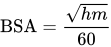
where is the height in centimeters and is the mass in kilograms. Calculate the rate of change of BSA with respect to height for a person of a constant mass of What is the rate at and Express your results in the correct units. Does the BSA increase more rapidly with respect to height at lower or higher heights?


