Difference between revisions of "009C Sample Final 2"

From Grad Wiki
Jump to navigation Jump to search
(Created page with "'''This is a sample, and is meant to represent the material usually covered in Math 9C for the final. An actual test may or may not be similar.''' '''Click on the <span class...")
 
 
(33 intermediate revisions by 2 users not shown)
Line 5: Line 5:
  
 
== [[009C_Sample Final 2,_Problem_1|<span class="biglink"><span style="font-size:80%">&nbsp;Problem 1&nbsp;</span></span>]] ==
 
== [[009C_Sample Final 2,_Problem_1|<span class="biglink"><span style="font-size:80%">&nbsp;Problem 1&nbsp;</span></span>]] ==
<span class="exam">Compute
+
<span class="exam">Test if the following sequences converge or diverge. Also find the limit of each convergent sequence.
  
::<span class="exam">a) <math style="vertical-align: -12px">\lim_{n\rightarrow \infty} \frac{3-2n^2}{5n^2+n+1}</math>
+
<span class="exam">(a) &nbsp;<math style="vertical-align: -16px">a_n=\frac{\ln(n)}{\ln(n+1)}</math>
  
::<span class="exam">b) <math style="vertical-align: -12px">\lim_{n\rightarrow \infty} \frac{\ln n}{\ln 3n}</math>
+
<span class="exam">(b) &nbsp;<math style="vertical-align: -15px">a_n=\bigg(\frac{n}{n+1}\bigg)^n</math>
  
 
== [[009C_Sample Final 2,_Problem_2|<span class="biglink"><span style="font-size:80%">&nbsp;Problem 2&nbsp;</span>]] ==
 
== [[009C_Sample Final 2,_Problem_2|<span class="biglink"><span style="font-size:80%">&nbsp;Problem 2&nbsp;</span>]] ==
<span class="exam"> Find the sum of the following series:
+
<span class="exam"> For each of the following series, find the sum if it converges. If it diverges, explain why.
  
::<span class="exam">a) <math>\sum_{n=0}^{\infty} (-2)^ne^{-n}</math>
+
<span class="exam">(a) &nbsp;<math style="vertical-align: -14px">4-2+1-\frac{1}{2}+\frac{1}{4}-\frac{1}{8}+\cdots</math>
  
::<span class="exam">b) <math>\sum_{n=1}^{\infty} \bigg(\frac{1}{2^n}-\frac{1}{2^{n+1}}\bigg)</math>
+
<span class="exam">(b) &nbsp;<math>\sum_{n=1}^{\infty} \frac{1}{(2n-1)(2n+1)}</math>
  
 
== [[009C_Sample Final 2,_Problem_3|<span class="biglink"><span style="font-size:80%">&nbsp;Problem 3&nbsp;</span>]] ==
 
== [[009C_Sample Final 2,_Problem_3|<span class="biglink"><span style="font-size:80%">&nbsp;Problem 3&nbsp;</span>]] ==
<span class="exam">Determine whether the following series converges or diverges.
+
<span class="exam">Determine if the following series converges or diverges. Please give your reason(s).
  
::::::<math>\sum_{n=0}^{\infty} (-1)^n \frac{n!}{n^n}</math>
+
<span class="exam">(a) &nbsp;<math>\sum_{n=1}^{\infty} \frac{n!}{(2n)!}</math>
 +
 
 +
<span class="exam">(b) &nbsp;<math>\sum_{n=1}^{\infty} (-1)^n \frac{1}{n+1}</math>
  
 
== [[009C_Sample Final 2,_Problem_4|<span class="biglink"><span style="font-size:80%">&nbsp;Problem 4&nbsp;</span>]] ==
 
== [[009C_Sample Final 2,_Problem_4|<span class="biglink"><span style="font-size:80%">&nbsp;Problem 4&nbsp;</span>]] ==
<span class="exam"> Find the interval of convergence of the following series.
+
<span class="exam">(a) Find the radius of convergence for the power series
 +
 
 +
::<math>\sum_{n=1}^{\infty} (-1)^n \frac{x^n}{n}.</math>
  
::::::<math>\sum_{n=0}^{\infty} (-1)^n \frac{(x+2)^n}{n^2}</math>
+
<span class="exam">(b) Find the interval of convergence of the above series.
  
 
== [[009C_Sample Final 2,_Problem_5|<span class="biglink"><span style="font-size:80%">&nbsp;Problem 5&nbsp;</span>]] ==
 
== [[009C_Sample Final 2,_Problem_5|<span class="biglink"><span style="font-size:80%">&nbsp;Problem 5&nbsp;</span>]] ==
<span class="exam"> Let
+
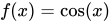
<span class="exam"> Find the Taylor Polynomials of order 0, 1, 2, 3 generated by &nbsp;<math style="vertical-align: -5px">f(x)=\cos(x)</math>&nbsp; at &nbsp;<math style="vertical-align: -14px">x=\frac{\pi}{4}.</math>
  
::::::<math>f(x)=\sum_{n=1}^{\infty} nx^n</math>
+
== [[009C_Sample Final 2,_Problem_6|<span class="biglink"><span style="font-size:80%">&nbsp;Problem 6&nbsp;</span>]] ==
 
+
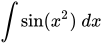
<span class="exam">(a) Express the indefinite integral &nbsp;<math style="vertical-align: -13px">\int \sin(x^2)~dx</math>&nbsp; as a power series.
::<span class="exam">a) Find the radius of convergence of the power series.


::<span class="exam">b) Determine the interval of convergence of the power series.


::<span class="exam">c) Obtain an explicit formula for the function <math style="vertical-align: -5px">f(x)</math>.
 
  
== [[009C_Sample Final 2,_Problem_6|<span class="biglink"><span style="font-size:80%">&nbsp;Problem 6&nbsp;</span>]] ==
+
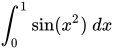
<span class="exam">(b) Express the definite integral &nbsp;<math style="vertical-align: -14px">\int_0^1 \sin(x^2)~dx</math>&nbsp; as a number series.
<span class="exam"> Find the Taylor polynomial of degree 4 of <math style="vertical-align: -5px">f(x)=\cos^2x</math> at <math>a=\frac{\pi}{4}</math>.


== [[009C_Sample Final 2,_Problem_7|<span class="biglink"><span style="font-size:80%">&nbsp;Problem 7&nbsp;</span>]] ==
 
== [[009C_Sample Final 2,_Problem_7|<span class="biglink"><span style="font-size:80%">&nbsp;Problem 7&nbsp;</span>]] ==
  
<span class="exam">A curve is given in polar coordinates by
+
<span class="exam">(a) Consider the function &nbsp;<math style="vertical-align: -16px">f(x)=\bigg(1-\frac{1}{2}x\bigg)^{-2}.</math>&nbsp; Find the first three terms of its Binomial Series.
::::::<math>r=1+\sin\theta</math>
 
  
::<span class="exam">a) Sketch the curve.
+
<span class="exam">(b) Find its radius of convergence.
 
 
::<span class="exam">b) Compute <math style="vertical-align: -12px">y'=\frac{dy}{dx}</math>.


::<span class="exam">c) Compute <math style="vertical-align: -12px">y''=\frac{d^2y}{dx^2}</math>.


== [[009C_Sample Final 2,_Problem_8|<span class="biglink"><span style="font-size:80%">&nbsp;Problem 8&nbsp;</span>]] ==
 
== [[009C_Sample Final 2,_Problem_8|<span class="biglink"><span style="font-size:80%">&nbsp;Problem 8&nbsp;</span>]] ==
  
<span class="exam">A curve is given in polar coordinates by
+
<span class="exam">Find &nbsp;<math>n</math>&nbsp; such that the Maclaurin polynomial of degree &nbsp;<math>n</math>&nbsp; of &nbsp;<math style="vertical-align: -5px">f(x)=\cos(x)</math>&nbsp; approximates &nbsp;<math style="vertical-align: -13px">\cos \bigg(\frac{\pi}{3}\bigg)</math>&nbsp; within 0.0001 of the actual value.
::::::<math>r=1+\sin 2\theta</math>
 
::::::<math>0\leq \theta \leq 2\pi</math>


::<span class="exam">a) Sketch the curve.


::<span class="exam">b) Find the area enclosed by the curve.


== [[009C_Sample Final 2,_Problem_9|<span class="biglink"><span style="font-size:80%">&nbsp;Problem 9&nbsp;</span>]] ==
 
== [[009C_Sample Final 2,_Problem_9|<span class="biglink"><span style="font-size:80%">&nbsp;Problem 9&nbsp;</span>]] ==
  
 
<span class="exam">A curve is given in polar coordinates by  
 
<span class="exam">A curve is given in polar coordinates by  
::::::<span class="exam"><math>r=\theta</math>
+
::<span class="exam"><math>r=\sin(2\theta).</math>
::::::<span class="exam"><math>0\leq \theta \leq 2\pi</math>
 
  
<span class="exam">Find the length of the curve.
+
<span class="exam">(a) Sketch the curve.
  
== [[009C_Sample Final 2,_Problem_10|<span class="biglink"><span style="font-size:80%">&nbsp;Problem 10&nbsp;</span>]] ==
+
<span class="exam">(b) Compute &nbsp;<math style="vertical-align: -14px">y'=\frac{dy}{dx}.</math>
  
<span class="exam">A curve is given in polar parametrically by
+
<span class="exam">(c) Compute &nbsp;<math style="vertical-align: -14px">y''=\frac{d^2y}{dx^2}.</math>
::::::<span class="exam"><math>x(t)=3\sin t</math>
 
::::::<span class="exam"><math>y(t)=4\cos t</math>
 
::::::<span class="exam"><math>0\leq t \leq 2\pi</math>
 
  
::<span class="exam">a) Sketch the curve.
+
== [[009C_Sample Final 2,_Problem_10|<span class="biglink"><span style="font-size:80%">&nbsp;Problem 10&nbsp;</span>]] ==
  
::<span class="exam">b) Compute the equation of the tangent line at <math>t_0=\frac{\pi}{4}</math>.
+
<span class="exam">Find the length of the curve given by
 +
::<span class="exam"><math>x=t^2</math>
 +
::<span class="exam"><math>y=t^3</math>
 +
::<span class="exam"><math>1\leq t \leq 2</math>

Latest revision as of 15:02, 3 December 2017

This is a sample, and is meant to represent the material usually covered in Math 9C for the final. An actual test may or may not be similar.

Click on the  boxed problem numbers  to go to a solution.

 Problem 1 

Test if the following sequences converge or diverge. Also find the limit of each convergent sequence.

(a)  

(b)  Failed to parse (MathML with SVG or PNG fallback (recommended for modern browsers and accessibility tools): Invalid response ("Math extension cannot connect to Restbase.") from server "https://wikimedia.org/api/rest_v1/":): {\displaystyle a_n=\bigg(\frac{n}{n+1}\bigg)^n}

 Problem 2 

For each of the following series, find the sum if it converges. If it diverges, explain why.

(a)  Failed to parse (MathML with SVG or PNG fallback (recommended for modern browsers and accessibility tools): Invalid response ("Math extension cannot connect to Restbase.") from server "https://wikimedia.org/api/rest_v1/":): {\displaystyle 4-2+1-\frac{1}{2}+\frac{1}{4}-\frac{1}{8}+\cdots}

(b)  Failed to parse (MathML with SVG or PNG fallback (recommended for modern browsers and accessibility tools): Invalid response ("Math extension cannot connect to Restbase.") from server "https://wikimedia.org/api/rest_v1/":): {\displaystyle \sum_{n=1}^{\infty} \frac{1}{(2n-1)(2n+1)}}

 Problem 3 

Determine if the following series converges or diverges. Please give your reason(s).

(a)  Failed to parse (MathML with SVG or PNG fallback (recommended for modern browsers and accessibility tools): Invalid response ("Math extension cannot connect to Restbase.") from server "https://wikimedia.org/api/rest_v1/":): {\displaystyle \sum_{n=1}^{\infty} \frac{n!}{(2n)!}}

(b)  Failed to parse (MathML with SVG or PNG fallback (recommended for modern browsers and accessibility tools): Invalid response ("Math extension cannot connect to Restbase.") from server "https://wikimedia.org/api/rest_v1/":): {\displaystyle \sum_{n=1}^{\infty} (-1)^n \frac{1}{n+1}}

 Problem 4 

(a) Find the radius of convergence for the power series

Failed to parse (MathML with SVG or PNG fallback (recommended for modern browsers and accessibility tools): Invalid response ("Math extension cannot connect to Restbase.") from server "https://wikimedia.org/api/rest_v1/":): {\displaystyle \sum_{n=1}^{\infty} (-1)^n \frac{x^n}{n}.}

(b) Find the interval of convergence of the above series.

 Problem 5 

Find the Taylor Polynomials of order 0, 1, 2, 3 generated by  Failed to parse (MathML with SVG or PNG fallback (recommended for modern browsers and accessibility tools): Invalid response ("Math extension cannot connect to Restbase.") from server "https://wikimedia.org/api/rest_v1/":): {\displaystyle f(x)=\cos(x)}   at  Failed to parse (MathML with SVG or PNG fallback (recommended for modern browsers and accessibility tools): Invalid response ("Math extension cannot connect to Restbase.") from server "https://wikimedia.org/api/rest_v1/":): {\displaystyle x=\frac{\pi}{4}.}

 Problem 6 

(a) Express the indefinite integral  Failed to parse (MathML with SVG or PNG fallback (recommended for modern browsers and accessibility tools): Invalid response ("Math extension cannot connect to Restbase.") from server "https://wikimedia.org/api/rest_v1/":): {\displaystyle \int \sin(x^2)~dx}   as a power series.

(b) Express the definite integral  Failed to parse (MathML with SVG or PNG fallback (recommended for modern browsers and accessibility tools): Invalid response ("Math extension cannot connect to Restbase.") from server "https://wikimedia.org/api/rest_v1/":): {\displaystyle \int_0^1 \sin(x^2)~dx}   as a number series.

 Problem 7 

(a) Consider the function  Failed to parse (MathML with SVG or PNG fallback (recommended for modern browsers and accessibility tools): Invalid response ("Math extension cannot connect to Restbase.") from server "https://wikimedia.org/api/rest_v1/":): {\displaystyle f(x)=\bigg(1-\frac{1}{2}x\bigg)^{-2}.}   Find the first three terms of its Binomial Series.

(b) Find its radius of convergence.

 Problem 8 

Find  Failed to parse (MathML with SVG or PNG fallback (recommended for modern browsers and accessibility tools): Invalid response ("Math extension cannot connect to Restbase.") from server "https://wikimedia.org/api/rest_v1/":): {\displaystyle n}   such that the Maclaurin polynomial of degree  Failed to parse (MathML with SVG or PNG fallback (recommended for modern browsers and accessibility tools): Invalid response ("Math extension cannot connect to Restbase.") from server "https://wikimedia.org/api/rest_v1/":): {\displaystyle n}   of  Failed to parse (MathML with SVG or PNG fallback (recommended for modern browsers and accessibility tools): Invalid response ("Math extension cannot connect to Restbase.") from server "https://wikimedia.org/api/rest_v1/":): {\displaystyle f(x)=\cos(x)}   approximates  Failed to parse (MathML with SVG or PNG fallback (recommended for modern browsers and accessibility tools): Invalid response ("Math extension cannot connect to Restbase.") from server "https://wikimedia.org/api/rest_v1/":): {\displaystyle \cos \bigg(\frac{\pi}{3}\bigg)}   within 0.0001 of the actual value.

 Problem 9 

A curve is given in polar coordinates by

Failed to parse (MathML with SVG or PNG fallback (recommended for modern browsers and accessibility tools): Invalid response ("Math extension cannot connect to Restbase.") from server "https://wikimedia.org/api/rest_v1/":): {\displaystyle r=\sin(2\theta).}

(a) Sketch the curve.

(b) Compute  Failed to parse (MathML with SVG or PNG fallback (recommended for modern browsers and accessibility tools): Invalid response ("Math extension cannot connect to Restbase.") from server "https://wikimedia.org/api/rest_v1/":): {\displaystyle y'=\frac{dy}{dx}.}

(c) Compute  Failed to parse (MathML with SVG or PNG fallback (recommended for modern browsers and accessibility tools): Invalid response ("Math extension cannot connect to Restbase.") from server "https://wikimedia.org/api/rest_v1/":): {\displaystyle y''=\frac{d^2y}{dx^2}.}

 Problem 10 

Find the length of the curve given by

Failed to parse (MathML with SVG or PNG fallback (recommended for modern browsers and accessibility tools): Invalid response ("Math extension cannot connect to Restbase.") from server "https://wikimedia.org/api/rest_v1/":): {\displaystyle x=t^2}
Failed to parse (MathML with SVG or PNG fallback (recommended for modern browsers and accessibility tools): Invalid response ("Math extension cannot connect to Restbase.") from server "https://wikimedia.org/api/rest_v1/":): {\displaystyle y=t^3}
Failed to parse (MathML with SVG or PNG fallback (recommended for modern browsers and accessibility tools): Invalid response ("Math extension cannot connect to Restbase.") from server "https://wikimedia.org/api/rest_v1/":): {\displaystyle 1\leq t \leq 2}