Difference between revisions of "022 Sample Final A, Problem 4"
Jump to navigation
Jump to search
| Line 1: | Line 1: | ||
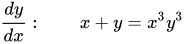
| − | + | <span class="exam"> Use implicit differentiation to find <math>\frac{dy}{dx}: \qquad x+y = x^3y^3</math> | |
{| class="mw-collapsible mw-collapsed" style = "text-align:left;" | {| class="mw-collapsible mw-collapsed" style = "text-align:left;" | ||
Revision as of 13:06, 30 May 2015
Use implicit differentiation to find
| Foundations: |
|---|
| When we use implicit differentiation, we combine the chain rule with the fact that is a function of , and could really be written as Because of this, the derivative of with respect to requires the chain rule, so |


Solution:
| Step 1: |
|---|
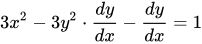
| First, we differentiate each term separately with respect to to find that differentiates implicitly to |
| . |

| Step 2: |
|---|
| Since they don't ask for a general expression of , but rather a particular value at a particular point, we can plug in the values and to find |
| which is equivalent to . This solves to |





| Final Answer: |
|---|