Difference between revisions of "004 Sample Final A, Problem 10"
Jump to navigation
Jump to search
Kayla Murray (talk | contribs) |
Kayla Murray (talk | contribs) |
||
| Line 34: | Line 34: | ||
! Step 3: | ! Step 3: | ||
|- | |- | ||
| − | | | + | |If we set <math>x=1</math> in the above equation, we get <math>16A=64</math> and <math>A=4</math>. |
|- | |- | ||
| − | | | + | |If we set <math>x=-3</math> in the above equation, we get <math>-4C=4</math> and <math>C=-1</math>. |
| − | |||
| − | |||
| − | |||
| − | |||
|} | |} | ||
| Line 46: | Line 42: | ||
! Step 4: | ! Step 4: | ||
|- | |- | ||
| − | | | + | |In the equation <math>6x^2+27x+31=A(x+3)^2+B(x+3)(x-1)+C(x-1)</math>, we compare the constant terms of both sides. We must have |
|- | |- | ||
| − | | | + | |<math>9A-3B-C=31</math>. Substituting <math>A=4</math> and <math>C=-1</math>, we get <math>B=2</math>. |
|- | |- | ||
| − | | | + | |Thus, the partial fraction decomposition is <math>\frac{4}{x-1}+\frac{2}{x+3}+\frac{-1}{{(x+3)}^2}</math> |
|} | |} | ||
| Line 56: | Line 52: | ||
! Final Answer: | ! Final Answer: | ||
|- | |- | ||
| − | | | + | |<math>\frac{4}{x-1}+\frac{2}{x+3}+\frac{-1}{{(x+3)}^2}</math> |
|} | |} | ||
[[004 Sample Final A|<u>'''Return to Sample Exam</u>''']] | [[004 Sample Final A|<u>'''Return to Sample Exam</u>''']] | ||
Latest revision as of 16:43, 4 May 2015
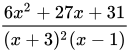
Decompose into separate partial fractions.
| Foundations |
|---|
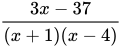
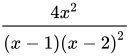
| 1) What is the form of the partial fraction decomposition of ? |
| 2) What is the form of the partial fraction decomposition of ? |
| Answer: |
| 1) |
| 2) |


Solution:
| Step 1: |
|---|
| We set . |

| Step 2: |
|---|
| Multiplying both sides of the equation by , we get |
| . |


| Step 3: |
|---|
| If we set in the above equation, we get and . |
| If we set in the above equation, we get and . |


| Step 4: |
|---|
| In the equation , we compare the constant terms of both sides. We must have |
| . Substituting and , we get . |
| Thus, the partial fraction decomposition is |


| Final Answer: |
|---|