|
|
| Line 7: |
Line 7: |
| | <span class="exam">(c) <math style="vertical-align: -5px">y=\sin^{-1} x</math> | | <span class="exam">(c) <math style="vertical-align: -5px">y=\sin^{-1} x</math> |
| | | | |
| − | {| class="mw-collapsible mw-collapsed" style = "text-align:left;"
| + | <hr> |
| − | !Foundations:
| + | [[009A Sample Midterm 2, Problem 3 Solution|'''<u>Solution</u>''']] |
| − | |-
| |
| − | |'''1.''' '''Product Rule'''
| |
| − | |-
| |
| − | | <math>\frac{d}{dx}(f(x)g(x))=f(x)g'(x)+f'(x)g(x)</math>
| |
| − | |-
| |
| − | |'''2.''' '''Quotient Rule''' | |
| − | |-
| |
| − | | <math>\frac{d}{dx}\bigg(\frac{f(x)}{g(x)}\bigg)=\frac{g(x)f'(x)-f(x)g'(x)}{(g(x))^2}</math>
| |
| − | |-
| |
| − | |'''3.''' '''Chain Rule'''
| |
| − | |-
| |
| − | | <math>\frac{d}{dx}(f(g(x)))=f'(g(x))g'(x)</math>
| |
| − | |}
| |
| | | | |
| | | | |
| − | '''Solution:''' | + | [[009A Sample Midterm 2, Problem 3 Detailed Solution|'''<u>Detailed Solution</u>''']] |
| | | | |
| − | '''(a)'''
| |
| | | | |
| − | {| class="mw-collapsible mw-collapsed" style = "text-align:left;"
| + | [[009A_Sample_Midterm_2|'''<u>Return to Sample Exam</u>''']] |
| − | !Step 1:
| |
| − | |-
| |
| − | |Using the Chain Rule, we have
| |
| − | |-
| |
| − | | <math>\frac{dy}{dx}=3\bigg(\frac{x^2+3}{x^2-1}\bigg)^2\bigg(\frac{x^2+3}{x^2-1}\bigg)'.</math>
| |
| − | |
| |
| − | |}
| |
| − | | |
| − | {| class="mw-collapsible mw-collapsed" style = "text-align:left;"
| |
| − | !Step 2:
| |
| − | |-
| |
| − | |Now, using the Quotient Rule, we have
| |
| − | |-
| |
| − | | <math>\begin{array}{rcl}
| |
| − | \displaystyle{\frac{dy}{dx}} & = & \displaystyle{3\bigg(\frac{x^2+3}{x^2-1}\bigg)^2\bigg(\frac{x^2+3}{x^2-1}\bigg)'}\\
| |
| − | &&\\
| |
| − | & = & \displaystyle{3\bigg(\frac{x^2+3}{x^2-1}\bigg)^2\bigg(\frac{(x^2-1)(x^2+3)'-(x^2+3)(x^2-1)'}{(x^2-1)^2}\bigg)}\\
| |
| − | &&\\
| |
| − | & = & \displaystyle{3\bigg(\frac{x^2+3}{x^2-1}\bigg)^2\bigg(\frac{(x^2-1)(2x)-(x^2+3)(2x)}{(x^2-1)^2}\bigg)}\\
| |
| − | &&\\
| |
| − | & = & \displaystyle{3\bigg(\frac{x^2+3}{x^2-1}\bigg)^2\bigg(\frac{2x^3-2x-2x^3-6x}{(x^2-1)^2}\bigg)}\\
| |
| − | &&\\
| |
| − | & = & \displaystyle{\frac{3(x^2+3)^2(-8x)}{(x^2-1)^4}.}
| |
| − | \end{array}</math>
| |
| − | |}
| |
| − | | |
| − | '''(b)'''
| |
| − | | |
| − | {| class="mw-collapsible mw-collapsed" style = "text-align:left;"
| |
| − | !Step 1:
| |
| − | |-
| |
| − | |Using the Product Rule, we have
| |
| − | |-
| |
| − | | <math>\frac{dy}{dx}=x(\cos(\sqrt{x+1}))'+(x)'\cos(\sqrt{x+1}).</math>
| |
| − | |-
| |
| − | |
| |
| − | |}
| |
| − | | |
| − | {| class="mw-collapsible mw-collapsed" style = "text-align:left;"
| |
| − | !Step 2:
| |
| − | |-
| |
| − | |Now, using the Chain Rule, we get
| |
| − | |-
| |
| − | | <math>\begin{array}{rcl}
| |
| − | \displaystyle{\frac{dy}{dx}} & = & \displaystyle{x(\cos(\sqrt{x+1}))'+(x)'\cos(\sqrt{x+1})}\\
| |
| − | &&\\
| |
| − | & = & \displaystyle{x(-\sin(\sqrt{x+1}))(\sqrt{x+1})'+(1)\cos(\sqrt{x+1})}\\
| |
| − | &&\\
| |
| − | & = & \displaystyle{-x\sin(\sqrt{x+1})\frac{1}{2\sqrt{x+1}}(x+1)'+\cos(\sqrt{x+1})}\\
| |
| − | &&\\
| |
| − | & = & \displaystyle{\frac{-x\sin(\sqrt{x+1})}{2\sqrt{x+1}}+\cos(\sqrt{x+1}).}
| |
| − | \end{array}</math>
| |
| − | |}
| |
| − | | |
| − | '''(c)'''
| |
| − | | |
| − | {| class="mw-collapsible mw-collapsed" style = "text-align:left;"
| |
| − | !Step 1:
| |
| − | |-
| |
| − | |Let <math style="vertical-align: -5px">y=\sin^{-1}(x).</math> Then,
| |
| − | |-
| |
| − | | <math>\sin(y)=x</math>
| |
| − | |-
| |
| − | |for <math>y</math> in the interval <math>\bigg[-\frac{\pi}{2},\frac{\pi}{2}\bigg].</math>
| |
| − | |-
| |
| − | |Using implicit differentiation, we have
| |
| − | |-
| |
| − | | <math>\cos(y) \frac{dy}{dx}=1.</math>
| |
| − | |-
| |
| − | |Solving for <math style="vertical-align: -15px">\frac{dy}{dx},</math> we get
| |
| − | |-
| |
| − | | <math>\frac{dy}{dx}=\frac{1}{\cos(y)}.</math>
| |
| − | |}
| |
| − | | |
| − | {| class="mw-collapsible mw-collapsed" style = "text-align:left;"
| |
| − | !Step 2:
| |
| − | |-
| |
| − | |Now, since <math>\sin(y)=x,</math> we have the following diagram.
| |
| − | |-
| |
| − | |(Insert diagram)
| |
| − | |-
| |
| − | |Therefore,
| |
| − | |-
| |
| − | | <math>\cos(y)=\sqrt{1-x^2}.</math>
| |
| − | |-
| |
| − | |Hence,
| |
| − | |-
| |
| − | | <math>\begin{array}{rcl}
| |
| − | \displaystyle{\frac{dy}{dx}} & = & \displaystyle{\frac{1}{\cos(y)}}\\
| |
| − | &&\\
| |
| − | & = & \displaystyle{\frac{1}{\sqrt{1-x^2}}.}
| |
| − | \end{array}</math>
| |
| − | |}
| |
| − | | |
| − | | |
| − | {| class="mw-collapsible mw-collapsed" style = "text-align:left;"
| |
| − | !Final Answer:
| |
| − | |-
| |
| − | | '''(a)''' <math>\frac{3(x^2+3)^2(-8x)}{(x^2-1)^4}</math>
| |
| − | |-
| |
| − | | '''(b)''' <math>\frac{-x\sin(\sqrt{x+1})}{2\sqrt{x+1}}+\cos(\sqrt{x+1})</math>
| |
| − | |-
| |
| − | | '''(c)''' <math>\frac{1}{\sqrt{1-x^2}}</math>
| |
| − | |}
| |
| − | [[009A_Sample_Final_2|'''<u>Return to Sample Exam</u>''']] | |
Compute Failed to parse (MathML with SVG or PNG fallback (recommended for modern browsers and accessibility tools): Invalid response ("Math extension cannot connect to Restbase.") from server "https://wikimedia.org/api/rest_v1/":): {\displaystyle \frac{dy}{dx}.}
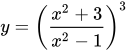
(a) Failed to parse (MathML with SVG or PNG fallback (recommended for modern browsers and accessibility tools): Invalid response ("Math extension cannot connect to Restbase.") from server "https://wikimedia.org/api/rest_v1/":): {\displaystyle y=\bigg(\frac{x^2+3}{x^2-1}\bigg)^3}
(b) Failed to parse (MathML with SVG or PNG fallback (recommended for modern browsers and accessibility tools): Invalid response ("Math extension cannot connect to Restbase.") from server "https://wikimedia.org/api/rest_v1/":): {\displaystyle y=x\cos(\sqrt{x+1})}
(c) Failed to parse (MathML with SVG or PNG fallback (recommended for modern browsers and accessibility tools): Invalid response ("Math extension cannot connect to Restbase.") from server "https://wikimedia.org/api/rest_v1/":): {\displaystyle y=\sin^{-1} x}
Solution
Detailed Solution
Return to Sample Exam