Difference between revisions of "Strategies for Testing Series"

From Grad Wiki
Jump to navigation Jump to search
Line 5: Line 5:
 
This list is just meant to serve as a guideline for which tests you should consider applying to a given series.
 
This list is just meant to serve as a guideline for which tests you should consider applying to a given series.
  
'''1.'''
+
'''1.''' If the series is of the form &nbsp;<math>\sum \frac{1}{n^p} </math>&nbsp; or &nbsp;<math>\sum ar^n,</math>&nbsp; then the series is a &nbsp;<math>p</math>-series or a geometric series
  
'''2.'''
+
For the &nbsp;<math>p</math>-series &nbsp;<math>\sum \frac{1}{n^p},</math>&nbsp; it is convergent if &nbsp;<math>p>1</math>&nbsp; and divergent if &nbsp;<math>p\le 1.</math>
  
'''3.'''
+
For the geometric series &nbsp;<math>\sum ar^n,</math>&nbsp; it is convergent if &nbsp;<math>|r|<1</math>&nbsp; and divergent if &nbsp;<math>|r|\ge 1.</math>
  
'''4.'''
+
'''2.''' If the series has a form similar to a &nbsp;<math>p</math>-series or a geometric series, then one of the comparison tests should be considered.
  
'''5.'''
+
'''3.''' If you can see that &nbsp;<math>\lim_{n\rightarrow \infty} a_n \neq 0,</math> then you should use the Divergence Test or &nbsp;<math>n</math>th term test.
  
'''6.'''
+
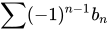
'''4.''' If the series has the form &nbsp;<math>\sum (-1)^n b_n</math>&nbsp; or &nbsp;<math>\sum (-1)^{n-1} b_n</math>&nbsp; with &nbsp;<math>b_n>0</math>&nbsp; for all &nbsp;<math>n,</math>&nbsp; then the Alternating Series Test should be considered.
  
'''NOTE:'''
+
'''5.''' If the series involves factorials or other products (including constants raised to the &nbsp;<math>n</math>th power), the Ratio Test should be considered. '''NOTE:''' The Ratio Test should not be used for rational functions of &nbsp;<math>n.</math>
 +
 
 +
'''6.''' If &nbsp;<math>a_n=f(n)</math>&nbsp; for some function &nbsp;<math>f(x)</math>&nbsp; where &nbsp;<math>\int_a^\infty f(x)~dx</math>&nbsp; is easily evaluated, the Integral Test should be considered (if all the hypothesis of the Integral Test are satisfied).
 +
 
 +
'''NOTE:''' These strategies are used for determining whether a series converges or diverges. However, these are not the strategies one should use if we are determining whether or not a series is absolutely convergent.

Revision as of 11:33, 22 October 2017

In general, there are no specific rules as to which test to apply to a given series.

Instead, we classify series by their form and give tips as to which tests should be considered.

This list is just meant to serve as a guideline for which tests you should consider applying to a given series.

1. If the series is of the form  Failed to parse (MathML with SVG or PNG fallback (recommended for modern browsers and accessibility tools): Invalid response ("Math extension cannot connect to Restbase.") from server "https://wikimedia.org/api/rest_v1/":): {\displaystyle \sum \frac{1}{n^p} }   or  Failed to parse (MathML with SVG or PNG fallback (recommended for modern browsers and accessibility tools): Invalid response ("Math extension cannot connect to Restbase.") from server "https://wikimedia.org/api/rest_v1/":): {\displaystyle \sum ar^n,}   then the series is a  Failed to parse (MathML with SVG or PNG fallback (recommended for modern browsers and accessibility tools): Invalid response ("Math extension cannot connect to Restbase.") from server "https://wikimedia.org/api/rest_v1/":): {\displaystyle p} -series or a geometric series

For the  Failed to parse (MathML with SVG or PNG fallback (recommended for modern browsers and accessibility tools): Invalid response ("Math extension cannot connect to Restbase.") from server "https://wikimedia.org/api/rest_v1/":): {\displaystyle p} -series  Failed to parse (MathML with SVG or PNG fallback (recommended for modern browsers and accessibility tools): Invalid response ("Math extension cannot connect to Restbase.") from server "https://wikimedia.org/api/rest_v1/":): {\displaystyle \sum \frac{1}{n^p},}   it is convergent if  Failed to parse (MathML with SVG or PNG fallback (recommended for modern browsers and accessibility tools): Invalid response ("Math extension cannot connect to Restbase.") from server "https://wikimedia.org/api/rest_v1/":): {\displaystyle p>1}   and divergent if  Failed to parse (MathML with SVG or PNG fallback (recommended for modern browsers and accessibility tools): Invalid response ("Math extension cannot connect to Restbase.") from server "https://wikimedia.org/api/rest_v1/":): {\displaystyle p\le 1.}

For the geometric series  Failed to parse (MathML with SVG or PNG fallback (recommended for modern browsers and accessibility tools): Invalid response ("Math extension cannot connect to Restbase.") from server "https://wikimedia.org/api/rest_v1/":): {\displaystyle \sum ar^n,}   it is convergent if  Failed to parse (MathML with SVG or PNG fallback (recommended for modern browsers and accessibility tools): Invalid response ("Math extension cannot connect to Restbase.") from server "https://wikimedia.org/api/rest_v1/":): {\displaystyle |r|<1}   and divergent if  Failed to parse (MathML with SVG or PNG fallback (recommended for modern browsers and accessibility tools): Invalid response ("Math extension cannot connect to Restbase.") from server "https://wikimedia.org/api/rest_v1/":): {\displaystyle |r|\ge 1.}

2. If the series has a form similar to a  Failed to parse (MathML with SVG or PNG fallback (recommended for modern browsers and accessibility tools): Invalid response ("Math extension cannot connect to Restbase.") from server "https://wikimedia.org/api/rest_v1/":): {\displaystyle p} -series or a geometric series, then one of the comparison tests should be considered.

3. If you can see that  Failed to parse (MathML with SVG or PNG fallback (recommended for modern browsers and accessibility tools): Invalid response ("Math extension cannot connect to Restbase.") from server "https://wikimedia.org/api/rest_v1/":): {\displaystyle \lim_{n\rightarrow \infty} a_n \neq 0,} then you should use the Divergence Test or  Failed to parse (MathML with SVG or PNG fallback (recommended for modern browsers and accessibility tools): Invalid response ("Math extension cannot connect to Restbase.") from server "https://wikimedia.org/api/rest_v1/":): {\displaystyle n} th term test.

4. If the series has the form  Failed to parse (MathML with SVG or PNG fallback (recommended for modern browsers and accessibility tools): Invalid response ("Math extension cannot connect to Restbase.") from server "https://wikimedia.org/api/rest_v1/":): {\displaystyle \sum (-1)^n b_n}   or  Failed to parse (MathML with SVG or PNG fallback (recommended for modern browsers and accessibility tools): Invalid response ("Math extension cannot connect to Restbase.") from server "https://wikimedia.org/api/rest_v1/":): {\displaystyle \sum (-1)^{n-1} b_n}   with  Failed to parse (MathML with SVG or PNG fallback (recommended for modern browsers and accessibility tools): Invalid response ("Math extension cannot connect to Restbase.") from server "https://wikimedia.org/api/rest_v1/":): {\displaystyle b_n>0}   for all  Failed to parse (MathML with SVG or PNG fallback (recommended for modern browsers and accessibility tools): Invalid response ("Math extension cannot connect to Restbase.") from server "https://wikimedia.org/api/rest_v1/":): {\displaystyle n,}   then the Alternating Series Test should be considered.
5. If the series involves factorials or other products (including constants raised to the  Failed to parse (MathML with SVG or PNG fallback (recommended for modern browsers and accessibility tools): Invalid response ("Math extension cannot connect to Restbase.") from server "https://wikimedia.org/api/rest_v1/":): {\displaystyle n} th power), the Ratio Test should be considered. NOTE: The Ratio Test should not be used for rational functions of  Failed to parse (MathML with SVG or PNG fallback (recommended for modern browsers and accessibility tools): Invalid response ("Math extension cannot connect to Restbase.") from server "https://wikimedia.org/api/rest_v1/":): {\displaystyle n.}

6. If  Failed to parse (MathML with SVG or PNG fallback (recommended for modern browsers and accessibility tools): Invalid response ("Math extension cannot connect to Restbase.") from server "https://wikimedia.org/api/rest_v1/":): {\displaystyle a_n=f(n)}   for some function  Failed to parse (MathML with SVG or PNG fallback (recommended for modern browsers and accessibility tools): Invalid response ("Math extension cannot connect to Restbase.") from server "https://wikimedia.org/api/rest_v1/":): {\displaystyle f(x)}   where  Failed to parse (MathML with SVG or PNG fallback (recommended for modern browsers and accessibility tools): Invalid response ("Math extension cannot connect to Restbase.") from server "https://wikimedia.org/api/rest_v1/":): {\displaystyle \int_a^\infty f(x)~dx}   is easily evaluated, the Integral Test should be considered (if all the hypothesis of the Integral Test are satisfied).

NOTE: These strategies are used for determining whether a series converges or diverges. However, these are not the strategies one should use if we are determining whether or not a series is absolutely convergent.