Difference between revisions of "031 Review Part 3, Problem 5"
Jump to navigation
Jump to search
Kayla Murray (talk | contribs) |
Kayla Murray (talk | contribs) |
||
| (2 intermediate revisions by the same user not shown) | |||
| Line 3: | Line 3: | ||
2 & -6 | 2 & -6 | ||
\end{bmatrix}^k</math> by diagonalizing the matrix. | \end{bmatrix}^k</math> by diagonalizing the matrix. | ||
| − | |||
{| class="mw-collapsible mw-collapsed" style = "text-align:left;" | {| class="mw-collapsible mw-collapsed" style = "text-align:left;" | ||
!Foundations: | !Foundations: | ||
| + | |- | ||
| + | |Recall: | ||
| + | |- | ||
| + | |1. To diagonalize a matrix, you need to know the eigenvalues of the matrix. | ||
| + | |- | ||
| + | |2. '''Diagonalization Theorem''' | ||
|- | |- | ||
| | | | ||
| + | :An <math style="vertical-align: 0px">n\times n</math> matrix <math style="vertical-align: 0px">A</math> is diagonalizable if and only if <math style="vertical-align: 0px">A</math> has <math style="vertical-align: 0px">n</math> linearly independent eigenvectors. | ||
| + | |- | ||
| + | | | ||
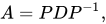
| + | :In fact, <math style="vertical-align: -4px">A=PDP^{-1},</math> with <math style="vertical-align: 0px">D</math> a diagonal matrix, if and only if the columns of <math style="vertical-align: 0px">P</math> are <math style="vertical-align: 0px">n</math> linearly | ||
| + | |- | ||
| + | | | ||
| + | :independent eigenvectors of <math style="vertical-align: 0px">A.</math> In this case, the diagonal entries of <math style="vertical-align: 0px">D</math> are eigenvalues of <math style="vertical-align: 0px">A</math> that | ||
| + | |- | ||
| + | | | ||
| + | :correspond, respectively , to the eigenvectors in <math style="vertical-align: 0px">P.</math> | ||
|} | |} | ||
| Line 16: | Line 31: | ||
{| class="mw-collapsible mw-collapsed" style = "text-align:left;" | {| class="mw-collapsible mw-collapsed" style = "text-align:left;" | ||
!Step 1: | !Step 1: | ||
| + | |- | ||
| + | |To diagonalize this matrix, we need to find the eigenvalues and a basis for each eigenspace. | ||
| + | |- | ||
| + | |First, we find the eigenvalues of <math style="vertical-align: 0px">A</math> by solving <math style="vertical-align: -5px">\text{det }(A-\lambda I)=0.</math> | ||
| + | |- | ||
| + | | <math>\begin{array}{rcl} | ||
| + | \displaystyle{\text{det }(A-\lambda I)} & = & \displaystyle{\text{det }\bigg(\begin{bmatrix} | ||
| + | 1 & -6 \\ | ||
| + | 2 & -6 | ||
| + | \end{bmatrix}-\begin{bmatrix} | ||
| + | \lambda & 0 \\ | ||
| + | 0 & \lambda | ||
| + | \end{bmatrix}\bigg)}\\ | ||
| + | &&\\ | ||
| + | & = & \displaystyle{\text{det }\bigg(\begin{bmatrix} | ||
| + | 1-\lambda & -6 \\ | ||
| + | 2 & -6-\lambda | ||
| + | \end{bmatrix}\bigg)}\\ | ||
| + | &&\\ | ||
| + | & = & \displaystyle{(1-\lambda)(-6\lambda)+12}\\ | ||
| + | &&\\ | ||
| + | & = & \displaystyle{\lambda^2+5\lambda+6}\\ | ||
| + | &&\\ | ||
| + | & = & \displaystyle{(\lambda+2)(\lambda+3).}\\ | ||
| + | \end{array}</math> | ||
| + | |- | ||
| + | |Therefore, setting | ||
|- | |- | ||
| | | | ||
| + | ::<math>(\lambda+2)(\lambda+3)=0,</math> | ||
| + | |- | ||
| + | |we find that the eigenvalues of <math style="vertical-align: 0px">A</math> are <math style="vertical-align: 0px">-2</math> and <math style="vertical-align: 0px">-3.</math> | ||
|} | |} | ||
{| class="mw-collapsible mw-collapsed" style = "text-align:left;" | {| class="mw-collapsible mw-collapsed" style = "text-align:left;" | ||
!Step 2: | !Step 2: | ||
| + | |- | ||
| + | |Now, we find a basis for each eigenspace by solving <math style="vertical-align: -6px">(A-\lambda I)\vec{x}=\vec{0}</math> for each eigenvalue <math style="vertical-align: 0px">\lambda.</math> | ||
| + | |- | ||
| + | |For the eigenvalue <math style="vertical-align: -4px">\lambda=-2,</math> we have | ||
| + | |- | ||
| + | | | ||
| + | <math>\begin{array}{rcl} | ||
| + | \displaystyle{A+2I} & = & \displaystyle{\begin{bmatrix} | ||
| + | 1 & -6 \\ | ||
| + | 2 & -6 | ||
| + | \end{bmatrix}+\begin{bmatrix} | ||
| + | 2 & 0 \\ | ||
| + | 0 & 2 | ||
| + | \end{bmatrix}}\\ | ||
| + | &&\\ | ||
| + | & = & \displaystyle{\begin{bmatrix} | ||
| + | 3 & -6 \\ | ||
| + | 2 & -4 | ||
| + | \end{bmatrix}}\\ | ||
| + | &&\\ | ||
| + | & \sim & \displaystyle{\begin{bmatrix} | ||
| + | 1 & -2 \\ | ||
| + | 0 & 0 | ||
| + | \end{bmatrix}.} | ||
| + | \end{array}</math> | ||
| + | |- | ||
| + | |We see that <math style="vertical-align: -3px">x_2</math> is a free variable. So, a basis for the eigenspace corresponding to <math style="vertical-align: 0px">-2</math> is | ||
| + | |- | ||
| + | | | ||
| + | ::<math>\bigg\{\begin{bmatrix} | ||
| + | 2 \\ | ||
| + | 1 \\ | ||
| + | \end{bmatrix}\bigg\}.</math> | ||
| + | |||
| + | |} | ||
| + | |||
| + | {| class="mw-collapsible mw-collapsed" style = "text-align:left;" | ||
| + | !Step 3: | ||
| + | |- | ||
| + | |For the eigenvalue <math style="vertical-align: -4px">\lambda=-3,</math> we have | ||
| + | |- | ||
| + | | | ||
| + | <math>\begin{array}{rcl} | ||
| + | \displaystyle{A+3I} & = & \displaystyle{\begin{bmatrix} | ||
| + | 1 & -6 \\ | ||
| + | 2 & -6 | ||
| + | \end{bmatrix}-\begin{bmatrix} | ||
| + | 3 & 0 \\ | ||
| + | 0 & 3 | ||
| + | \end{bmatrix}}\\ | ||
| + | &&\\ | ||
| + | & = & \displaystyle{\begin{bmatrix} | ||
| + | 4 & -6 \\ | ||
| + | 2 & -3 | ||
| + | \end{bmatrix}}\\ | ||
| + | &&\\ | ||
| + | & \sim & \displaystyle{\begin{bmatrix} | ||
| + | 1 & \frac{-3}{2} \\ | ||
| + | 0 & 0 | ||
| + | \end{bmatrix}.} | ||
| + | \end{array}</math> | ||
| + | |- | ||
| + | |We see that <math style="vertical-align: -3px">x_2</math> is a free variable. So, a basis for the eigenspace corresponding to <math style="vertical-align: 0px">-3</math> is | ||
| + | |- | ||
| + | | | ||
| + | ::<math>\bigg\{\begin{bmatrix} | ||
| + | \frac{3}{2} \\ | ||
| + | 1 \\ | ||
| + | \end{bmatrix}\bigg\}.</math> | ||
| + | |} | ||
| + | |||
| + | {| class="mw-collapsible mw-collapsed" style = "text-align:left;" | ||
| + | !Step 4: | ||
| + | |- | ||
| + | |To diagonalize our matrix, we use the information from the steps above. | ||
| + | |- | ||
| + | | | ||
| + | Using the Diagonalization Theorem, we have <math style="vertical-align: -1px">A=PDP^{-1}</math> where | ||
| + | |- | ||
| + | | | ||
| + | ::<math>D=\begin{bmatrix} | ||
| + | -2 & 0 \\ | ||
| + | 0 & -3 | ||
| + | \end{bmatrix},P=\begin{bmatrix} | ||
| + | 2 & \frac{3}{2} \\ | ||
| + | 1 & 1 | ||
| + | \end{bmatrix}.</math> | ||
| + | |} | ||
| + | |||
| + | {| class="mw-collapsible mw-collapsed" style = "text-align:left;" | ||
| + | !Step 5: | ||
| + | |- | ||
| + | |Notice that | ||
|- | |- | ||
| | | | ||
| + | <math>\begin{array}{rcl} | ||
| + | \displaystyle{A^k} & = & \displaystyle{(PDP^{-1})^k}\\ | ||
| + | &&\\ | ||
| + | & = & \displaystyle{PD^kP^{-1}}\\ | ||
| + | &&\\ | ||
| + | & = & \displaystyle{\begin{bmatrix} | ||
| + | 2 & \frac{3}{2} \\ | ||
| + | 1 & 1 | ||
| + | \end{bmatrix}\bigg(\begin{bmatrix} | ||
| + | -2 & 0 \\ | ||
| + | 0 & -3 | ||
| + | \end{bmatrix}\bigg)^k (-2)\begin{bmatrix} | ||
| + | 1 & -\frac{3}{2} \\ | ||
| + | -1 & 2 | ||
| + | \end{bmatrix}}\\ | ||
| + | &&\\ | ||
| + | & = & \displaystyle{\begin{bmatrix} | ||
| + | 2 & \frac{3}{2} \\ | ||
| + | 1 & 1 | ||
| + | \end{bmatrix}\begin{bmatrix} | ||
| + | (-2)^k & 0 \\ | ||
| + | 0 & (-3)^k | ||
| + | \end{bmatrix} \begin{bmatrix} | ||
| + | -2 & 3 \\ | ||
| + | 2 & -4 | ||
| + | \end{bmatrix}}\\ | ||
| + | &&\\ | ||
| + | & = & \displaystyle{\begin{bmatrix} | ||
| + | 2 & \frac{3}{2} \\ | ||
| + | 1 & 1 | ||
| + | \end{bmatrix}\begin{bmatrix} | ||
| + | (-2)^{k+1} & 3(-2)^k \\ | ||
| + | 2(-3)^k & (-4)(-3)^k | ||
| + | \end{bmatrix}} \\ | ||
| + | &&\\ | ||
| + | & = & \displaystyle{\begin{bmatrix} | ||
| + | 2(-2)^{k+1}+3(-3)^k & 6(-2)^k+-6(-3)^k \\ | ||
| + | (-2)^{k+1}+2(-3)^k & 3(-2)^k+(-4)(-3)^k | ||
| + | \end{bmatrix}.} \\ | ||
| + | \end{array}</math> | ||
|} | |} | ||
| Line 30: | Line 208: | ||
!Final Answer: | !Final Answer: | ||
|- | |- | ||
| + | | <math>\begin{bmatrix} | ||
| + | 2(-2)^{k+1}+3(-3)^k & 6(-2)^k+-6(-3)^k \\ | ||
| + | (-2)^{k+1}+2(-3)^k & 3(-2)^k+(-4)(-3)^k | ||
| + | \end{bmatrix}</math> | ||
| | | | ||
|} | |} | ||
| − | [[031_Review_Part_3|'''<u>Return to | + | [[031_Review_Part_3|'''<u>Return to Review Problems</u>''']] |
Latest revision as of 13:59, 15 October 2017
Find a formula for by diagonalizing the matrix.

| Foundations: |
|---|
| Recall: |
| 1. To diagonalize a matrix, you need to know the eigenvalues of the matrix. |
| 2. Diagonalization Theorem |
|
|
|
|




Solution:
| Step 1: |
|---|
| To diagonalize this matrix, we need to find the eigenvalues and a basis for each eigenspace. |
| First, we find the eigenvalues of by solving |
| Therefore, setting |
|
|
| we find that the eigenvalues of are and |


| Step 2: |
|---|
| Now, we find a basis for each eigenspace by solving for each eigenvalue |
| For the eigenvalue we have |
|
|
| We see that is a free variable. So, a basis for the eigenspace corresponding to is |
|
|


| Step 3: |
|---|
| For the eigenvalue we have |
|
|
| We see that is a free variable. So, a basis for the eigenspace corresponding to is |
|
|


| Step 4: |
|---|
| To diagonalize our matrix, we use the information from the steps above. |
|
Using the Diagonalization Theorem, we have where |
|
|


| Step 5: |
|---|
| Notice that |
|
|

| Final Answer: | |
|---|---|
