Difference between revisions of "Chain Rule"
Kayla Murray (talk | contribs) (Created page with "==Introduction== Taking the derivatives of <em>simple functions</em> (i.e. polynomials) is easy using the power rule. For example, if <math style="vertical-align: -5px...") |
Kayla Murray (talk | contribs) |
||
| Line 1: | Line 1: | ||
==Introduction== | ==Introduction== | ||
| + | It is relatively easy to calculate the derivatives of <em>simple functions</em>, like polynomials or trigonometric functions. | ||
| + | |||
| + | But, what about more complicated functions? | ||
| + | |||
| + | For example, <math>f(x)=\sin(3x)</math> or <math>g(x)=(x+1)^8?</math> | ||
| + | |||
| + | Well, the key to calculating the derivatives of these functions is to recognize that these functions are compositions. | ||
| + | |||
| + | For <math>f(x)=\sin(3x),</math> it is the composition of the function <math>y=3x</math> with <math>y=\sin(x).</math> | ||
| + | |||
| + | Similarly, for <math>g(x)=(x+1)^8,</math> it is the composition of <math>y=x+1</math> and <math>y=x^8.</math> | ||
| + | |||
| + | So, how do we take the derivative of compositions? | ||
| + | |||
| + | The answer to this question is exactly the Chain Rule. | ||
| + | |||
| + | '''Chain Rule''' | ||
| + | |||
| + | Let <math>y=f(u)</math> be a differentiable function of <math>u</math> and let <math>u=g(x)</math> be a differentiable function of <math>x.</math> | ||
| + | |||
| + | Then, <math>y=f(g(x))</math> is a differentiable function of <math>x</math> and | ||
| + | |||
| + | ::<math>y'=f'(g(x))\cdot g'(x).</math> | ||
| + | |||
| + | |||
| + | |||
Taking the derivatives of <em>simple functions</em> (i.e. polynomials) is easy using the power rule. | Taking the derivatives of <em>simple functions</em> (i.e. polynomials) is easy using the power rule. | ||
Revision as of 09:14, 9 October 2017
Introduction
It is relatively easy to calculate the derivatives of simple functions, like polynomials or trigonometric functions.
But, what about more complicated functions?
For example, or


Well, the key to calculating the derivatives of these functions is to recognize that these functions are compositions.
For it is the composition of the function with


Similarly, for it is the composition of and


So, how do we take the derivative of compositions?
The answer to this question is exactly the Chain Rule.
Chain Rule
Let be a differentiable function of and let be a differentiable function of


Then, is a differentiable function of and


Taking the derivatives of simple functions (i.e. polynomials) is easy using the power rule.
For example, if then


But, what about more complicated functions?
For example, what is when


Or what about when


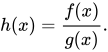
Notice is a product, and is a quotient. So, to answer the question of how to calculate these derivatives, we look to the Product Rule and the Quotient Rule. The Product Rule and the Quotient Rule give us formulas for calculating these derivatives.


Product Rule
Let Then,


Quotient Rule
Let Then,

Warm-Up
Calculate

1) Failed to parse (MathML with SVG or PNG fallback (recommended for modern browsers and accessibility tools): Invalid response ("Math extension cannot connect to Restbase.") from server "https://wikimedia.org/api/rest_v1/":): {\displaystyle f(x)=(x^2+x+1)(x^3+2x^2+4)}
| Solution: |
|---|
| Using the Product Rule, we have |
|
| Then, using the Power Rule, we have |
|
| NOTE: It is not necessary to use the Product Rule to calculate the derivative of this function. |
| You can distribute the terms and then use the Power Rule. |
| In this case, we have |
|
| Now, using the Power Rule, we get |
|
| In general, calculating derivatives in this way is tedious. It would be better to use the Product Rule. |
| Final Answer: |
|---|
| Failed to parse (MathML with SVG or PNG fallback (recommended for modern browsers and accessibility tools): Invalid response ("Math extension cannot connect to Restbase.") from server "https://wikimedia.org/api/rest_v1/":): {\displaystyle f'(x)=(x^2+x+1)(3x^2+4x)+(2x+1)(x^3+2x^2+4)} |
| or equivalently |
| Failed to parse (MathML with SVG or PNG fallback (recommended for modern browsers and accessibility tools): Invalid response ("Math extension cannot connect to Restbase.") from server "https://wikimedia.org/api/rest_v1/":): {\displaystyle f'(x)=x^5+3x^4+3x^3+6x^2+4x+4} |
2) Failed to parse (MathML with SVG or PNG fallback (recommended for modern browsers and accessibility tools): Invalid response ("Math extension cannot connect to Restbase.") from server "https://wikimedia.org/api/rest_v1/":): {\displaystyle f(x)=\frac{x^2+x^3}{x}}
| Solution: |
|---|
|
Using the Quotient Rule, we have |
|
| Then, using the Power Rule, we have |
|
| NOTE: It is not necessary to use the Quotient Rule to calculate the derivative of this function. |
| You can divide and then use the Power Rule. |
| In this case, we have |
|
| Now, using the Power Rule, we get |
|
| Final Answer: |
|---|
| Failed to parse (MathML with SVG or PNG fallback (recommended for modern browsers and accessibility tools): Invalid response ("Math extension cannot connect to Restbase.") from server "https://wikimedia.org/api/rest_v1/":): {\displaystyle f'(x)=\frac{x(2x+3x^2)-(x^2+x^3)}{x^2}} |
| or equivalently |
| Failed to parse (MathML with SVG or PNG fallback (recommended for modern browsers and accessibility tools): Invalid response ("Math extension cannot connect to Restbase.") from server "https://wikimedia.org/api/rest_v1/":): {\displaystyle f'(x)=1+2x} |
3) Failed to parse (MathML with SVG or PNG fallback (recommended for modern browsers and accessibility tools): Invalid response ("Math extension cannot connect to Restbase.") from server "https://wikimedia.org/api/rest_v1/":): {\displaystyle f(x)=\frac{\sin x}{\cos x}}
| Solution: |
|---|
| Using the Quotient Rule, we get |
|
| since Failed to parse (MathML with SVG or PNG fallback (recommended for modern browsers and accessibility tools): Invalid response ("Math extension cannot connect to Restbase.") from server "https://wikimedia.org/api/rest_v1/":): {\displaystyle \sin^2 x+\cos^2 x=1} and Failed to parse (MathML with SVG or PNG fallback (recommended for modern browsers and accessibility tools): Invalid response ("Math extension cannot connect to Restbase.") from server "https://wikimedia.org/api/rest_v1/":): {\displaystyle \sec x=\frac{1}{\cos x}.} |
| Since Failed to parse (MathML with SVG or PNG fallback (recommended for modern browsers and accessibility tools): Invalid response ("Math extension cannot connect to Restbase.") from server "https://wikimedia.org/api/rest_v1/":): {\displaystyle \frac{\sin x}{\cos x}=\tan x,} we have |
|
| Final Answer: |
|---|
| Failed to parse (MathML with SVG or PNG fallback (recommended for modern browsers and accessibility tools): Invalid response ("Math extension cannot connect to Restbase.") from server "https://wikimedia.org/api/rest_v1/":): {\displaystyle f'(x)=\sec^2 x} |
Exercise 1
Calculate the derivative of Failed to parse (MathML with SVG or PNG fallback (recommended for modern browsers and accessibility tools): Invalid response ("Math extension cannot connect to Restbase.") from server "https://wikimedia.org/api/rest_v1/":): {\displaystyle f(x)=\frac{1}{x^2}(\csc x-4).}
First, we need to know the derivative of Failed to parse (MathML with SVG or PNG fallback (recommended for modern browsers and accessibility tools): Invalid response ("Math extension cannot connect to Restbase.") from server "https://wikimedia.org/api/rest_v1/":): {\displaystyle \csc x.} Recall
- Failed to parse (MathML with SVG or PNG fallback (recommended for modern browsers and accessibility tools): Invalid response ("Math extension cannot connect to Restbase.") from server "https://wikimedia.org/api/rest_v1/":): {\displaystyle \csc x =\frac{1}{\sin x}.}
Now, using the Quotient Rule, we have
- Failed to parse (MathML with SVG or PNG fallback (recommended for modern browsers and accessibility tools): Invalid response ("Math extension cannot connect to Restbase.") from server "https://wikimedia.org/api/rest_v1/":): {\displaystyle \begin{array}{rcl} \displaystyle{\frac{d}{dx}(\csc x)} & = & \displaystyle{\frac{d}{dx}\bigg(\frac{1}{\sin x}\bigg)}\\ &&\\ & = & \displaystyle{\frac{\sin x (1)'-1(\sin x)'}{\sin^2 x}}\\ &&\\ & = & \displaystyle{\frac{\sin x (0)-\cos x}{\sin^2 x}}\\ &&\\ & = & \displaystyle{\frac{-\cos x}{\sin^2 x}} \\ &&\\ & = & \displaystyle{-\csc x \cot x.} \end{array}}
Using the Product Rule and Power Rule, we have
- Failed to parse (MathML with SVG or PNG fallback (recommended for modern browsers and accessibility tools): Invalid response ("Math extension cannot connect to Restbase.") from server "https://wikimedia.org/api/rest_v1/":): {\displaystyle \begin{array}{rcl} \displaystyle{f'(x)} & = & \displaystyle{\frac{1}{x^2}(\csc x-4)'+\bigg(\frac{1}{x^2}\bigg)'(\csc x-4)}\\ &&\\ & = & \displaystyle{\frac{1}{x^2}(-\csc x \cot x+0)+(-2x^{-3})(\csc x-4)}\\ &&\\ & = & \displaystyle{\frac{-\csc x \cot x}{x^2}+\frac{-2(\csc x-4)}{x^3}.} \end{array}}
So, we have
- Failed to parse (MathML with SVG or PNG fallback (recommended for modern browsers and accessibility tools): Invalid response ("Math extension cannot connect to Restbase.") from server "https://wikimedia.org/api/rest_v1/":): {\displaystyle f'(x)=\frac{-\csc x \cot x}{x^2}+\frac{-2(\csc x-4)}{x^3}.}
Exercise 2
Calculate the derivative of Failed to parse (MathML with SVG or PNG fallback (recommended for modern browsers and accessibility tools): Invalid response ("Math extension cannot connect to Restbase.") from server "https://wikimedia.org/api/rest_v1/":): {\displaystyle g(x)=2x\sin x \sec x.}
Notice that the function Failed to parse (MathML with SVG or PNG fallback (recommended for modern browsers and accessibility tools): Invalid response ("Math extension cannot connect to Restbase.") from server "https://wikimedia.org/api/rest_v1/":): {\displaystyle g(x)} is the product of three functions.
We start by grouping two of the functions together. So, we have Failed to parse (MathML with SVG or PNG fallback (recommended for modern browsers and accessibility tools): Invalid response ("Math extension cannot connect to Restbase.") from server "https://wikimedia.org/api/rest_v1/":): {\displaystyle g(x)=(2x\sin x)\sec x.}
Using the Product Rule, we get
- Failed to parse (MathML with SVG or PNG fallback (recommended for modern browsers and accessibility tools): Invalid response ("Math extension cannot connect to Restbase.") from server "https://wikimedia.org/api/rest_v1/":): {\displaystyle \begin{array}{rcl} \displaystyle{g'(x)} & = & \displaystyle{(2x\sin x)(\sec x)'+(2x\sin x)'\sec x}\\ &&\\ & = & \displaystyle{(2x\sin x)(\tan^2 x)+(2x\sin x)'\sec x.} \end{array}}
Now, we need to use the Product Rule again. So,
- Failed to parse (MathML with SVG or PNG fallback (recommended for modern browsers and accessibility tools): Invalid response ("Math extension cannot connect to Restbase.") from server "https://wikimedia.org/api/rest_v1/":): {\displaystyle \begin{array}{rcl} \displaystyle{g'(x)} & = & \displaystyle{2x\sin x\tan^2 x+(2x(\sin x)'+(2x)'\sin x)\sec x}\\ &&\\ & = & \displaystyle{2x\sin x\tan^2 x+(2x\cos x+2\sin x)\sec x.} \end{array}}
So, we have
- Failed to parse (MathML with SVG or PNG fallback (recommended for modern browsers and accessibility tools): Invalid response ("Math extension cannot connect to Restbase.") from server "https://wikimedia.org/api/rest_v1/":): {\displaystyle g'(x)=2x\sin x\tan^2 x+(2x\cos x+2\sin x)\sec x.}
But, there is another way to do this problem. Notice
- Failed to parse (MathML with SVG or PNG fallback (recommended for modern browsers and accessibility tools): Invalid response ("Math extension cannot connect to Restbase.") from server "https://wikimedia.org/api/rest_v1/":): {\displaystyle \begin{array}{rcl} \displaystyle{g(x)} & = & \displaystyle{2x\sin x\sec x}\\ &&\\ & = & \displaystyle{2x\sin x\frac{1}{\cos x}}\\ &&\\ & = & \displaystyle{2x\tan x.} \end{array}}
Now, you would only need to use the Product Rule once instead of twice.
Exercise 3
Calculate the derivative of Failed to parse (MathML with SVG or PNG fallback (recommended for modern browsers and accessibility tools): Invalid response ("Math extension cannot connect to Restbase.") from server "https://wikimedia.org/api/rest_v1/":): {\displaystyle h(x)=\frac{x^2\sin x+1}{x^2\cos x+3}.}
Using the Quotient Rule, we have
- Failed to parse (MathML with SVG or PNG fallback (recommended for modern browsers and accessibility tools): Invalid response ("Math extension cannot connect to Restbase.") from server "https://wikimedia.org/api/rest_v1/":): {\displaystyle h'(x)=\frac{(x^2\cos x+3)(x^2\sin x+1)'-(x^2\sin x+1)(x^2\cos x+3)'}{(x^2\cos x+3)^2}.}
Now, we need to use the Product Rule. So, we have
- Failed to parse (MathML with SVG or PNG fallback (recommended for modern browsers and accessibility tools): Invalid response ("Math extension cannot connect to Restbase.") from server "https://wikimedia.org/api/rest_v1/":): {\displaystyle \begin{array}{rcl} \displaystyle{h'(x)} & = & \displaystyle{\frac{(x^2\cos x+3)(x^2(\sin x)'+(x^2)'\sin x)-(x^2\sin x+1)(x^2(\cos x)'+(x^2)'\cos x)}{(x^2\cos x+3)^2}}\\ &&\\ & = & \displaystyle{\frac{(x^2\cos x+3)(x^2\cos x+2x\sin x)-(x^2\sin x+1)(-x^2\sin x+2x\cos x)}{(x^2\cos x+3)^2}.} \end{array}}
So, we get
- Failed to parse (MathML with SVG or PNG fallback (recommended for modern browsers and accessibility tools): Invalid response ("Math extension cannot connect to Restbase.") from server "https://wikimedia.org/api/rest_v1/":): {\displaystyle h'(x)=\frac{(x^2\cos x+3)(x^2\cos x+2x\sin x)-(x^2\sin x+1)(-x^2\sin x+2x\cos x)}{(x^2\cos x+3)^2}.}
Exercise 4
Calculate the derivative of Failed to parse (MathML with SVG or PNG fallback (recommended for modern browsers and accessibility tools): Invalid response ("Math extension cannot connect to Restbase.") from server "https://wikimedia.org/api/rest_v1/":): {\displaystyle f(x)=\frac{e^x}{x^2\sin x}.}
First, using the Quotient Rule, we have
- Failed to parse (MathML with SVG or PNG fallback (recommended for modern browsers and accessibility tools): Invalid response ("Math extension cannot connect to Restbase.") from server "https://wikimedia.org/api/rest_v1/":): {\displaystyle \begin{array}{rcl} \displaystyle{f'(x)} & = & \displaystyle{\frac{x^2\sin x (e^x)'-e^x(x^2\sin x)'}{(x^2\sin x)^2}}\\ &&\\ & = & \displaystyle{\frac{x^2\sin x e^x - e^x(x^2\sin x)'}{x^4\sin^2 x}.} \end{array}}
Now, we need to use the Product Rule. So, we have
- Failed to parse (MathML with SVG or PNG fallback (recommended for modern browsers and accessibility tools): Invalid response ("Math extension cannot connect to Restbase.") from server "https://wikimedia.org/api/rest_v1/":): {\displaystyle \begin{array}{rcl} \displaystyle{f'(x)} & = & \displaystyle{\frac{x^2\sin x e^x - e^x(x^2(\sin x)'+(x^2)'\sin x)}{x^4\sin^2 x}}\\ &&\\ & = & \displaystyle{\frac{x^2\sin x e^x - e^x(x^2\cos x+2x\sin x)}{x^4\sin^2 x}.} \end{array}}
So, we have
- Failed to parse (MathML with SVG or PNG fallback (recommended for modern browsers and accessibility tools): Invalid response ("Math extension cannot connect to Restbase.") from server "https://wikimedia.org/api/rest_v1/":): {\displaystyle f'(x)=\frac{x^2\sin x e^x - e^x(x^2\cos x+2x\sin x)}{x^4\sin^2 x}.}