Difference between revisions of "009A Sample Midterm 1, Problem 1"
Jump to navigation
Jump to search
Kayla Murray (talk | contribs) |
Kayla Murray (talk | contribs) |
||
| Line 100: | Line 100: | ||
| <math>\lim_{x\rightarrow -3^+} \frac{x}{x^2-9}</math> | | <math>\lim_{x\rightarrow -3^+} \frac{x}{x^2-9}</math> | ||
|- | |- | ||
| − | |is either equal to <math style="vertical-align: -1px"> | + | |is either equal to <math style="vertical-align: -1px">\infty</math> or <math style="vertical-align: -1px">-\infty.</math> |
|} | |} | ||
| Line 122: | Line 122: | ||
|Since both the numerator and denominator will be negative (have the same sign), | |Since both the numerator and denominator will be negative (have the same sign), | ||
|- | |- | ||
| − | | <math>\lim_{x\rightarrow -3^+} \frac{x}{x^2-9}= | + | | <math>\lim_{x\rightarrow -3^+} \frac{x}{x^2-9}=\infty.</math> |
|} | |} | ||
| Line 129: | Line 129: | ||
!Final Answer: | !Final Answer: | ||
|- | |- | ||
| − | | '''(a)''' <math> | + | | '''(a)''' <math> -6</math> |
|- | |- | ||
| '''(b)''' <math>\frac{4}{5}</math> | | '''(b)''' <math>\frac{4}{5}</math> | ||
|- | |- | ||
| − | | '''(c)''' <math> | + | | '''(c)''' <math>\infty</math> |
|} | |} | ||
[[009A_Sample_Midterm_1|'''<u>Return to Sample Exam</u>''']] | [[009A_Sample_Midterm_1|'''<u>Return to Sample Exam</u>''']] | ||
Revision as of 10:03, 13 March 2017
Find the following limits:
(a) Find provided that

![{\displaystyle \lim _{x\rightarrow 2}{\bigg [}{\frac {4-g(x)}{x}}{\bigg ]}=5.}](https://wikimedia.org/api/rest_v1/media/math/render/svg/81d23dbe64c4cb46da5b3a09f0267a3cfbe494f1)
(b) Find

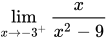
(c) Evaluate
| Foundations: |
|---|
| 1. If Failed to parse (MathML with SVG or PNG fallback (recommended for modern browsers and accessibility tools): Invalid response ("Math extension cannot connect to Restbase.") from server "https://wikimedia.org/api/rest_v1/":): {\displaystyle \lim_{x\rightarrow a} g(x)\neq 0,} we have |
| Failed to parse (MathML with SVG or PNG fallback (recommended for modern browsers and accessibility tools): Invalid response ("Math extension cannot connect to Restbase.") from server "https://wikimedia.org/api/rest_v1/":): {\displaystyle \lim_{x\rightarrow a} \frac{f(x)}{g(x)}=\frac{\displaystyle{\lim_{x\rightarrow a} f(x)}}{\displaystyle{\lim_{x\rightarrow a} g(x)}}.} |
| 2. Failed to parse (MathML with SVG or PNG fallback (recommended for modern browsers and accessibility tools): Invalid response ("Math extension cannot connect to Restbase.") from server "https://wikimedia.org/api/rest_v1/":): {\displaystyle \lim_{x\rightarrow 0} \frac{\sin x}{x}=1} |
Solution:
(a)
| Step 1: |
|---|
| Since Failed to parse (MathML with SVG or PNG fallback (recommended for modern browsers and accessibility tools): Invalid response ("Math extension cannot connect to Restbase.") from server "https://wikimedia.org/api/rest_v1/":): {\displaystyle \lim_{x\rightarrow 2} x =2\ne 0,} |
| we have |
| Failed to parse (MathML with SVG or PNG fallback (recommended for modern browsers and accessibility tools): Invalid response ("Math extension cannot connect to Restbase.") from server "https://wikimedia.org/api/rest_v1/":): {\displaystyle \begin{array}{rcl} \displaystyle{5} & = & \displaystyle{\lim _{x\rightarrow 2} \bigg[\frac{4-g(x)}{x}\bigg]}\\ &&\\ & = & \displaystyle{\frac{\lim_{x\rightarrow 2} (4-g(x))}{\lim_{x\rightarrow 2} x}}\\ &&\\ & = & \displaystyle{\frac{\lim_{x\rightarrow 2} (4-g(x))}{2}.} \end{array}} |
| Step 2: |
|---|
| If we multiply both sides of the last equation by Failed to parse (MathML with SVG or PNG fallback (recommended for modern browsers and accessibility tools): Invalid response ("Math extension cannot connect to Restbase.") from server "https://wikimedia.org/api/rest_v1/":): {\displaystyle 2,} we get |
| Failed to parse (MathML with SVG or PNG fallback (recommended for modern browsers and accessibility tools): Invalid response ("Math extension cannot connect to Restbase.") from server "https://wikimedia.org/api/rest_v1/":): {\displaystyle 10=\lim_{x\rightarrow 2} (4-g(x)).} |
| Now, using linearity properties of limits, we have |
| Failed to parse (MathML with SVG or PNG fallback (recommended for modern browsers and accessibility tools): Invalid response ("Math extension cannot connect to Restbase.") from server "https://wikimedia.org/api/rest_v1/":): {\displaystyle \begin{array}{rcl} \displaystyle{10} & = & \displaystyle{\lim_{x\rightarrow 2} 4 -\lim_{x\rightarrow 2}g(x)}\\ &&\\ & = & \displaystyle{4-\lim_{x\rightarrow 2} g(x).}\\ \end{array}} |
| Step 3: |
|---|
| Solving for Failed to parse (MathML with SVG or PNG fallback (recommended for modern browsers and accessibility tools): Invalid response ("Math extension cannot connect to Restbase.") from server "https://wikimedia.org/api/rest_v1/":): {\displaystyle \lim_{x\rightarrow 2} g(x)} in the last equation, |
| we get |
|
Failed to parse (MathML with SVG or PNG fallback (recommended for modern browsers and accessibility tools): Invalid response ("Math extension cannot connect to Restbase.") from server "https://wikimedia.org/api/rest_v1/":): {\displaystyle \lim_{x\rightarrow 2} g(x)=-6.} |
(b)
| Step 1: |
|---|
| First, we write |
| Failed to parse (MathML with SVG or PNG fallback (recommended for modern browsers and accessibility tools): Invalid response ("Math extension cannot connect to Restbase.") from server "https://wikimedia.org/api/rest_v1/":): {\displaystyle \lim_{x\rightarrow 0} \frac{\sin(4x)}{5x}=\lim_{x\rightarrow 0} \frac{4}{5} \bigg(\frac{\sin(4x)}{4x}\bigg).} |
| Step 2: |
|---|
| Now, we have |
| Failed to parse (MathML with SVG or PNG fallback (recommended for modern browsers and accessibility tools): Invalid response ("Math extension cannot connect to Restbase.") from server "https://wikimedia.org/api/rest_v1/":): {\displaystyle \begin{array}{rcl} \displaystyle{\lim_{x\rightarrow 0} \frac{\sin(4x)}{5x}} & = & \displaystyle{\frac{4}{5}\lim_{x\rightarrow 0} \frac{\sin(4x)}{4x}}\\ &&\\ & = & \displaystyle{\frac{4}{5}(1)}\\ &&\\ & = & \displaystyle{\frac{4}{5}.} \end{array}} |
(c)
| Step 1: |
|---|
| When we plug in Failed to parse (MathML with SVG or PNG fallback (recommended for modern browsers and accessibility tools): Invalid response ("Math extension cannot connect to Restbase.") from server "https://wikimedia.org/api/rest_v1/":): {\displaystyle -3} into Failed to parse (MathML with SVG or PNG fallback (recommended for modern browsers and accessibility tools): Invalid response ("Math extension cannot connect to Restbase.") from server "https://wikimedia.org/api/rest_v1/":): {\displaystyle \frac{x}{x^2-9},} |
| we get Failed to parse (MathML with SVG or PNG fallback (recommended for modern browsers and accessibility tools): Invalid response ("Math extension cannot connect to Restbase.") from server "https://wikimedia.org/api/rest_v1/":): {\displaystyle \frac{-3}{0}.} |
| Thus, |
| Failed to parse (MathML with SVG or PNG fallback (recommended for modern browsers and accessibility tools): Invalid response ("Math extension cannot connect to Restbase.") from server "https://wikimedia.org/api/rest_v1/":): {\displaystyle \lim_{x\rightarrow -3^+} \frac{x}{x^2-9}} |
| is either equal to Failed to parse (MathML with SVG or PNG fallback (recommended for modern browsers and accessibility tools): Invalid response ("Math extension cannot connect to Restbase.") from server "https://wikimedia.org/api/rest_v1/":): {\displaystyle \infty} or Failed to parse (MathML with SVG or PNG fallback (recommended for modern browsers and accessibility tools): Invalid response ("Math extension cannot connect to Restbase.") from server "https://wikimedia.org/api/rest_v1/":): {\displaystyle -\infty.} |
| Step 2: |
|---|
| To figure out which one, we factor the denominator to get |
| Failed to parse (MathML with SVG or PNG fallback (recommended for modern browsers and accessibility tools): Invalid response ("Math extension cannot connect to Restbase.") from server "https://wikimedia.org/api/rest_v1/":): {\displaystyle \lim_{x\rightarrow -3^+} \frac{x}{x^2-9}=\lim_{x\rightarrow -3^+} \frac{x}{(x-3)(x+3)}.} |
| We are taking a right hand limit. So, we are looking at values of Failed to parse (MathML with SVG or PNG fallback (recommended for modern browsers and accessibility tools): Invalid response ("Math extension cannot connect to Restbase.") from server "https://wikimedia.org/api/rest_v1/":): {\displaystyle x} |
| a little bigger than Failed to parse (MathML with SVG or PNG fallback (recommended for modern browsers and accessibility tools): Invalid response ("Math extension cannot connect to Restbase.") from server "https://wikimedia.org/api/rest_v1/":): {\displaystyle -3.} (You can imagine values like Failed to parse (MathML with SVG or PNG fallback (recommended for modern browsers and accessibility tools): Invalid response ("Math extension cannot connect to Restbase.") from server "https://wikimedia.org/api/rest_v1/":): {\displaystyle x=-2.9.} ) |
| For these values, the numerator will be negative. |
| Also, for these values, Failed to parse (MathML with SVG or PNG fallback (recommended for modern browsers and accessibility tools): Invalid response ("Math extension cannot connect to Restbase.") from server "https://wikimedia.org/api/rest_v1/":): {\displaystyle x-3} will be negative and Failed to parse (MathML with SVG or PNG fallback (recommended for modern browsers and accessibility tools): Invalid response ("Math extension cannot connect to Restbase.") from server "https://wikimedia.org/api/rest_v1/":): {\displaystyle x+3} will be positive. |
| Therefore, the denominator will be negative. |
| Since both the numerator and denominator will be negative (have the same sign), |
| Failed to parse (MathML with SVG or PNG fallback (recommended for modern browsers and accessibility tools): Invalid response ("Math extension cannot connect to Restbase.") from server "https://wikimedia.org/api/rest_v1/":): {\displaystyle \lim_{x\rightarrow -3^+} \frac{x}{x^2-9}=\infty.} |
| Final Answer: |
|---|
| (a) Failed to parse (MathML with SVG or PNG fallback (recommended for modern browsers and accessibility tools): Invalid response ("Math extension cannot connect to Restbase.") from server "https://wikimedia.org/api/rest_v1/":): {\displaystyle -6} |
| (b) Failed to parse (MathML with SVG or PNG fallback (recommended for modern browsers and accessibility tools): Invalid response ("Math extension cannot connect to Restbase.") from server "https://wikimedia.org/api/rest_v1/":): {\displaystyle \frac{4}{5}} |
| (c) Failed to parse (MathML with SVG or PNG fallback (recommended for modern browsers and accessibility tools): Invalid response ("Math extension cannot connect to Restbase.") from server "https://wikimedia.org/api/rest_v1/":): {\displaystyle \infty} |