Difference between revisions of "009C Sample Final 3, Problem 1"
Jump to navigation
Jump to search
Kayla Murray (talk | contribs) |
Kayla Murray (talk | contribs) |
||
| Line 57: | Line 57: | ||
|- | |- | ||
|Hence, we can use L'Hopital's Rule to calculate this limit. | |Hence, we can use L'Hopital's Rule to calculate this limit. | ||
| + | |} | ||
| + | |||
| + | {| class="mw-collapsible mw-collapsed" style = "text-align:left;" | ||
| + | !Step 3: | ||
| + | |- | ||
| + | |Now, we have | ||
|- | |- | ||
| | | | ||
| + | <math>\begin{array}{rcl} | ||
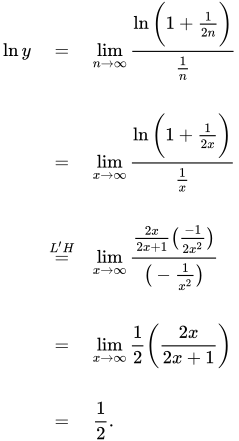
| + | \displaystyle{\ln y } & = & \displaystyle{\lim_{n\rightarrow \infty} \frac{\ln \bigg(1+\frac{1}{2n}\bigg)}{\frac{1}{n}}}\\ | ||
| + | &&\\ | ||
| + | & = & \displaystyle{\lim_{x\rightarrow \infty} \frac{\ln \bigg(1+\frac{1}{2x}\bigg)}{\frac{1}{x}}}\\ | ||
| + | &&\\ | ||
| + | & \overset{L'H}{=} & \displaystyle{\lim_{x\rightarrow \infty} \frac{\frac{2x}{2x+1}\big(\frac{-1}{2x^2}\big)}{\big(-\frac{1}{x^2}\big)}}\\ | ||
| + | &&\\ | ||
| + | & = & \displaystyle{\lim_{x\rightarrow \infty} \frac{1}{2}\bigg(\frac{2x}{2x+1}\bigg)}\\ | ||
| + | &&\\ | ||
| + | & = & \displaystyle{\frac{1}{2}.} | ||
| + | \end{array}</math> | ||
| + | |} | ||
| + | |||
| + | {| class="mw-collapsible mw-collapsed" style = "text-align:left;" | ||
| + | !Step 4: | ||
| + | |- | ||
| + | |Since <math style="vertical-align: -13px">\ln y= \frac{1}{2},</math> we know | ||
| + | |- | ||
| + | | <math>y=e^{\frac{1}{2}}.</math> | ||
|} | |} | ||
| Line 85: | Line 110: | ||
!Final Answer: | !Final Answer: | ||
|- | |- | ||
| − | | '''(a)''' | + | | '''(a)''' <math>e^{\frac{1}{2}}</math> |
|- | |- | ||
| − | | '''(b)''' | + | | '''(b)''' |
|} | |} | ||
[[009C_Sample_Final_3|'''<u>Return to Sample Exam</u>''']] | [[009C_Sample_Final_3|'''<u>Return to Sample Exam</u>''']] | ||
Revision as of 16:33, 5 March 2017
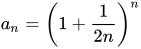
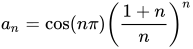
Which of the following sequences converges? Which diverges? Give reasons for your answers!

(a)
(b)
| Foundations: |
|---|
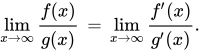
| L'Hôpital's Rule |
|
Suppose that and are both zero or both |
|
If is finite or |
|
then |


Solution:
(a)
| Step 1: |
|---|
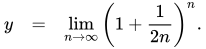
| Let
|
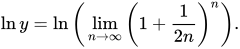
| We then take the natural log of both sides to get |
| Step 2: |
|---|
| We can interchange limits and continuous functions. |
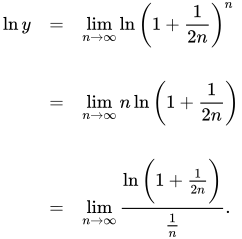
| Therefore, we have |
|
|
| Now, this limit has the form |
| Hence, we can use L'Hopital's Rule to calculate this limit. |

| Step 3: |
|---|
| Now, we have |
|
|
| Step 4: |
|---|
| Since we know |


(b)
| Step 1: |
|---|
| Step 2: |
|---|
| Final Answer: |
|---|
| (a) |
| (b) |
