Difference between revisions of "009C Sample Final 3, Problem 10"
Jump to navigation
Jump to search
Kayla Murray (talk | contribs) |
Kayla Murray (talk | contribs) |
||
| Line 10: | Line 10: | ||
!Foundations: | !Foundations: | ||
|- | |- | ||
| − | | | + | |'''1.''' What two pieces of information do you need to write the equation of a line? |
| − | |||
| − | |||
|- | |- | ||
| | | | ||
| + | You need the slope of the line and a point on the line. | ||
|- | |- | ||
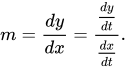
| − | | | + | |'''2.''' What is the slope of the tangent line of a parametric curve? |
|- | |- | ||
| | | | ||
| + | The slope is <math style="vertical-align: -21px">m=\frac{dy}{dx}=\frac{\frac{dy}{dt}}{\frac{dx}{dt}}.</math> | ||
|} | |} | ||
'''Solution:''' | '''Solution:''' | ||
| − | |||
| − | |||
{| class="mw-collapsible mw-collapsed" style = "text-align:left;" | {| class="mw-collapsible mw-collapsed" style = "text-align:left;" | ||
| − | ! | + | !(a) |
|- | |- | ||
| − | | | + | |Insert graph |
| − | |||
| − | |||
| − | |||
| − | |||
| − | |||
| − | |||
| − | |||
| − | |||
|- | |- | ||
| | | | ||
| Line 49: | Line 39: | ||
!Step 1: | !Step 1: | ||
|- | |- | ||
| − | | | + | |First, we need to find the slope of the tangent line. |
|- | |- | ||
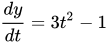
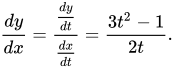
| − | | | + | |Since <math style="vertical-align: -14px">\frac{dy}{dt}=3t^2-1</math> and <math style="vertical-align: -14px">\frac{dx}{dt}=2t,</math> we have |
|- | |- | ||
| | | | ||
| + | <math>\frac{dy}{dx}=\frac{\frac{dy}{dt}}{\frac{dx}{dt}}=\frac{3t^2-1}{2t}.</math> | ||
|} | |} | ||
| Line 59: | Line 50: | ||
!Step 2: | !Step 2: | ||
|- | |- | ||
| − | | | + | |Now, the origin corresponds to <math>x=0</math> and <math>y=0.</math> |
| + | |- | ||
| + | |This gives us two equations. When we solve for <math>t,</math> we get <math>t=0.</math> | ||
| + | |- | ||
| + | |Plugging in <math>t=0</math> into | ||
| + | |- | ||
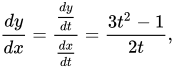
| + | | <math>\frac{dy}{dx}=\frac{\frac{dy}{dt}}{\frac{dx}{dt}}=\frac{3t^2-1}{2t},</math> | ||
| + | |- | ||
| + | |we see that <math>\frac{dy}{dx}</math> is undefined at <math>t=0.</math> | ||
|- | |- | ||
| − | | | + | |So, there is no tangent line at the origin. |
|} | |} | ||
| Line 68: | Line 67: | ||
!Final Answer: | !Final Answer: | ||
|- | |- | ||
| − | | '''(a)''' | + | | '''(a)''' See above |
|- | |- | ||
| − | | '''(b)''' | + | | '''(b)''' There is no tangent line at the origin. |
|} | |} | ||
[[009C_Sample_Final_3|'''<u>Return to Sample Exam</u>''']] | [[009C_Sample_Final_3|'''<u>Return to Sample Exam</u>''']] | ||
Revision as of 14:46, 5 March 2017
A curve is described parametrically by


(a) Sketch the curve for

(b) Find the equation of the tangent line to the curve at the origin.
| Foundations: |
|---|
| 1. What two pieces of information do you need to write the equation of a line? |
|
You need the slope of the line and a point on the line. |
| 2. What is the slope of the tangent line of a parametric curve? |
|
The slope is |
Solution:
| (a) |
|---|
| Insert graph |
(b)
| Step 1: |
|---|
| First, we need to find the slope of the tangent line. |
| Since and we have |
|
|

| Step 2: |
|---|
| Now, the origin corresponds to and |
| This gives us two equations. When we solve for we get |
| Plugging in into |
| we see that is undefined at |
| So, there is no tangent line at the origin. |



| Final Answer: |
|---|
| (a) See above |
| (b) There is no tangent line at the origin. |